
Raiffeisen Rio Review 2026: Pros & Cons
| Updated: |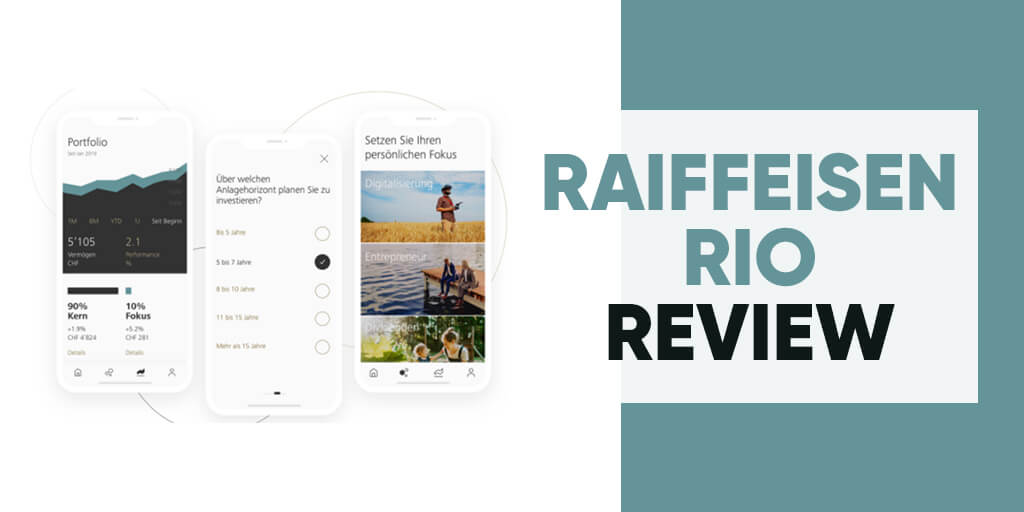
(Disclosure: Some of the links below may be affiliate links)
Recently, I reviewed Raiffeisen as a bank account, and several people asked me what I thought about their robo-advisor service. So, I researched this product.
Raiffeisen Rio is a new robo-advisor that was proposed by Raiffeisen. It is pretty different in how it invests your money.
In this review, I go into detail about the Raiffeisen Rio service. By the end of the review, you will know whether you should invest with Raiffeisen Rio.
| Management fee | 0.65% |
|---|---|
| Product Costs | 0.50% |
| Withholding Costs | 0.30% |
| Total Costs | 1.45% |
| Investing strategy | Active and passive |
| Investing products | Funds and structured products |
| Minimum investment | 5000 CHF |
| Currency conversion | Unknown |
| Customization | Limited |
| Sustainable | Not by default |
| Languages | French and German |
| Custody bank | Raiffeisen |
| Users | Unknown |
| Established | 2020 |
| Headquarters | St. Gallen, Switzerland |
Raiffeisen Rio
Raiffeisen Rio is a digital robo-advisor service by Raiffeisen. Raiffeisen launched this new service in August 2020, a relatively recent addition to the Swiss robo-advisor world.
It is essential to note that Rio is only available to Raiffeisen customers. You need to have a Raiffeisen e-banking account to try Rio. I think this is a significant limitation. It also means that you need to pay the fees on the bank account on top of the Rio fees if you want to use it without having a Raiffeisen bank account.
Rio is accessible through a mobile application. It is essential to mention that it is only accessible in the Rio application, not the web e-banking application.
To start investing with Rio, you must invest at least 5000 CHF. This amount is a standard minimum in Switzerland but is not the lowest available. So, it is not great to test the product.
Investment strategy
We take a look at how Rio is investing your money. It differs from the other robo-advisors I have covered on the blog.
First, you will have to choose your strategy. There are four different strategies available:
- Income with 25% stocks
- Balanced with 45% stocks
- Growth with 65% stocks
- Stocks with 95% stocks
It is slightly disappointing that they do not go higher than 95%, since several other robo-advisors allow you to go as high as 99%. Nevertheless, 95% is already a significant investment in stocks if you want to be aggressive.
The part not invested in stocks is partly in cash and partly in bonds. You cannot choose the allocations directly. Only these four strategies are available, no custom ones.
To choose between these strategies, Rio will ask you the usual questions to guess your risk tolerance and propose an adequate strategy. You can either accept the proposed strategy or choose another one.
Then, you must decide the priority for your core investments. There are three different priorities:
- Swissness to invest only in Swiss stocks and bonds
- Global to invest in the entire world
- Futura to invest only in sustainable companies in the world.
These are very standard priorities we can generally find with each robo-advisor in Switzerland.
Moreover, you can also choose some themes on which to focus more:
- Robotics
- Futura Green Energy
- eSports
- Digitalization
- Entrepreneurs
- Dividends
- Swiss stocks
Each theme that you add will take 5% of your total portfolio. So, if you add four themes to your portfolio, you will have 80% in the core components and 20% in the themes (5% each).
I believe it is good to give users some choice, but having only 5% in a theme will not make enough of a significant difference to matter in the long term. I would prefer to choose fewer themes but be able to allocate more to each of them.
Finally, we look into how they invest your money. The core components use semi-passive funds. I say semi-passive because they say they have an active component, but it is unclear what they mean exactly. On the other hand, the themes are all using structured products.
I do not think this is great. Semi-passive funds are just strictly worse than fully passive funds. But they would not be that bad. On the other hand, I would recommend against investing in structured products. These structured products are extremely complicated and offer no advantages over index funds. They also introduce more risks than simple funds.
For this reason, I would not invest in Raiffeisen Rio.
Furthermore, they do not directly share with which funds they are investing in precisely. It took me a long time to find the products they use for Raiffeisen Rio.
This lack of transparency is another reason I would not want to invest with them.
So, overall, you have a good choice of strategies and themes, but how they invest your money is not the best. I do not recommend this investing approach.
The fees
We must look at the fees of Raiffeisen Rio. Investing fees are more important than people think.
You will pay a management fee of 0.65% on your invested assets annually, which is not too bad in Switzerland. In addition, you will have to pay stamp duty.
The other thing not included in the management fee is the product costs. Each fund they will use to invest your money also has an annual fee.
Raiffeisen Rio claims the product costs are about 0.3% for core components and 0.6% for the themes. Again, they are not transparent with the funds they use. However, structured products are easily found. For instance, the eSports structured product has a 1.25% management fee, which is very expensive. The Futura Food product seems to have a 0.65% fee, which is also expensive but at least closer to the claims of Rio.
I could not find any core fund with 0.30%. They seem to be around 0.5%. But I have probably not found the proper ones.
Overall, these fees are not good. The core components, if around 0.3%, are reasonably priced. And the management fee is okay for Switzerland. On the other hand, the themes are too expensive. When everything is added together, this product is quite expensive.
But I think the main issue is Raiffeisen’s lack of transparency regarding the products they use for Raiffeisen Rio.
Is it safe to invest with Raiffeisen Rio?
To invest significant money in an online service, you must look at its safety.
With Raiffeisen Rio, it is difficult to know since they share very little information. Since Raiffeisen is a bank, we can assume they are using themselves as the custodian bank. Raiffeisen itself has a relatively good reputation. The deposit protection scheme of Switzerland will protect your cash.
As for your shares, we can also assume that Raiffeisen Rio will deposit them in your name at Raiffeisen Bank. This segregation is pretty safe. In case of bankruptcy, your shares will still be yours and should be transferred to another custodian bank. It may take a while, but as long as Raiffeisen Bank did not defraud you, your share should be safe.
On the other hand, you generally do not have such a guarantee with structured products. These are directly tied to the emitter. And with a structured product, you are not the owner of any underlying share. If the emitter goes bankrupt, you will likely lose your entire investment.
Overall, it is relatively safe to invest with Raiffeisen Rio if you do not invest in themes. If you do, you increase the risk because these products are significantly riskier than shares.
Is Raiffeisen Rio secure?
Then, we look at whether it is technically secure.
Usually, I would start by looking at what they share about technical security. Unfortunately, Raiffeisen shares nothing about that.
I have found some extra links pointing out that Raiffeisen Rio can only be Used with two-factor authentication, which is excellent.
And I have not found any news of a data leak at Raiffeisen or with Rio.
Overall, the service looks secure, but I wish they would share more about security on their website.
User Reviews
Finally, we look at user reviews of Raiffeisen Rio.
First, I have looked at reviews on the Apple Store. There, reviews are primarily positive. People like that they can invest very easily and choose their focus. On the other hand, people criticize Rio for not sharing the exact products they are investing in. And users also do not like the fees.
On the Play Store, reviews are more mixed between negative and positive. On the plus side, people say the app is easy to use, even for beginner investors. On the negative side, many people have technical difficulties and cannot log in. Other reviews also mention the lack of transparency with the fees and the products.
Overall, users are relatively satisfied with Raiffeisen Rio, but they agree that the app should be much more transparent.
Alternatives to Raiffeisen Rio

An excellent and innovative Robo-advisor by Finpension.
- Most tax-efficient Robo-advisor
- Access to private markets
We must look at the alternative to Raiffeisen Rio.
There are some much better robo-advisors available in Switzerland, like Finpension Invest and True Wealth. These robo-advisors are easier to use, have lower fees, and allow you to invest more aggressively.
Overall, I cannot find a significant advantage in Raiffeisen Rio compared to its alternatives. There are significantly better services in Switzerland, with better prices, higher transparency, and better investment strategies.
If you want more alternatives, I have an article about Swiss robo-advisors.
Raiffeisen Rio FAQ
How does Raiffeisen Rio invest your money?
Raiffeisen Rio uses a mix of funds and structured products to invest money for their customers.
Who is Raiffeisen Rio good for?
Raiffeisen Rio does not offer any advantage over any other alternatives.
Who is Raiffeisen Rio not good for?
Raiffeisen Rio is not a great Robo-advisor. There are much better services available.
Raiffeisen Rio Summary

Raiffeisen Rio is a robo-advisor service proposed by the Raiffeisen Bank. It is only available to customers of Raiffeisen bank. Contrary to most Robo-advisors, Raiffeisen Rio is using structured products.
Product Brand: Raiffeisen
2.5
Raiffeisen Rio Pros
Let's summarize the main advantages of Raiffeisen Rio:
- You can invest up to 95% in stocks
- You can invest sustainably
Raiffeisen Rio Cons
Let's summarize the main disadvantages of Raiffeisen Rio:
- Raiffeisen Rio is using structured products and active funds
- Limited to 5% allocation for each theme
- The information is not transparent on which fund they are using
- The themes are too expensive
- You need a Raiffeisen bank account to invest with Rio
- Riskier due to the use of structured products
Conclusion
Overall, Raiffeisen Rio is not a good investment solution. They are not transparent about the products they use, and the fact that they use structured products for their theme investments is a red flag for me.
Furthermore, this service is only available to Raiffeisen Bank customers. I would not recommend opening a Raiffeisen bank account to invest with Rio, and I would not recommend existing Raiffeisen customers invest with Rio either.
If you want a similar service, I have talked about several Swiss robo-advisors.
What about you? What do you think about Raiffeisen Rio?
More reading

Selma Review 2026 – Pros & Cons
Invest on autopilot. Read our review of Selma Finance, a beginner-friendly Swiss Robo-Advisor, and decide if it is the right tool to grow your wealth.
Finpension Invest Review 2026 – Pros & Cons
Wealth management for all? Read our review of Finpension Invest. We analyze the fees and strategies of this private investment solution.
Interview of Richard Toolen – CEO of Investart
Investart is a great online service that offers free investing in ETFs, to know more I interview Investart CEO, Richard Toolen.
Learn easy ways to optimize your finances and save thousands in Switzerland with our exclusive e-book. Learn about the most cost-effective financial services tailored for savvy residents and expats!
Get Your FREE Swiss Money-Saving Guide
Thanks for sharing, very good review. Best regards from Kanton Zürich…:-)
Thanks, Daniel!
Good assessment. The login procedure with Raiffeisen is a nightmare though. Couldn’t be more complicated.
Thanks for sharing this! I used to have a Raiffeisen account in my youth and it was already quite bad, but apparently, it did not get any better :)