
Finpension Invest Review 2026 – Pros & Cons
| Updated: |
(Disclosure: Some of the links below may be affiliate links)
Finpension already manages the best third pillar and the best vested benefits account. And they have now launched Finpension Invest, their robo-advisor service. It is a very exciting time.
As usual, we will look into the advantages and disadvantages of this new service in detail. We will also look at the fees, features, and security of Finpension Invest. By the end of this review, you will know whether you should use Finpension Invest and how it compares to other alternatives.
| Management fee | 0.39% |
|---|---|
| Product Costs | 0.10% |
| Withholding Costs | 0% – 0.15% (per canton) |
| Total Costs | 0.49% – 0.64% (per canton) |
| Investing strategy | Passive |
| Investing products | ETFs and index funds |
| Minimum investment | 0 CHF |
| Currency conversion | Free |
| Customization | Very high |
| Sustainable | Not by default |
| Languages | French, German, and English |
| Custody bank | Finpension |
| Users | 60’000 |
| Established | 2016 |
| Headquarters | Lucerne, Switzerland |
Finpension Invest

An excellent and innovative Robo-advisor by Finpension.
- Most tax-efficient Robo-advisor
- Access to private markets
I have already talked at length about Finpension on this blog. They originally had a 1e pillar account and then started to offer vested benefits because their customers wanted to keep their money with them once they quit work. And finally, they created Finpension 3a.
This company is fascinating because I consider their 3a to the best third pillar available at this time. And they also managed to get the best vested benefits account.
Since they started, they have always had an excellent reputation, and they have led several things in the way of innovation. As of 2026, they are managing over five billion CHF.
In 2024, they have now introduced another product in their lineup: Finpension Invest. This service is a robo-advisor outside the retirement system. They had been hinting at this already in 2023, so it is great to see the final product.
It is important to note that Finpension was approved as a securities firm by FINMA. It means that they can hold the securities themselves and do not need to use a custody bank.
For regulatory reasons, Finpension Invest is only offered to Swiss residents.
So, we will see in detail what Finpension Invest is.
Investing strategy
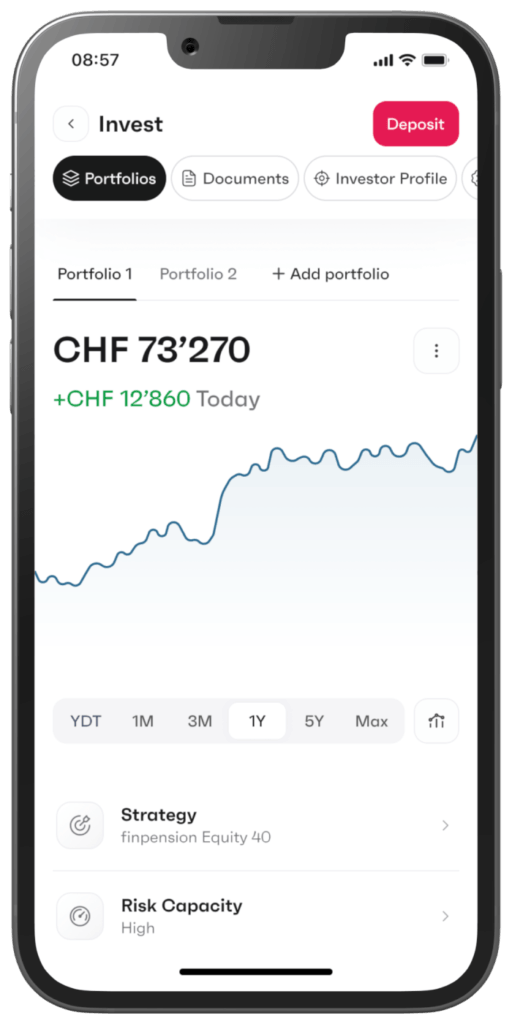
First, we will start with the investing strategy. It is essential to see how a robo-advisor invests to see whether we should use it or not.
Finpension Invest uses Exchange Traded Funds (ETFs) for stocks. For bonds, they use index funds. Using ETFs is the standard way Swiss robo-advisors work. The good news is that they only use index ETFs. Index ETFs are following an index instead of trying to pick stocks. This makes them cheap, and in practice they even beat active funds.
There is usually a tax-efficiency downside to using ETFs, but as we will see in the next chapter, Finpension Invest does not suffer from this downside.
There are two main ways to set up your strategy:
- Auto-Select: Will prepare a portfolio for you.
- Self-Select: Will let you be more specific about your strategy.
In all cases, you can reach up to 99% invested (in stocks or bonds). You will need to keep 1% in cash. You can even keep 99% in a money market fund if you are really risk-averse.
The part not invested in cash, stocks or money-market will be invested in Swiss bonds. This makes sense because your bonds are here to reduce risks in your portfolio. So, you should not introduce currency risk there. And hedging would not solve it because you would pay the costs of hedging and pay higher income tax (because of higher yields in foreign bonds).
For auto-select, you can select between three focuses for stocks:
- Global: Fully diversified internationally.
- Switzerland: Invest globally but with a strong bias on Swiss stocks.
- Sustainable: Only invest in sustainable stocks (globally).
For Self-Select, you have a few more options:
- Global: Fully diversified internationally.
- Europe: Invest globally but with a strong bias on European stocks.
- Switzerland: Invest globally but with a strong bias on Swiss stocks.
- Broad Impact: Sustainable investing with a global impact.
- Climate Impact: Sustainable investing with a focus on climate.
- Social Impact: Sustainable investing with a social focus.
And finally, as is standard with Finpension, you can also do a custom portfolio with Finpension Invest. This means you can pick up the funds directly yourself, among more than 40 available funds. You are at full liberty to invest in your portfolio.
In your account, you can have up to 10 different portfolios. Each of these can have a different strategy.
Finally, you can also invest in private markets. Private markets are deals outside the public stock market. With Finpension Invest, you have access to two institutional funds for private markets investment. This is quite impressive because no other robo-advisor provides you with access to private markets.
It is important to note that private markets will only be offered to those with a very high-risk profile (based on your answers to the risk assessment). This limitation makes a lot of sense because private markets can be very volatile.
Moreover, you cannot mix private market funds with other funds in the same portfolio. You can have multiple private market funds (in different portfolios), but each of these portfolios must be invested fully in private markets. Since you can have 10 portfolios, this is not a big limitation.
Overall, the investing strategy of Finpension Invest is excellent. They have all the bases covered, and they even offer access to private markets, something no other simple robo-advisor offers at this point. This service can be an excellent tool for long-term investing.
Example portfolio
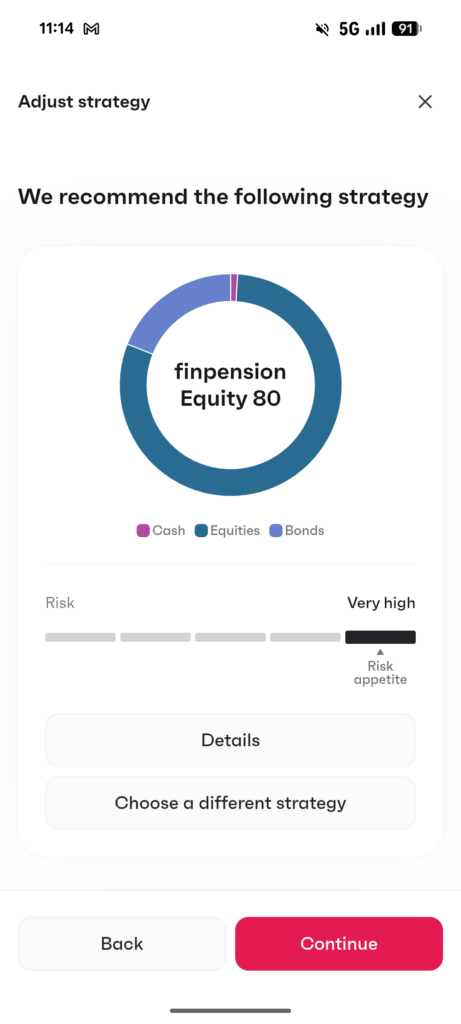
We can pick an example to look at the details of the strategies proposed by Finpension Invest. For me, the Finpension equity 80 (Global) strategy is a good example to look at.
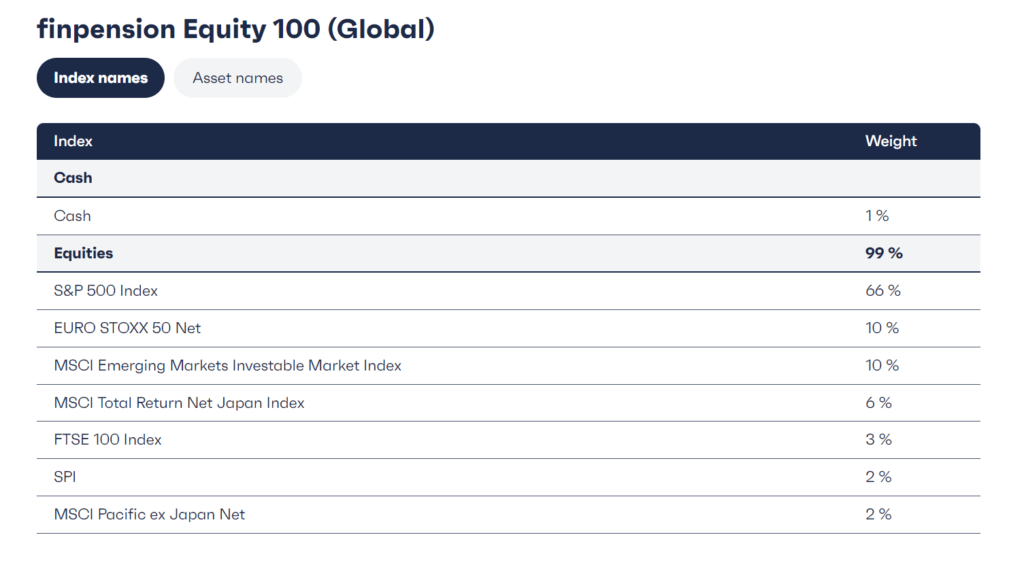
This portfolio is very well diversified since it covers all markets. Each country and region are represented based on their market capitalization. For instance, Switzerland is about 2% of the entire world stock market, while the US is currently about 66%.
You may be surprised by the number of funds. In theory, it would be simpler to use a world fund and let the fund pick the countries and do the rebalancing. However, since Finpension Invest wants to be extra efficient with taxes, they have to pick at least one fund for the US to allow BlackRock to do the full withholding reporting for them.
So, while I would generally prefer not having tiny percentages in a portfolio, in this case it makes total sense and this is very well diversified and balanced.
Finpension Invest Fees
Typically, the best criterion to distinguish between two robo-advisors is the price. To maximize your returns, you want to minimize your fees. So, it is essential to analyze the fees of Finpension Invest in detail.
Finpension Invest has a 0.30% custody fee and a 0.09% wealth management fee. This gives us a total fee of 0.39%. These fees include VAT.
It is worth noting that on your yearly statement, you will see these two fees separated. The custody fee is something you can usually deduct custody fees from your taxes, in most cantons. So, it is nice that they provide these two numbers separated.
On top of the 0.39%, you will need to pay the TER of the funds. On average, this will range from 0.08% to 0.10%.
Finally, Swiss stamp duty is also due on the transactions (for ETFs only, not index funds) and is not included in the all-in fee. As wealth managers, Finpension is obligated to charge this.
Since they are using ETFs, there is no issuing or redemption commission when you buy or sell. The currency conversion fee is also included into the fees.
Overall, the fees of Finpension Invest are excellent. A total fee of about 0.49% is really among the best we can find in Switzerland.
US Withholding Tax
We said before that ETFs generally have a disadvantage in tax efficiency. This is because the US taxes dividends at source. With a US ETF, you can avoid this, but not with a European ETF and no Swiss robo-advisor offers US ETFs. With a European ETF, you would lose 15% of the dividends coming from US stocks.
It is easy to estimate that cost. US stocks are currently 66% of the world stock market and have an average yield of 1.50%. So, on average, losing these dividends is the same as adding an extra fee of 0.1485% (rounded to 0.15%).
Normally, this is not reclaimable. However, Finpension managed a very innovative technique. They have a deal with BlackRock (the fund provider of the ETF). BlackRock will give them all the necessary information for each of the dividend withholdings. Then, Finpension can tie this back to the shares held by the users. And from that, they can produce a statement that can be added to the tax declaration to reclaim this fee!
It is worth noting that Finpension is currently speaking to the different tax offices to validate this technique. But we already know that Lucerne accepted this claim. So there is a good chance that more cantons will follow.
The DA-1 deductions can only be claimed if you reach a minimum of 100 CHF. The total will include Finpension claims and possibly other deductions you are doing yourself.
This feature really shows that Finpension knows their stuff. This feature gives a tremendous advantage to Finpension Invest against other Swiss robo-advisors.
Opening a Finpension Invest account?
If you already have a Finpension account (for your 3a, for instance), you can directly create a Finpension Invest portfolio from it. Otherwise, you can start creating an account from scratch either from the website or from the app, it should be a fairly quick process.
As with any robo-advisor onboarding, you will need to answer the usual risk assessment questions. From there, they will define your risk capacity. And again from there, they will suggest portfolios, but you can override the choice.
If you open a Finpension 3a account, please use my code FEYKV5. This code will give you a fee credit of 25 CHF (if you deposit 1000 CHF in the first 12 months) and will help my blog as well.
Overall, it is fairly standard to open an account at Finpension Invest.
Finpension Invest joint account
As of July 2025, Finpension now supports joint accounts! This is great news because very few joint investment accounts exist in Switzerland. If one of the two persons dies, the other person can still access the account since it is in both of their names.
The two people must reside in Switzerland. Then, they both must create an account with Finpension. Then, one of them can convert a portfolio into a joint portfolio, and this portfolio will be owned by both individuals. This works with a joint bank account or two individual bank accounts (in which case, both accounts must be validated).
It is excellent to see this feature because this can be helpful to many married couples.
Finpension Invest Child account
Another great feature of Finpension Invest is that we can use it to invest for our children.
Indeed, we can create a separate portfolio for a child. This also works for joint accounts, so both parents can contribute and see the child account. You can have several accounts for your children if you have more than one.
It is important to note that the account remains in your name. It will not be automatically transferred when your child is of age; you have to decide when you want to transfer it.
Since Finpension Invest is a great robo-advisor, it makes sense to use it for your children.
Deposits and withdrawals
We can also look at how to deposit and withdraw money to and from your account.
First, we should note you can start investing with as little as 1 CHF in your account. This is great because many robo-advisors have significantly higher limits.
To fund your account, you can do a simple bank transfer. However, you must declare your bank accounts in advance. This means you can only transfer money from an account you have declared, and this account must be in your name. You can register multiple accounts in the app.
You can currently only fund your account in CHF, like most robo-advisors.
Furthermore, you can also withdraw money directly from the interfaces. You can choose to which saved account you want to transfer money .
Overall, deposits, and withdrawals are really convenient at Finpension Invest. And we will see in the next section, you can make it even easier by automating it.
Extra features
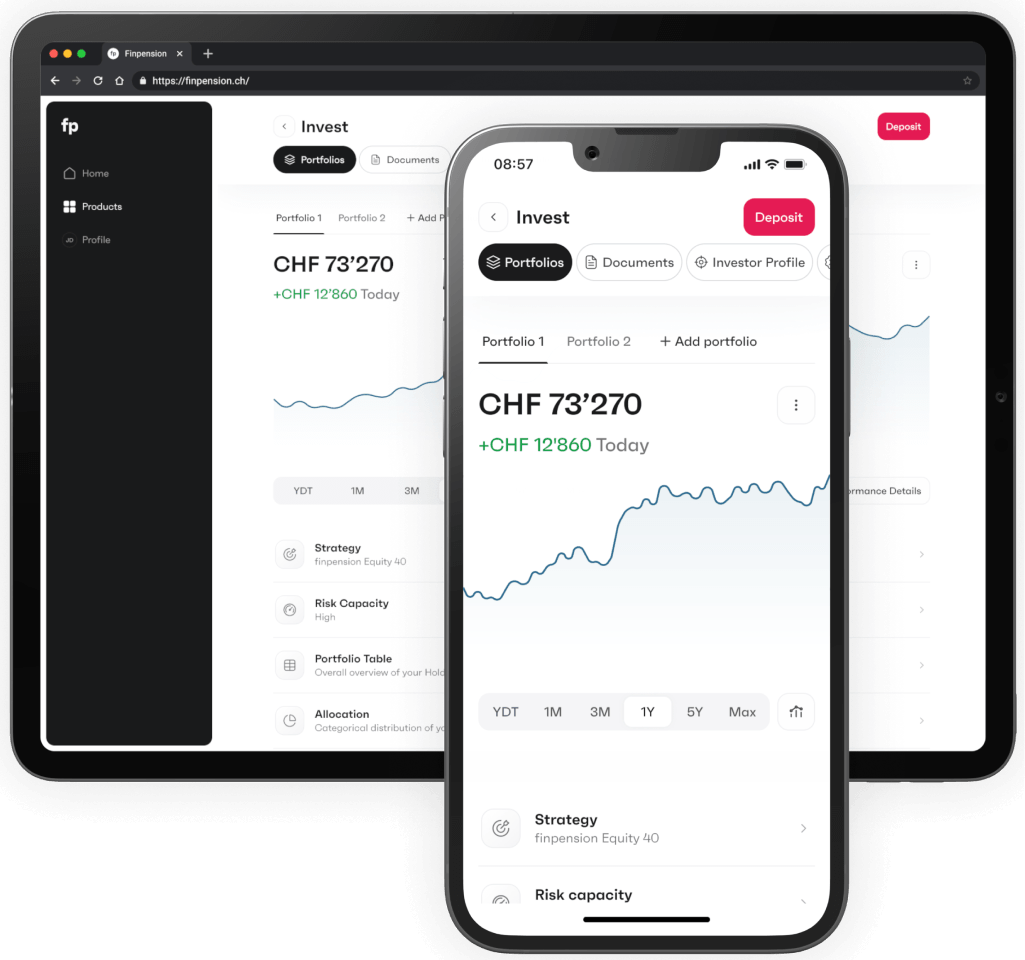
On top of the basic investing features, there are also some very interesting extra features.
First, you can transfer money directly from one portfolio to another. This can be very practical. And this also allows you to transfer money from one portfolio to another service, like your 3a. I think they did an impressive job of integrating all their services together.
You can fully automate your investment thanks to the weekly reinvesting. With that, people can set up a standing order from their bank to their Finpension account, and everything will be invested at most a week later. It is akin to a savings plan.
And you can also do the contrary with a de-savings plan. This allows you to set a standing order to withdraw money automatically and regularly. For instance, you could say you want 1000 CHF per month, and Finpension Invest will automatically sell enough shares to reach that amount and send that to your bank account. Again, you can set up multiple of these plans for each of your portfolios.
Overall, it is excellent to see all these features already on the first version of Finpension Invest. From the start, they already have more features than most competitors.
Safety
Of course, we should not forget about the security of our money. You never want to send your money to a service that you cannot trust with this money.
Contrary to most robo-advisors, Finpension Invest has a securities firm license. It means they can hold securities directly themselves, without relying on a third-party custody bank. From a regulation perspective, everything is in order.
If Finpension were to go bankrupt, shares would be safe because Finpension has to segregate customer assets from their own. It would likely take a while because it would have to be transferred to a new custodian bank, but this should work well.
It is worth mentioning that Finpension has been profitable since 2019 (only a few years after creation). This is important for the long-term use of the service. Many robo-advisors in Switzerland are losing money.
I have not been aware of any technical security issue with Finpension.
The only small downside is that they are a new securities firm (since March 2024). However, Finpension itself has been managing money since 2016 and has well over 5 billion Swiss francs in assets under management. This gives them a lot of experience.
Overall, money at Finpension Invest should be as safe as with any other Swiss robo-advisor.
Alternatives
An excellent way to get an idea of how good a service is to compare it against other alternatives. There are many robo-advisors available in Switzerland. I have compared Finpension Invest against three services.
Finpension Invest vs True Wealth

TrueWealth is an excellent Swiss robo-advisor with very affordable prices, making it a great robo-advisor for serious investors.
Use code SWISS100 to receive up to 100 CHF in fee credits.
- Very customizable
True Wealth is a very affordable robo-advisor, the most mature available in Switzerland. They also have a great range of features and are serious.
The investing strategies of these two services are really similar. They both use ETFs and focus on cheap index ETFs. And you have a very high level of customization in both cases. A slight advantage of Finpension would be to offer access to private markets, but it depends on whether you want that or not.
You need 8000 CHF to start with True Wealth, while Finpension Invest lets you invest with as little as 1 CHF.
Looking at the fees, True Wealth has a total fee of about 0.63%, while Finpension Invest is at 0.49%. This is a significant difference. It is worth mentioning that True Wealth has degressive fees. So, if you have a massive portfolio, True Wealth could become cheaper.
But once we factor in the 0.15% tax advantage of Finpension Invest, it will always be cheaper than True Wealth. It is worth mentioning that True Wealth also has a feature to reclaim the US dividends. However, this will depend on which custody bank you use. If you use BLKB, you will not get any tax advantage. You will get it only with Saxo because they will then be able to use US ETFs. But this is very poorly documented by True Wealth.
Overall, both have more or less the same feature set, but Finpension Invest is significantly cheaper and has a lower minimum.
Finpension Invest vs Findependent

Findependent is a very affordable Robo-advisor with a focus on sustainable investments. Invest your money easily! Get 20CHF in your account with code PoorSwiss.
- Excellent fees
Findependent is a more recent robo-advisor with low prices and a nice range of features.
Both robo-advisors use ETFs. Findependent only lets you invest 98% in stocks, slightly below 99% of Finpension Invest. Furthermore, by default, Findependent will only use ESG ETFs. You can create a custom portfolio to go around this. So, overall, Finpension is more flexible in the choices, especially with the addition of private markets.
You need 500 CHF to start with Findependent while Finpension Invest will let you start with 1 CHF.
From a fee perspective, both are quite well priced. Findependent charges a 0.40% fee, while Finpension Invest is at 0.39%. But the currency exchange fees of Findependent are much higher (0.50% against 0.002%) and stock exchange fees are not included in Findependent. And when we factor in the extra tax efficiency of Finpension Invest, it will be cheaper than Findependent. However, it is worth mentioning that Findependent has a staggered fee (all the way to 0.29% at one million of assets).
Overall, Finpension Invest has some significant advantages over Findependent. It is cheaper, more flexible and has a lower minimum.
Finpension Invest vs Selma
Selma is another robo-advisor that has a stronger target on beginners. They aim to make investing simple, without the bells and whistles.
Selma only gives you the choice between sustainable and standard investment. Apart from this, you will have no choice on the portfolio. The portfolio will be chosen based on your answers to the questions from the risk assessment. This makes it easier for beginners, but also much less flexible than Finpension Invest.
As for fees, Selma has a base fee of 0.68% plus about 0.22% for the ETFs, for a total fee of a 0.90%. When we compare this against the 0.49% total fee for Finpension Invest, this is a very significant difference. And if we take the extra 0.15% in tax efficiency, this gets even more significant.
It is worth mentioning that Selma’s fee can be reduced if you have a large portfolio. The minimum fee is 0.42% with 500,000 CHF, much closer to Finpension Invest.
For any medium-to-advanced investors, Finpension Invest is a significantly better option than to its flexibility and fees. Using Selma would mean paying a significant premium that should be well thought of.
Finpension Invest vs VIAC Invest
In December 2024, VIAC followed Finpension with their robo-advisor service, VIAC Invest. Since these services are quite similar, we should compare them in more detail.
One difference in how things are being done is that VIAC created its own funds and invests customer assets in them. Finpension on the other hand, uses other funds directly. In practice, this makes little difference for users, unless they want to customize. In this case, Finpension has a major customization advantage since you can choose all funds directly.
The base fees of both services are the same at 0.49%. However, VIAC Invest does not have any stamp duty included. But VIAC Invest has some small to medium redemption and subscription fees, while Finpension does not.
The main difference is how US dividends are handled. In some cantons, you can get all the withholding back with Finpension Invest (0% withholding). In other cantons, you get the usual 15% withholding. Unfortunately, VIAC invest uses Swiss funds for US stocks, resulting in 30% withholding. This makes a major difference in favor of Finpension Invest.
For me, this tax-efficiency advantage is enough to make Finpension Invest a better option.
If you would like to learn more, you can read my detailed comparison of Finpension Invest vs VIAC Invest.
Finpension Invest FAQ
How many portfolios can you have with Finpension Invest?
You can have up to 10 portfolios, each with a different strategy.
What is the minimum you can invest with Finpension Invest?
You can start investing with as little as 1 CHF.
Who can invest with Finpension Invest?
All Swiss residents that are at least 18 years old (and are not US citizens).
Who is Finpension Invest good for?
Finpension Invest is great if you want to invest in the stock market (or private markets) and want to minimize their fees.
Who is Finpension Invest not good for?
Finpension Invest is not great if you are an investing expert so that you can invest by yourself.
Finpension Invest Summary

Wealth management for all? Read our review of Finpension Invest. We analyze the fees and strategies of this private investment solution.
Product Brand: Finpension
5
Finpension Invest Pros
Let's summarize the main advantages of Finpension Invest:
- Outstanding fees.
- Excellent tax-efficiency.
- Can invest up to 99% in stocks.
- Can invest with as little as 1 CHF.
- Great investing strategy.
- Excellent integration with other Finpension services.
- Web and mobile applications.
- Advanced customization.
- Access to private markets.
- Very transparent.
Finpension Invest Cons
Let's summarize the main disadvantages of Finpension Invest:
- Entirely new solution.
- Stamp Duty is not included in the management fees.
Conclusion
An excellent and innovative Robo-advisor by Finpension.
- Most tax-efficient Robo-advisor
- Access to private markets
Finpension is an impressive service. Their new service, Finpension Invest, is again an excellent service. They offer a very nice set of features, excellent portfolios, and top-of-the-line fees.
This service offers very innovative features, such as the wonderful tax withholding support for US dividends. Now that I see this, I wonder why no other service went through this before. This really shows that Finpension is willing to go one step further to provide exceptional service.
Seeing all these features and fees together, I now believe that Finpension Invest is the new best robo-advisor available.
For transparency, I must mention that I am not using a robo-advisor myself. I am investing directly through a broker account. If you have the knowledge and the willingness to do so, investing by yourself with a great broker will be cheaper than investing through a robo-advisor.
What about you? What do you think about Finpension Invest?
More reading

clevercircles Review 2026 – Pros & Cons
clevercirlcles is a new Swiss Robo-advisor, with a twist. They add a community feature to the system. Is that enough to shine? Let's find out.
Finpension Invest vs VIAC Invest 2026
The best wealth app? Finpension Invest vs VIAC Invest: We compare fees, strategies, and features to help you choose the best private investment app.
Raiffeisen Rio Review 2026: Pros & Cons
Is Rio worth it? Read our review of Raiffeisen Rio. We analyze the high fees and structured products to see if this app is a good way to invest.
Learn easy ways to optimize your finances and save thousands in Switzerland with our exclusive e-book. Learn about the most cost-effective financial services tailored for savvy residents and expats!
Get Your FREE Swiss Money-Saving Guide
Hi Baptiste,
Do you know if the dividend tax reclaim works in Fribourg? I currently have Selma, Finpension and Truewealth and am deciding whether to invest in Vangaurd/iShares S&P 500 ETFs directly rather than letting the providers choose my portfolio. I’m checking the difference between a custom portfolio on Finpension, a euro based ETF on Neon Invest or a US based ETF on Saxo. Any thoughts?
Thanks a lot!
Hi Tim,
I don’t think it does. I have not heard back from Finpension about any other canton that accepted this. It is possible to try, I would say, and simply ask for the documentation from Finpension Invest and then submit it to the tax authorities, but there is no guarantee.
For me, the main criteria between a robo-advisor and a broker is down to preference. If you can invest yourself, it’s going to be more efficient through a broker. If you can’t handle it yourself (or don’t want to), a robo-advisor is best.
Hello Baptiste,
For a swiss person who is 35 years old and want to invest regularly in autoinvest each month (set up and forget it) which roboadvisor is the best choice according to you in terms of fees but also making money between finvest pension and true wealth?
And how many portfolio and strategy exactly would you recommend?
Thanks !
Hi Celine
In any case, the strategy should be adapted to your risk profile. You should vary the stock according to how much risk you can take.
I would personally go with Finpension Invest as a robo-advisor if I was using one.
Hi Gabriel,
FP is more expensive, each year you pay 0.39%
Neon: 0% each year, 0.5% buying and 0.5% selling (ETF WORLD..) or 0% with saving plan.
Do a simulation with chat gpt, 200 chf monthly for 20 years, average growth 7%.
You will be surprised
Hi Baptiste
I’ve read some of your blog entries and opened a fin pension 3a account.
I’m also interested in the fin pension investment option. Now I’ve read here, that it may not be the best option for total beginners (which I am). Could you say why, or what you would recommend instead?
Thank you,
Heidi
Hi Heidi
If you are comfortable with Finpension 3a, you will be fine with Finpension Invest. They are quite similar.
Finpension has many options for doing some custom things, which is sometimes less ideal for a beginner. But if you are already using one of their services, I would not worry too much about that.
Hello! Thanks a lot for the blog.
I’ve been playing around with your comparison tools and think I am missing something. I plan to invest for at least 10 years with the idea of buying a house. From the broker comparison tool I get a minimum of 626.- for 10 years with interactive broker and then selling (invest with a goal, starting with 10k and 1k a month). With Finpension invest it is 65.-/year i.e. 650.- after 10 years (starting with 10k and 1k a month), and selling is free in that case?
I am missing something here? Or is the selling part of the brokers always overlooked when comparing broker costs?
Hi Jean,
Yes and no :)
These numbers seem right to me with 10k and 1k a month.
However, if you do 100k and 1k a month, the results are drastically different:
* Interactive Brokers will cost 643 CHF, barely more than for 10k
* Finpension will now cost 506 CHF per year, or 5060 CHF for 10 years, almost 10 times more than IB
Robo-advisors can be cheaper than brokers for low to medium amounts. But as soon as you increase the amounts, they can be orders of magnitude more expensive.
Hi Bapriste,
Thanks for reviewing this.
After opening fp 3a account, I’ve been considering opening the investment account as well. One thing I didn’t quite understand: how and when I can withdraw money from fp Investment account? And does it follow the same rules from the professional/nonprofessional investor point of view (e.g. it’s better to keep assets at least for 6 months, etc)?
Regards,
Alojzy
PS: Yesterday I received an email from fp 3a regarding receiving 25 CHF bonus, so I guess you should also have received the same thing as I had used your promo code.
Hi Alojzy
Good question. Fortunately, you can sell and withdraw at any time. Operations are made once a week, so you may have to wait a week for the shares to be liquidated.
I don’t think there is any risk to being considered a professional investor since you are not investing by yourself. On the other hand, it should still be considered like long-term investing.
Thanks for using my code!
Hi,
Thanks for the response.
Sure thing, long-term HODLing is the only reasonable way to invest without 30h every day to keep an eye on the market.
I simply like knowing this sort of details before committing.
If I already have a fp 3a account verified, I guess I can only hit a button to open an investment account and it’ll be opened jjust like that, right? If so, I guess I’ll just give it a shot to see what it is like.
Regards,
Alojzy
Exactly, if you already have a 3a with them, it’s easy to open an investment account as well. Let us know your experience if you do so.
Hi Baptiste
Have you reviewed your positions with finnpension here like you have done with the IB positions.
I don’t see it here.
I am going to open 5 accounts with finnpension and as I have an horizon of 20 years, I am going to invest a bit more aggressively now. Rebalancing Will be by default.
Is there any chance you are reviewing your strategy in finnpension?
Thank you
Vanesa
Hi Vanessa
I am afraid I don’t know what you mean by “reviewing your strategy in finpension”. If I were to use Finpension Invest, I would probably use Finpension Equity 100.
Dear Baptiste,
Thank you for your great posts. I was wondering what is most cost efficient and return efficient for me, between Finpension Invest and Neon Invest. I already have ETFs in Neon Invest. I buy more or less once per month and plan on holding everything for a couple of decades. I know Neon Invest is not a robo-advisor. But is it also cheaper overall?
Thanks in advance!
Best,
Gabriel
Hi Gabriel
It depends on how much you buy per month and whether you use the savings plan from Neon Invest.
If you use the savings plan, Neon Invest can be cheaper until you sell.
If you invest a lot, Finpension Invest can be cheaper with lower percentages.
If you have a significant wealth, FInpension Invest will be more expensive.
You can check our broker comparison tool and our robo-advisor comparison tool to compare them.
Dear Baptiste,
Thank you for your reply. I used the calculators, and it looks like Finpension would be much cheaper. But the robo-advisor calculator seems to not take into account the investment horizon (which in my case would be around 30 years). The yearly fee would increase accordingly, as the total portfolio value increases with monthly inputs. So I am still a bit confused…
Over 30 years, FP is going to be significantly more expensive if you keep investing regularly.