
arvy Review 2026 – Pros & Cons
| Updated: |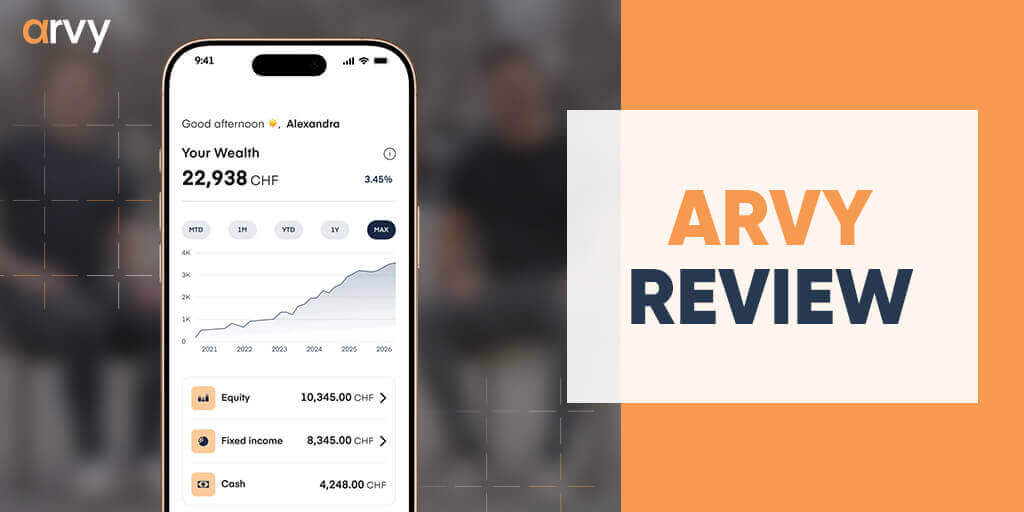
(Disclosure: Some of the links below may be affiliate links)
arvy is a robo-advisor that invests differently from others by using its own active fund of stocks. Since it has been requested multiple times by my readers, it was time to review this robo-advisor service.
In this review, we will look in detail into the advantages and disadvantages of this service. For that, we will look at the fees, the investing strategy, and the security of arvy. By the end of the article, you should know whether you should use arvy for your investing and how it compares with other alternatives.
| Management fee | 0.39% – 0.79% |
|---|---|
| Product Costs | 0.06% – 0.22% |
| Withholding Costs | 0.15% – 0.21% |
| Total Costs | 0.60% – 1.22% |
| Investing strategy | Active |
| Investing products | Stocks, ETFs, and funds |
| Minimum investment | 500 CHF |
| Currency conversion | Free |
| Customization | Very low |
| Sustainable | By default |
| Languages | German and English |
| Custody bank | Hypothekarbank Lenzburg |
| Users | N/A |
| Established | 2023 |
| Headquarters | Zürich, Switzerland |
arvy
arvy itself was founded in 2023. The company has a FINMA license as a manager of collective assets.
The story is quite interesting because it is very different from other robo-advisors. In 2018, the story started as asset management for a multi-family office. The founders created a fund that reached 200 million USD while they were managing 400 million USD in total. They then founded arvy and its arvy equity fund upon which the robo-advisor service is based.
In 2025, arvy was managing about 50 million CHF. And it is very interesting to note that the company reached break-even in 2025 already, after less than two years. This is much faster than most fintech companies.
The service is only available to Swiss residents and is currently available in English and German. It is worth noting that the service is not open to US citizens.
Arvy is primarily a robo-advisor service through its arvy savings plan. But they also have a third pillar account, arvy pillar 3a plan, based on the same investing strategy. They even have a children’s account. However, in this article, we will focus only on the robo-advisor service. If you want additional information on the third pillar, please let me know in the comments below.
It is worth mentioning who arvy is trying to target: people interested in learning about investing but do not want to invest alone. In that, they are actively pursuing active investing because their investors want to be able to react to market trends.
Now, we can see in detail what arvy is and what it costs.
Investing strategy
It is essential to understand how a robo-advisor invests before using such a service.
Most Swiss robo-advisors invest in ETFs. Some robo-advisors invest in stocks or mutual funds. arvy has a different strategy because they use their own arvy equity fund, but they also allow two other different strategies.
For each of the three strategies, arvy has three different asset allocations:
- Defensive with 30% equities
- Balanced with 60% equities
- Growth with 100% equities
It is great that we can invest 100% in equities.
World market (ETF savings plan)
The world market strategy is an ETF strategy. It was added to arvy in October 2026. arvy also calls it the ETF savings plan.
This investing strategy simply invests in ETFs that are picked by the experts at arvy. The strategy invests in the entire world through a world ETF. There is no Swiss bias. This is great because many robo-advisors have a massive Swiss bias by default.
If we look at the 100% equities portfolio, we can see these two ETFs:
- 88% in UBS Core MSCI World UCITS ETF
- 12% in UBS (CH) Index Fund – Equities Emerging Markets NSL I-A-acc
This portfolio is very simple! This is a good thing. I like that they focus mostly on a world ETF. And since this ETF does not include emerging markets, they add an emerging markets ETF for diversification.
Overall, this strategy is very simple and efficient.
Founder’s pick (equity fund)
The founder’s pick strategy is based on their own equity fund. It is called like this because it contains the same positions as those owned by the founders of arvy. Up to October 2026, this was the only strategy available.
The arvy equity fund invests in stocks following an active approach. They are using their own approach to select large-cap and mega-cap stocks. It is interesting to mention that this fund is also available as a fund (outside arvy) with brokers like Swissquote.
The fund invests in the whole world, but it currently has a strong focus on the United States, with 73% invested, followed by France with 14.2%. Other countries have much lower weight. One interesting fact is that arvy invests much less in tech (about 5%) than a standard index (27%). This may reduce sector risk.
For reference, here are the top 5 constituents of the fund (as of March 2025):
- Eli Lilly & Co. (Health Care)
- Rollins Inc. (Industrials)
- Philip Morris (Consumer Staples)
- Waste Management Inc. (Industrials)
- Safran SA (Industrials)
Everything that is not invested in stocks is invested in bonds. And for that, arvy is investing in the Flossbach von Storch Bond Opportunities fund. Again, this is an active fund but from another company.
So, at most, there are two positions in our portfolio at arvy, two active funds. The funds themselves have more constituents, but at least the portfolio is simple.
Investments are processed twice a month, on the second and sixteenth calendar days.
For me personally, this is not the strategy I would use. I am more in favor of passive investing. History has shown that over the long term, active investing performs worse than passive investing. The fact that no customization is possible is a disadvantage for me as well, but it could be an advantage for people that do not want to choose. This is what I would recommend to most people, especially people interested in low-fee long-term growth.
If you are interested in a more active approach, then arvy may be more interesting to you. You will need to be prepared to pay the higher costs that it has, as we will see in the next section.
It is worth mentioning that both founders invest their own money in this fund, meaning they have ‘skin in the game’ alongside their clients.
World market + Founders’ picks (hybrid)
Finally, the third strategy is simply a combination of the first two. If you want a mix of the world market strategy (ETFs) and the founder’s pick strategy (with single stocks), you can put your strategy in the middle.
In this case, half of your portfolio will be from ETFs, and half of your portfolio will be from the founder’s pick strategy. This is equivalent to having both strategies in parallel, but they are combined into one for simplicity.
If you are not fully decided between ETFs and single stocks, this could be an interesting strategy.
Arvy Fees
When comparing multiple robo-advisor services, it is important to compare the fees. It is usually what will make the most difference in terms of total returns over the long term. So, it is necessary to look at the fees of arvy in detail.
The most important point is the management fee. You will pay this fee each year based on your total assets invested with arvy. This fee is different for each strategy:
- 0.39% for the world market strategy
- 0.79% for the founder’s pick strategy
- 0.59% for the combined strategy
0.39% is an excellent fee for a robo-advisor. On the other hand, 0.79% is a very high fee to start with. So, whether arvy is expensive or not will highly depend on your choice of strategy.
We should mention that arvy is only 3 years old. We can expect fees to lower once they reach a higher amount of managed wealth. And since arvy is trying to create a community, some of these costs are also justified there.
Additionally, the product costs must also be considered. Again, these vary for each strategy:
- 0.06% to 0.07% for the world market strategy
- 0.12% to 0.22% for the founder’s pick strategy
- 0.12% to 0.13% for the hybrid strategy
Additionally, strategies with ETFs and bonds incur some stamp duty fees. But the strategy with stocks does not incur any (since they use their own funds).
Additionally, we must take US withholding tax into account.
- Since the arvy equity fund has its domicile in Liechtenstein, it is subject to a 30% US withholding rate (like it would in Switzerland). The stocks that arvy invests in have lower-than-average dividends. So, we can factor in a 1% dividend yield and about 70% US stocks. So, this will give us an extra 0.21% extra indirect fee (or surcharge).
- For the ETFs, the domicile of the world ETF is Ireland, which is only subject to a 15% US withholding rate. This is the second best domicile if we exclude the US. With a higher dividend yield of about 1.5%, we get an extra 0.15% drag.
If we put everything together, we get these fees:
- For the world market strategy: 0.60% to 0.61%
- For the founder’s pick strategy: 1.12% to 1.22%
- For the hybrid strategy: 0.89% to 0.90%
The world market strategy is well priced, when we compare it to other Swiss robo-advisors. However. the other two strategies are costly.
One should really have trust in the arvy methodology to pay such a high fee. Paying more than a 1.30% fee is too expensive for me. However, if we compare apples to apples, this is not too bad when compared with other active investing strategies. But we should note that it is more than twice as expensive as a passive robo-advisor.
One good thing is that the tax statement is included in the fee. This is good because some Swiss financial services are using that extra fee.
Another good thing is that since the equity fund has a domicile in Liechtenstein, there is no stamp duty for the fund (ETFs and bonds will still incur it). Most robo-advisors do not include this fee, so it is good to know that this one does not apply. Another advantage is that they have access to institutional currency exchange, meaning about a 0.05% currency exchange fee, much lower than the 0.25% industry standard.
Onboarding
To create an account with arvy, you need to download the mobile application from your app store (App Store and Google Play are supported).
The rest is quite standard; you will need to give out your personal information and answer the usual risk questionnaire. After that, your account will have to be verified by the bank.
We can expect onboarding to take about two business days. This is standard for services that rely on a custodian bank. So, overall, it should be simple and relatively fast to start investing with arvy.
Deposits and withdrawals
We can then continue with how arvy handles deposits and withdrawals.
arvy is based around a savings plan. You need a minimum of 500 CHF to open an account. And then, you need to set up a recurring investment of at least 50 CHF per month to continue investing.
I like the fact that they encourage people to contribute regularly to their accounts because regularity is key to getting good investing returns. But they are also quite flexible. Indeed, you can stop investing at any time. You are not locked into a fixed amount.
You can also withdraw at any time. For that, the shares will be sold, and you should be getting back your money in a few business days (the time to settle everything with the custodian bank).
Safety
Whenever considering any service to invest any amount of money with, it is essential to ensure the money is safe.
arvy is an asset manager, not a bank, so they cannot hold securities. For that, they use Hypothekarbank Lenzburg as a custodian bank. This is a well-established bank that has a good reputation. If arvy were to go bankrupt, the money would be safe with HBL. It will likely take time to recover assets.
This is slightly more complicated since they also manage their own fund. But the shares inside the fund are safe. In case of bankruptcy of arvy, the fund will either be liquidated and people will get back the proceeds, or the fund will be allocated a new manager that will manage it.
Overall, money should be safe with arvy. We should mention that it is a relatively new company that manages a low amount of money.
Alternatives
Finally, we should compare arvy with some alternative robo-advisors.
arvy vs Finpension Invest
An excellent and innovative Robo-advisor by Finpension.
- Most tax-efficient Robo-advisor
- Access to private markets
Finpension is a mature company in Switzerland that serves multiple markets, including a robo-advisor service, Finpension Invest.
Both allow you to invest 99% in stocks. Finpension Invest only invests in index ETFs, while arvy invests in ETFs and active funds. Finpension Invest also lets investors invest in crypto and private markets. And we can do custom portfolios with them, something that is not possible with arvy.
Finpension has total fees of 0.64% (it can go lower in some cantons depending on taxes). arvy has a total fee of 0.60% for its passive world market strategy. The active strategy would be twice as expensive as Finpension.
Overall, given the higher flexibility and maturity, I feel like Finpension Invest has an advantage over the arvy passive strategy. However, it is nice to note that arvy managed to be cheaper than Finpension Invest only a few years after its inception.
arvy vs Findependent

Findependent is a very affordable Robo-advisor with a focus on sustainable investments. Invest your money easily! Get 20CHF in your account with code PoorSwiss.
- Excellent fees
Findependent is another recent robo-advisor, started only two years before arvy.
Both allow you to invest 99% in stocks. Findependent uses index ETFs and uses sustainable ETFs by default, but you can use custom strategies if you prefer. With arvy, you are not forced into sustainable options, so you would not have to do a custom strategy to avoid them.
The total fee of Findependent is 0.71%, compared to 0.60% for arvy.
In this case, I feel like arvy has an advantage over Findependent. Their world market strategy will be cheaper and simpler than the one from Findependent.
arvy FAQ
Can you do a custom portfolio with arvy?
No, you can only invest in their arvy equity fund.
Who is arvy good for?
arvy is good for people that want an affordable ETF savings plan or people that are ready to pay high fees for arvy's active investing strategy.
Who is arvy not good for?
arvy is not good for people that want some customization.
arvy Summary
Is arvy the right robo-advisor for you? We review arvy’s active investing strategy, its high total fees, and how it compares to top Swiss alternatives.
4
arvy Pros
Let's summarize the main advantages of arvy:
- 99% invested in stocks
- Simple portfolios
- Option to use a passive ETF strategy
- Good fees for passive strategy
arvy Cons
Let's summarize the main disadvantages of arvy:
- Use active investing by default
- Very high fees for active strategy
- Only available in German and English
- Only available on mobile, no web app
- No custom portfolios
Conclusion
Overall, the arvy service is interesting because it is different from other robo-advisors. It has its own equity fund. And it uses active investing instead of passive investing. If you are looking for an active investing robo-advisor that helps you learn investing, arvy may be interesting for you.
Additionally, it also offers passive options with a world market strategy based on ETFs.
However, I am not convinced by their active strategy. The active management comes at a high cost, with more than 1.20% per year. It feels like investing money in a bank. My belief is that such high fees will weigh down investor returns. So, I would recommend using a passive strategy to save on fees.
If you want to use a robo-advisor to manage your money, there are some better robo-advisors available. You can look at the best Swiss robo-advisors if you need help choosing.
As usual, I should mention that I am not using robo-advisors myself. I am investing directly in ETFs with a broker account, which is cheaper than a robo-advisor. Robo-advisors are not bad at all; they are a way to reduce the complexity at the expense of fees for people that are not ready to invest by themselves.
What about you? What do you think about arvy?
More reading

VIAC Invest Review 2026 – Pros & Cons
Invest without limits. Read our review of VIAC Invest. We test their private investment solution to see if it's as good as their famous 3a pillar.
Interview of Felix Niederer, CEO of True Wealth Robo-Advisor
Robo-Advisor insights. Read our interview with Felix Niederer, CEO of True Wealth, and learn about their mission to lower investing fees.
Interview of Richard Toolen – CEO of Investart
Investart is a great online service that offers free investing in ETFs, to know more I interview Investart CEO, Richard Toolen.
Learn easy ways to optimize your finances and save thousands in Switzerland with our exclusive e-book. Learn about the most cost-effective financial services tailored for savvy residents and expats!
Get Your FREE Swiss Money-Saving Guide
As of Oct 2026 their fees are very close to Finpension. Might want to update the article.
https://arvy.ch/en/fees/
Hi Nik
Good catch, but it seems that the fee that is comparable is for the ETF savings plan at 0.39% but it is not yet available (written SOON).
I will do a full refresh of the article once they have released the new products.
Are Swiss residents required to report income and bank deposits in foreign countries when they file their Swiss tax return?
I believe we must indeed declare all sources of income and wealth in our tax return.
Yes.