
The Swiss FIRE Paradox – High income – High expenses
| Updated: |
(Disclosure: Some of the links below may be affiliate links)
Today’s article is a guest article by Chris Hogan from Portfolio Atlas. He will be talking about the Swiss FIRE paradox. I am happy to have him as a guest writer today.
A Swiss FIRE number is among the highest in the world. It’s worth asking ourselves what that number can do for you when we stop looking only in Swiss francs. This piece takes a Zurich dual-income couple and works out what their portfolio actually buys them in a range of other cities. We use the same withdrawal-rate math and historical backtests they’d use at home.
The Swiss FIRE Paradox
Strong incomes in Switzerland should compress the accumulation phase of achieving FIRE. However, due to high cost of living expenses, Switzerland’s FIRE-chasers are still the furthest from the finish line.
With highly competitive Swiss incomes comes inflated spending targets. A lean but comfortable life in Switzerland can cost a couple at least CHF 52,600 ($65,100 USD), but commonly much more. This is the Swiss FIRE paradox: making more won’t always get you closer to FIRE than any other European country unless we consider geoarbitrage.
A dual-income Zurich couple at the regional median income is CHF 180,000 ($223,000 USD). This income bests most European countries. However, it comes with a Zurich price tag for a couple to comfortably FIRE of CHF 2.45M ($3.04M USD). Even with aggressive savings rates, this makes FIRE within Switzerland extremely challenging.
Below is a breakdown of savings rates needed to FIRE in Switzerland. Taking our Zurich couple from above, their annual savings rates must be the numbers below to hit their FIRE goals by certain age milestones.
- Retiring at 40 in Zurich means saving CHF 113,600 every year or 63% of pre-tax income.
- Retiring at 50 in Zurich means saving CHF 51,300 every year or 29% of pre-tax income.
- Retiring at 60 in Zurich means saving CHF 27,100 every year or 15% of pre-tax income.
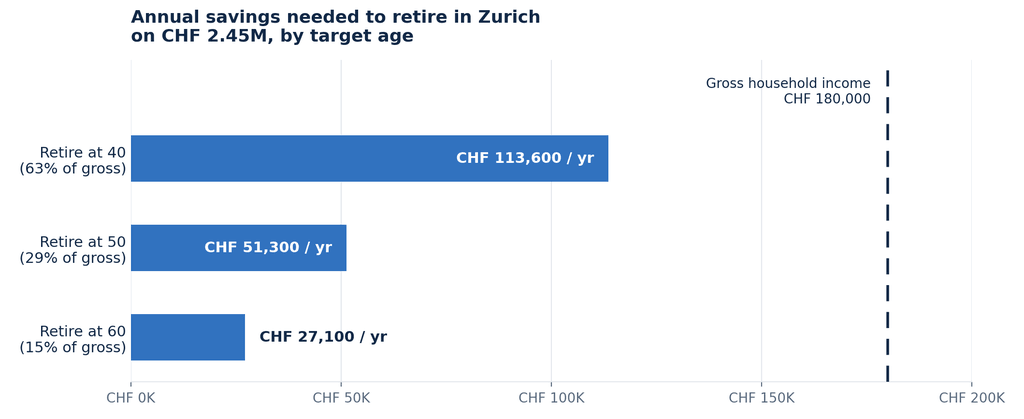
Saving CHF 113,600 a year requires banking nearly 2/3rds of your income, which exceeds most couples’s abilities when factoring in Swiss taxes, required insurance, and rent. Even retiring by your 50s means over a quarter of all paychecks must be stowed away – also a challenging feat with the high Swiss taxes and daily life expenses.
Comparing this to neighboring countries, you can live the same lifestyle for less than half that net worth when willing to FIRE outside of Switzerland, but first let’s cover our methodology.
Methodology
Let’s take a look at where these numbers come from: CHF 2.45M to retire in Switzerland. Leveraging the 4% rule, this gives our couple CHF 8,166 each month to cover their expenses.
On Portfolio Atlas, our dataset is in USD, converted at USD/CHF 0.8075 as of July 17, 2026, re-run at today’s rate.
What’s a lifestyle like at this price point? They live in a one-bedroom apartment nearby the lake. They eat out multiple times a week and enjoy monthly comedy shows and nightlife. Their budget allows several weekend ski trips in the winter still with supplemental passive income to cover taxis – they don’t have a car, and they don’t need one. This is a comfortable lifestyle in a city with a high quality of life.
Our couple is not living a lean lifestyle, but they’re also not close to topping what Zurich has to offer. CHF 8,166 monthly translates to CHF 98,000 annually, which, when following the Trinity study’s 4% rule, we multiply by 25 (the conventional “safe” withdrawal rate) and land at CHF 2.45M required to fund their life.
However, the 4% rule deserves less trust than many early retirees give it. It’s from the Trinity study that is based on 30-year retirements. For those looking to retire early, we might be looking at 40-year or 50-year retirements. This is where the 4% rule can break down.
Rather than rely exclusively on the 4% rule, we backtested this data against historical rolling markets from the past 150 years (from 1871 to 2022), factoring in inflation with a 75%/25% stock/bond portfolio rebalanced annually.
Back to our couple… At 30 years of retirement, withdrawing 4% of their portfolio to retire comfortably in Zurich succeeds 96.7% of the time, failing in 3.3% of real historical scenarios.
Quick aside – what is failure here? Failure means our couple ran out of money while they were alive. This matches our 4% rule closely. What if our couple retires with 50 years to spare? Our historical backtest on real stock market growth shows they succeed in 83.5% of scenarios, failing 16.5% of the time. 1 retirement out of 6 runs out of funds while our couple is still alive even while they follow the 4% rule.
At 3% withdrawal rates, every stock market scenario from the past 150 years resulted in our couple never running out of money for 50 years of retirement.
This isn’t meant to scare folks into over-saving. In fact, with flexible spending habits, couples can overcome many of the challenges revealed in historical backtests, but our methodology serves to showcase how assumptions should examine real data before making life-changing decisions.
Now, to cover some mechanical details of our analysis… We’re assuming a couple, not an individual. Expenses do not scale linearly from one person to two, and we scale each expense discretely – groceries increase at different rates from rent, and rent scales differently from insurance.
What if there were another path to derisk our couple’s early retirement? Below we share what geoarbitrage has to offer our Swiss couple.
Staying Close
FIREing in Zurich is an expensive decision, but feeling away from home is where the real problems can manifest. What options does one have when they don’t want to work until they’re 65 but also don’t want to be so far from home? Here we’ll examine alternatives that afford a much earlier retirement than Zurich without feeling like we traveled halfway across the world.
Lisbon is a three-hour flight from Zurich. Valencia is two. Spain shares Switzerland’s time zones, and Portugal is only one hour behind – calling your mom requires no more planning than it does when she lives across town. You can make the ad hoc weekend dinner with just a day’s heads-up.
What your money does for you in Zurich does much more when you look outside the country, but still nearby. Lisbon costs you CHF 3,370/month, CHF 2,860 for Porto, and CHF 2,690 for Valencia, all for a similar quality of life.
How? The category lines make it pretty clear. Housing costs in Lisbon are only CHF 1,680 for a similar setup as Zurich. Healthcare drops substantially from CHF 1,195 to CHF 258 in Iberia, as nothing out there matches the Swiss KVG premium. At this same FIRE tier, you get a nice central flat, frequent dining out, and great healthcare.
The same comfortable retirement in Zurich comes with a price tag of CHF 98,000 annually or CHF 2.45M. Looking at nearby countries, it drops substantially for our couple.
- Lisbon FIRE needs CHF 1.01M
- Porto FIRE needs CHF 858k
- Valencia FIRE needs CHF 807k
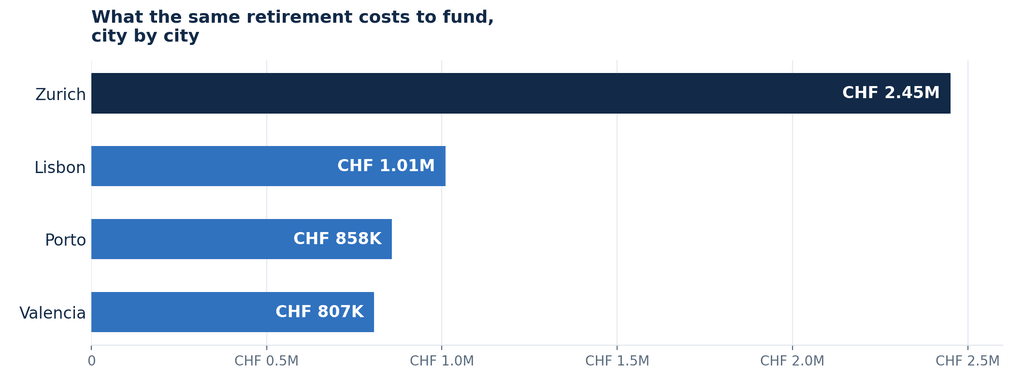
If our couple saves up CHF 2.45M working in Zurich, they could retire at withdrawal rates of 1.7% (Lisbon), 1.4% (Porto), or 1.3% (Valencia). Even 2% never failed in the past 150 years of data, and this is lower than that.
For our couple, they’re comfortable calling their folks an hour later and taking an extra day to plan a flight for Saturday night dinner with their Zurich friends. What does this geoarbitrage flexibility mean for them? It means years of early retirement are coming back to them.
This couple started from CHF 0 at 25 years old and aggressively saved 29% of their Zurich average couple income for 25 years. They can retire in Zurich safely by 50.
- Retiring in Lisbon gets them 10.9 years back
- Retiring in Porto gets them 12.5 years back
- Retiring in Valencia gets them 13.1 years back
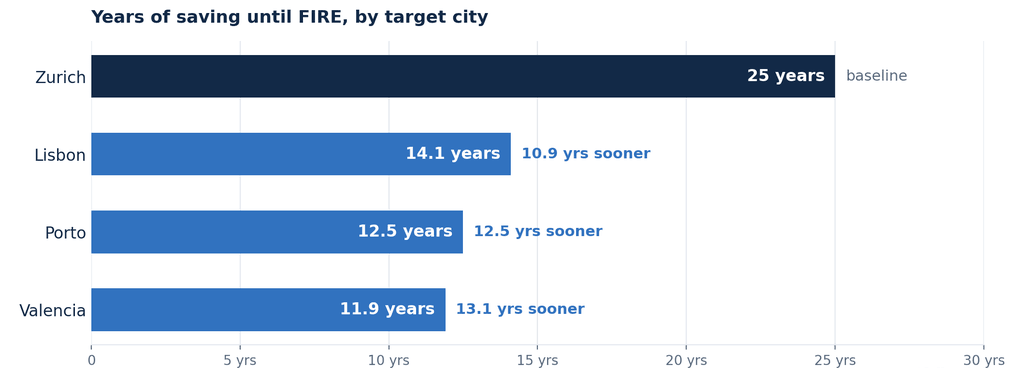
Already have money saved up? You’re farther ahead than our couple and can extrapolate your own timelines, speed running our couple’s FIRE journey.
This isn’t an ad for Lisbon, Porto, or Valencia either. There are many cities like these surrounding Switzerland with significantly lower price tags for similar FIRE lifestyles. We encourage you to research what lifestyle works best for you beyond these three examples.
Going Farther
The previous section was your life away from home, without feeling like it. This is your life away from home, and you can tell.
If you want family nearby, staying close makes sense. But what if you’re comfortable being anywhere in the world for those extra years of freedom?
Chiang Mai, Da Nang, and Medellin practically sit on the other side of the world from Zurich. It’s a 13-hour flight from Vietnam or Thailand back home to Zurich, and your time zones will be 5-7 hours off from anyone back home. Saturday night dinners become part of your big trips once or twice a year and are no longer a weekend whim.
The monetary value you get back is the real tradeoff for this distance. Monthly expenses for similar qualities of life in these 3 cities are below:
- Chiang Mai costs CHF 2,262/month
- Da Nang costs CHF 2,408/month
- Medellin costs CHF 2,516/month
These costs are lower due to similar reasons as Iberia, but even louder. Housing costs are CHF 651/month, and good private healthcare is about CHF 299/month in Chiang Mai. Withdrawal rates for our couple that waits until they have CHF 2.45M are 1.1% and 1.2% now. Every historical backtest suggests they will die with significantly more money than they started with.
- Retiring in Medellin gets them 13.7 years back
- Retiring in Da Nang gets them 14.1 years back
- Retiring in Chiang Mai gets them 14.6 years back
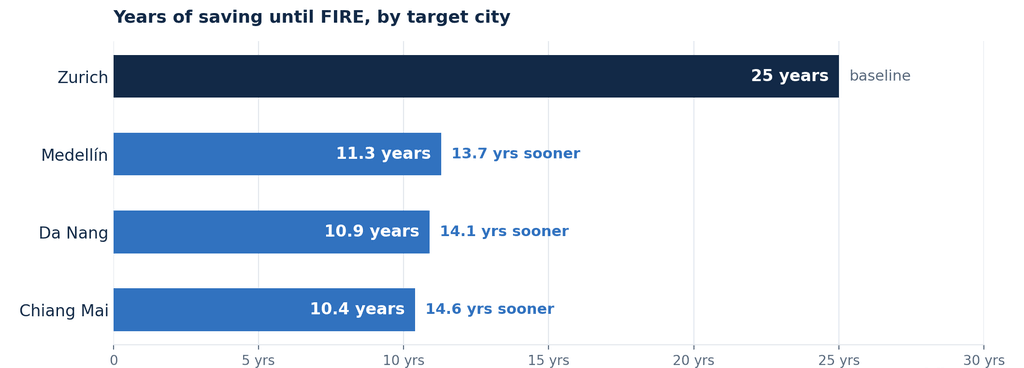
There’s a quiet lesson here. Retiring in Chiang Mai only gets you about an extra year or two back but costs you living across the world. Going farther won’t shave substantial years off your FIRE journey, but what it will do is give significantly higher confidence margins with your decision.
When traveling to Thailand and Vietnam, there are real visa issues to consider beyond the numbers. Thailand has a 10-year LTR visa requiring you to be 50 or older with an 80,000 income. Young retirees have more hurdles. Vietnam has no retirement visa, meaning you’ll have to balance shorter stays. Colombia is very friendly now, but visa requirements change frequently. It’s important to do your own research into the logistical work that comes with moving countries.
Like earlier, this isn’t an ad for these 3 cities. They’re a few data points on a much bigger curve that includes dozens of cities with similar lifestyles and price tags. The right one for you may depend on more than just your withdrawal rate.
The Swiss Twist
So far we’ve only discussed the raw numbers that go hand in hand with FIRE. What we haven’t touched on is what it means to actually leave Switzerland, which is a bit more overhead than simply booking a one-way flight.
Many Swiss expatriates forget they have their second pillar – the occupational pension – but only if they retire under specific conditions. Moving to an EU or EFTA country, the mandatory part of your pension remains in a Swiss account until retirement age – then it becomes accessible to you. However, should you move outside these European countries, your entire pension is available for you to immediately withdraw. In a poetic asymmetry, moving farther away from home to cheaper non-EU/EFTA countries yields more money now for you to leverage in your younger FIRE years.
Nothing is certain in life but death and taxes. Your pension withdrawal is taxed. However, the taxes are dependent on the canton in which your money sits – notably not necessarily where you last lived. Before deregistering to FIRE outside of Switzerland, people can move money to lower tax cantons before withdrawals and often execute common tax strategies like splitting withdrawals over multiple years.
Take a look at our couple as an example. Say they have CHF 600,000 sitting in their pension fund when they choose to move to Chiang Mai. With their foundation seated in Zurich, they’re paying CHF 49,100 in taxes. If they file the paperwork to transfer their foundation to Schwyz then they’re paying CHF 27,800 in taxes – CHF 21,300 saved for strategically filed paperwork.
With the third pillar, some of the departure math works in your favor. Once you deregister, your 3a account unlocks and your canton wealth tax ends. Switzerland charges no exit tax on your portfolio either. For the first 1M invested, you’re paying about CHF 1,744 annually until you file to deregister.
When you deregister, your Swiss health insurance ends. However, you may need to buy into a new plan. Healthcare costs are covered in our analysis, but treat that as directional – individual circumstances cause variances in what you pay for coverage. Additionally, you take on the risk of exchange rates. Although CHF is traditionally a safe, strong currency to own, many find holding a year or two in the local currency comes with stabilizing benefits. This is not financial advice; there are more things to think about as we consider geoarbitrage beyond Switzerland.
Your new country may tax the payout too; this is dependent on the current treaties in place. Tax rates also change, including Schwyz cutting taxes in 2026, so take the section more as a directional guide and less as hard numbers that will remain precise forever.
This is the time when two hours with a financial expert can pay for itself ten times over as you enter your FIRE journey.
Should I Stay?
You’ve heard five data-centric sections arguing why you might want to leave. An equally important question to ask yourself is if it’s worth it…
The healthcare you’re paying CHF 1,195 for in Switzerland is world-class. You’ll notice this is difficult to rival anywhere else you move to. Your friends are a short bike ride away. Hop on the train, and you’re at your parents house for dinner. Moving away usually means giving this up and starting many of your relationships over.
Moving back to Switzerland after deregistering is not automatic for everyone. There are many hoops to jump through should you want to come back, including restarting your base health insurance. By staying in Switzerland, you never close the door on returning home. When you leave, a few doors close behind you.
Our research suggests that you don’t have to leave Switzerland to FIRE early. Our couple can retire in Lugano with CHF 356k less than Zurich – or around CHF 2.1M. You stay with your KVG system, you keep your pension, and your family in Zurich is a two-hour train ride away.
There’s another FIRE path to consider that blends parts of both worlds. You can spend 5 months in Zurich with your friends and family and 7 in Valencia. This comes with a blended cost of CHF 59,700 (opposed to CHF 98,000 staying in Zurich), putting your FIRE number closer to CHF 1.49M, cutting 6.5 years off your working FIRE journey. Now, mind the fine print. Spend more than 183 days in Spain, and you accidentally trigger Spanish residency. You also keep paying your Swiss wealth tax.
FIRE doesn’t have to be black and white, but every degree you turn the dial comes with a cost. What happens when a parent gets sick and you’re a 13-hour flight away in Chiang Mai? That’s categorically harder than a 3-hour flight. Data can help us price the options, but it can’t tell your gut what works best for you, while not all decisions need to be purely about the numbers.
Decision Framework
If you’re still reading, you can tell there is no one-size-fits-all approach. What we can do is provide a decision framework that might help you find the best path forward.
Distance. Decide how close you need to be to your loved ones. For some, a last-minute flight back home is sufficient coverage. For others, one to two flights a year will be fine. The answer to this most heavily shapes if you follow our hypothetical couple to Iberia or open the entire map up to find your new FIRE life. Not sure? A year of travel can help you discover what’s best without needing to make a full commitment yet.
EU/EFTA or not? There are big tax differences to your pension with this decision. Inside this region, that mandatory part of your pension stays locked within Switzerland until you are at retirement age. Branch outside, and it’s yours immediately.
Paperwork. Traveling among the EU countries is trivial with Swiss citizenship. Moving to Thailand comes with frequent visa renewals. If your version of FIRE doesn’t include recurring paperwork through your retirement, the set of destinations for you shrinks.
Money. This is where our geoarbitrage journey began, but we consider it the least important factor of the four on this decision tree. 3% withdrawal rates have never failed in 150 years of market returns. Going to 3.5% and you accept there is some risk in extreme series of events – historical data proves that 3.5% would not be enough in several 50-year periods. And then there’s the cheaper FIRE cities with good infrastructure, like Chiang Mai. Our couple could retire here with only 1.1% withdrawal rates, with triple the defensive margin needed and a long flight home.
The FIRE optionality of cities explored today is the point. The Swiss FIRE paradox is a menu, not a trap. The CHF 2.45M question isn’t “can we afford Zurich.” It’s “what is Zurich worth to us.” You now have every number you need to answer it. The only input missing is yours.
Thanks a lot to Chris for this guest article! If you would like to learn more about his methodology and data, he is sharing data and tips on Portfolio Atlas. He has a wealth of data on geo-arbitrage for FIRE. You should check it out!
More reading

Retiring early is simple but not easy
The hard truth about FIRE. Retiring early is mathematically simple but psychologically hard. Learn why discipline matters more than high income.
9 Things that are Wrong With FIRE
Is FIRE perfect? We discuss the common criticisms and downsides of the Financial Independence, Retire Early movement.
Retire Early: The Simple Guide – I wrote a book
I wrote a book, Retire Early: The Simple Guide, with Thomas Walke, another Swiss blogger. Our book is about the basics of early retirement.
Learn easy ways to optimize your finances and save thousands in Switzerland with our exclusive e-book. Learn about the most cost-effective financial services tailored for savvy residents and expats!
Get Your FREE Swiss Money-Saving Guide
I thought it was a really good article, thanks! It is interesting to see that travelling further afield outside Europe doesn’t have such a huge impact financially as might be expected.
Also very interesting to see that Lugano is only a little cheaper than Zurich. I would love to see extra cities in Switzerland added for comparison, especially some of the smaller ones like Martigny or Fribourg
Thanks, Oliver!
It would be great to build out a comparison with multiple cities indeed. Getting the data takes a lot of work, though.
This article inspired me to conduct a case study called “Zurich, Switzerland versus Midland, Michigan, USA: Geoarbitrage and the impact of tax and pension obligations”.
I posted it in this Poor Swiss forum thread:
https://forum.thepoorswiss.com/threads/zurich-switzerland-versus-midland-michigan-usa-geoarbitrage-and-the-impact-of-tax-and-pension-obligations.722
Its not a bad article.
BUT taxes are not considered.
If one were to fully retire on a portfolio, that is paying out dividends and interest via coupons, taxes and wealth taxes need to be considered.
Spain is murderous in this case…
Not sure if this should be called a guest post, a paid post or a paid guest post, but certainly not a high quality post.
It’s pretty well known that cost of living are very high in CH and that retiring in Southern Europe or in SE Asia results in a lower needed FIRE number.
In Spain in particular you should also consider their wealth tax, which can go up to 3.5%. This alone makes it a very poor FIRE retirement destination.
I do not understand the term going Farther. Is it religious ?
I will have used going further
Thanks a lot for the article. For those who plan to leave it will be important to do the full math and check on taxes. Someone might prefer to chose the annuity (monthly payout) of the 2nd pillar instead of lump sum. What would be the local income taxes for this? taxes. Some countries might require you to pay into their pension system. By the way anyone living in Switzerland is obliged to continue to pay into the AVS until the age of 65.
what are the taxes for capital gains on shares, property and inheritance tax, if you inherit or also what taxes your heirs would have to pay when you die…..