
Saxo vs Interactive Brokers 2026
| Updated: |
(Disclosure: Some of the links below may be affiliate links)
Saxo Bank has greatly improved its offer this last year. And while Interactive Brokers is my current and favorite broker, it may be interesting to compare it against Saxo Bank now.
So, it is time to compare Saxo vs Interactive Brokers in detail. I will examine and compare their fees, features, and usability. And we will also look at the user reviews for these two brokers.
|
Cheapest Swiss Broker
|
The best broker

|
Saxo
Saxo is a broker from Denmark, from 1992. They have an entity in Switzerland, licensed by FINMA. So, while they are technically a foreign broker, they work exactly like a Swiss broker and follow the same rules. Therefore, I consider Saxo to be a Swiss broker.
Saxo has more than a million customers worldwide, but it is unknown how many customers they have in Switzerland.
In 2024, Saxo slashed their fees, becoming competitive with other Swiss brokers. At this point, it is the cheapest Swiss broker, so definitely interesting to compare it against alternatives.
Interactive Brokers
Interactive Brokers is a US broker, from 1978, with multiple entities in Europe. In Switzerland, we are using the UK entity.
IB is a publicly traded company (helps with transparency)j and quite profitable (helps with sustainability). They currently have well over two million customers worldwide.
They have been known to have great fees for Swiss investors. And they provide access to many instruments in many stock exchanges.
Features
First, you need a broker that has all the features you need. If your broker does not fit your investing requirements, you must find another one. Therefore, we must compare the features of Saxo vs Interactive Brokers.
However, many brokers have many more features than we require. This does not improve them necessarily. We only care about the features we require. As simple passive investors, we use only a few features.
First, we can look at stock exchanges. In this case, both Saxo and Interactive Brokers provide us with access to the main stock exchanges. We have access to the major Swiss, European, and United States exchanges. These stock exchanges are all we need to build a great portfolio. Of course, they provide access to many more stock exchanges, but if we do not need them, we do not have to worry about them.
As for instruments, both brokers will provide us with access to ETFs, stocks, and bonds. Again, this is more than enough for simple investors, and both brokers provide access to further instruments such as futures and options.
Both brokers allow us to trade with US ETFs, the most efficient ETFs for Swiss investors. It is important because not doing that would be a significant disadvantage for one broker.
You can get interest on cash and margin loans at both brokers. Only Interactive Brokers offers fractional shares, but this is probably not something very essential for most people.
It is worth mentioning that Saxo provides e-tax statements, while Interactive Brokers does not. Many people like to use these statements to save time when filling out their taxes.
Overall, when comparing Saxo vs Interactive Brokers, both brokers have more than enough features to invest in the stock market.
Fees
It is critical to compare the fees for investing with brokers. Indeed, if we have the same portfolio on two brokers, the fees are what will differentiate our total returns. So, we will look at the fees of Saxo vs Interactive Brokers, in detail.
One disadvantage of IB is that its fee structure is more complex than Saxo. IB has two different fee structures (tiered and fixed) and two different fees for the currency conversions (manual and automated). For stocks, I will use the tiered pricing, which is generally better. And I will detail both for currency conversions.
We can start with the fixed fees. Both brokers have no custody fees or management fees. This is great.
For transactions, we must consider the fact that Saxo is a Swiss broker. As such, it will incur some Swiss stamp duty. Other than that, Saxo pricing is simple. Here are a few examples for standard stock exchanges:
- SIX Swiss Stock Exchange: 0.08% (minimum of 3 CHF)
- Euronext Paris: 0.08% (minimum of 2 EUR)
- NYSE: 0.08% (minimum of 1 USD)
On the other hand, the IB system is very complicated. I will not detail it here, but you can read more in my article about IB Fixed and Tiered pricing schemes.
To compare Saxo vs Interactive Brokers, I took different scenarios and ran them through our broker comparison tool and got the results for the total fees of each broker. I have defined six scenarios:
- A: 1000 CHF in portfolio, 100 CHF in monthly investment, and 0% world allocation.
- B: 1000 CHF in portfolio, 100 CHF in monthly investment, and 100% world allocation.
- C: 1000 CHF in portfolio, 100 CHF in monthly investment, and 80% world allocation.
- D: 10000 CHF in portfolio, 500 CHF in monthly investment, and 80% world allocation.
- E: 50000 CHF in portfolio, 1000 CHF in monthly investment, and 80% world allocation.
- F: 100000 CHF in portfolio, 2000 CHF in monthly investment, and 80% world allocation.
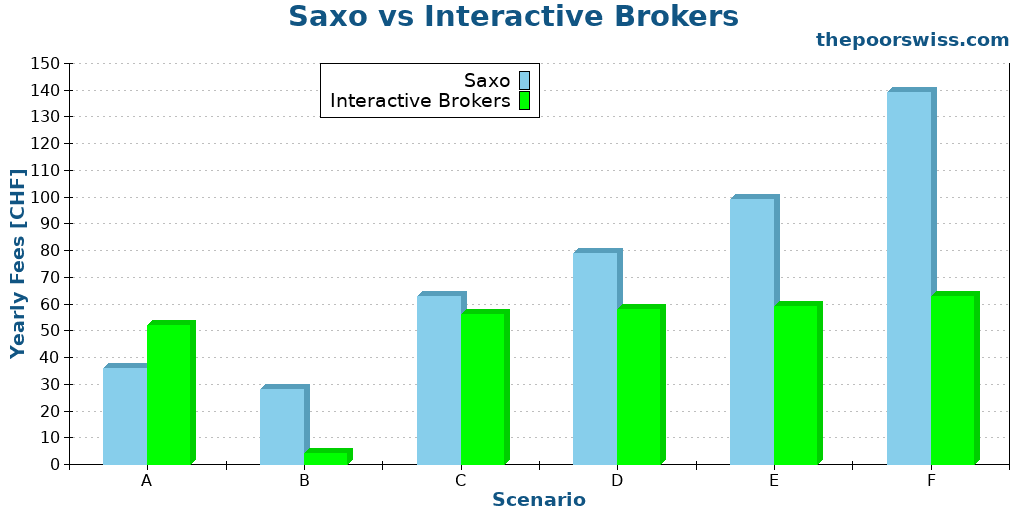
For small scenarios, Saxo compares well to Interactive Brokers. Then, it starts to become pricier. Then, the stamp duty starts to weigh on the balance (but Saxo cannot do anything about that). The currency conversions are also much higher for Saxo than for IB. If you only invest in a Swiss ETF, Saxo will do very well.
We can also look at currency conversion fees in detail. Saxo has a 0.25% currency conversion fee. A manual conversion on IB costs 2 USD (or 0.002% if you convert more than 100k). An automated conversion costs 0.03% without a minimum. Here are a few examples of conversions:
- 100 USD
- 0.25 USD at Saxo
- 2 USD for a manual conversion at IB
- 0.03 USD for an automation conversion
- 500 USD
- 1.25 USD at Saxo
- 2 USD for a manual conversion at IB
- 0.15 USD for an automation conversion
- 1000 USD
- 2.5 USD at Saxo
- 2 USD for a manual conversion at IB
- 0.30 USD for an automation conversion
- 10000 USD
- 25 USD at Saxo
- 2 USD for a manual conversion at IB
- 3 USD for an automatic conversion at IB
Overall, as long as you are using the cheapest way to convert, Interactive Brokers can be much cheaper than Saxo to convert. That being said, Saxo is quite fair at currency conversion, when we compare it with other Swiss brokers.
Overall, when comparing Saxo vs Interactive Brokers, while Saxo is very fairly priced, Interactive Brokers is still significantly cheaper.
Safety
We also compare the safety of holding investments at Saxo vs Interactive Brokers.
Both brokers are well established and are in a good financial situation, with many customers (both have beyond one million customers). This makes them less likely to fail.
The technical security of both brokers is good. I have not heard of any major breach in either of these brokers. They both have support for a second factor of authentication (2FA). I would personally not use a broker that does not have a second factor. This is a crucial step in improving the security of your online accounts. Interactive Brokers goes one step further in forcing 2FA for all users.
Both brokers are regulated. In Switzerland, Saxo is regulated by FINMA, like all other Swiss brokers. As a result, 100,000 CHF of cash will be insured in case of bankruptcy. IBKR has SIPC protection, protecting up to 500,000 USD (250,000 USD of cash protection). So, unless you keep a lot of cash, you should not have to worry about it.
In both cases, assets are segregated, so your shares are not in their accounts. This is done slightly differently by both brokers. In Switzerland, Saxo does full segregation, with one account for each customer. And IB uses so-called omnibus accounts, which are accounts for multiple customers. In practice, it should not make a difference.
Overall, as for safety and security, both Saxo and Interactive Brokers are safe.
Reputation
Finally, we can look at the reputation of Saxo vs Interactive Brokers.
Even though it is far from perfect, I usually use Trustpilot as a source of reviews. Saxo gets a 3.7 out of 5 for the reviews on the whole group and 4.2 for the reviews on the Switzerland entity. So, based on that only, Saxo is slightly better than IB. On the other hand, IB only gets a 3.3 out of 5.
In both cases, the most negative point is about the customer service. On the positive side, we find some good reviews about IB fees and some good reviews about Saxo being easy to use. And we also find some contradicting reviews because some people truly enjoy both customer service. This is often the case because people generally do reviews either when they are really happy or really angry.
If we look at their apps, on the Google Play Store, IBKR gets a 4.8 score while Saxo gets a 3.9. On the Apple App Store, Interactive Brokers gets a 4.5 and Saxo a 4.6. Overall, it looks like apps from Interactive Brokers fare slightly better.
From what I am hearing in Switzerland, Interactive Brokers has a better reputation than Saxo. But Saxo is becoming quite popular since they changed their fees in 2024.
Overall, regarding the reputation of Saxo vs Interactive Brokers, I would say that both brokers have a decent reputation.
Saxo vs Interactive Brokers Summary
We can make a summary of Saxo vs Interactive Brokers:
|
Cheapest Swiss Broker
|
The best broker
|
|
Primary Rating:
4.5
|
Primary Rating:
5.0
|
|
Extremely affordable
|
Extremely affordable
|
|
Pros:
|
Pros:
|
|
Cons:
|
Cons:
|
|
: (Swiss residents using my link get 200 CHF in trading credits) |
: |
- Good execution
- Good range of investing instruments
- Swiss broker
- Easy to use
- No custody fees
- Not the cheapest currency conversions
(Swiss residents using my link get 200 CHF in trading credits)
- Good execution
- Wide range of investing instruments
- Very low currency conversion fees
- No custody fees
- Not always easy to use
We can draw a few conclusions for Saxo vs Interactive Brokers:
- Interactive Brokers is cheaper in most cases
- Saxo can be cheaper for small portfolios
- Interactive Brokers is a foreign broker
- Saxo is a Swiss broker
- Both brokers have all the instruments we need
- Both brokers are really good options
Conclusion
Overall, Saxo and Interactive Brokers are great brokers for Swiss investors. Interactive Brokers remains the cheapest broker available for us. But Saxo is closer than I would have thought. For some people, the fact that Saxo has a Swiss entity regulated by FINMA is an advantage.
Overall, the choice of Saxo vs Interactive Brokers boils down to a simple point: Are you open to a foreign broker?
- If you are, Interactive Brokers can save you a significant amount of money in fees.
- If you are not, Saxo is an excellent choice that is very affordable.
I am currently using Interactive Brokers as my main broker. And I am using Saxo as my secondary broker, for diversification. I have a good experience with both brokers.
For more information on these two brokers, read my reviews:
What about you? Which broker do you prefer?
More reading

How to use Interactive Brokers for your investing
A simple guide to using Interactive Brokers for your day-to-day investing operations like buying shares or checking your profits.
Saxo vs Swissquote 2026 – Which is the best Swiss broker?
The big broker battle. Saxo vs Swissquote: We compare the two leaders in Switzerland to see which one offers the best fees, safety, and features.
Yuh vs Swissquote 2026 – Best Broker in 2026
Which broker wins? Yuh vs Swissquote: We compare the fees, features, and ETF selection to help you choose between the app and the full bank.
Learn easy ways to optimize your finances and save thousands in Switzerland with our exclusive e-book. Learn about the most cost-effective financial services tailored for savvy residents and expats!
Get Your FREE Swiss Money-Saving Guide
Hi! I’d love to get your opinion on what setup would make the most sense for me.
I’m 26, living in Switzerland, investing for the long term and I have a fairly high risk tolerance. I already contribute to my 3rd pillar, and I’d like to start investing around CHF 400/month, with the idea of increasing that amount as my salary grows.
I’m currently hesitating between IBKR and Saxo and for ETFs I’ve been looking at options like VT (as you suggested) and possibly a Swiss ETF as well.
If you were in my situation, which broker + ETF combination would you choose, especially considering fees and taxes?
Would you go for something like 100% global ETF or do you think adding a Swiss allocation makes sense?
Thanks a lot!
Hi Nicole
Congratulations for starting to invest early!
You cannot go wrong with either Saxo or IB for this kind of portfolio. In fact, at 400 CHF per month, the difference in fees should be negligible. Once you scale your monthly investment, the difference will be more in favor of IB.
It’s up to you to decide if you are ready to use a foreign broker or not?
As for the portfolio, I think a default 80% VT + 20% Swiss ETF (like CHSPI) is a good default for most people. I cannot really answer the question of the need for a home bias for you, but many people feel more comfortable about having a Swiss ETF in their portfolio. And others are perfectly fine with 100% VT.