
Best Third Pillar in Switzerland (2026): Top 3a Compared
| Updated: |
(Disclosure: Some of the links below may be affiliate links)
In Switzerland, contributing to your third pillar is one of the easiest ways to save on taxes. I recommend everybody to contribute to their third pillar.
But contributing to your third pillar is not enough. You should invest the money in your third pillar. That means you have to pick the best third pillar for your money. Since there are many options, choosing the best third pillar for your needs may be difficult.
So, this article is here to help you! We see how to choose the best third pillar!
What makes the best third pillar?
First, we must consider what makes the best third pillar. We must decide which factors will drive the choice.
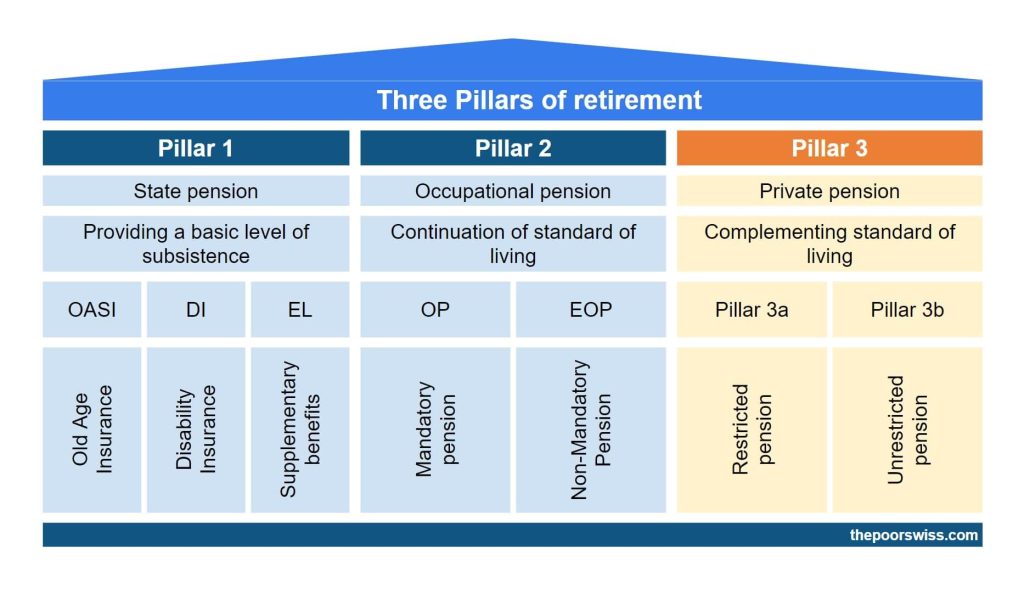
I assume you already know about the third pillar and are contributing to it. If you do not, you should learn why you should contribute to the third pillar. As of 2026, you can contribute 7258 CHF per year into your third pillar.
The goal of your third pillar is to provide you with enough money to retire comfortably. Therefore, you want your invested money to grow as much as possible while not taking too much risk. So, the best third pillar must support this goal!
There are five critical factors in choosing the best third pillar:
- A large allocation to stocks will increase your returns in the long term. The maximum is currently 99%.
- A diversified stock allocation reduces the volatility of your portfolio. Ideally, you would want world coverage.
- Low management fees to avoid wasting your returns in fees. We are aiming for a fee below 0.50% per year.
- The number of accounts possible. We are aiming for five accounts to allow staggering.
- The third pillar must not be with an insurance.
Since we are counting on the long term, there are also some things we can ignore:
- How good the app looks is not relevant. You will spend less than an hour every year.
- The interest on the cash part is irrelevant unless you do not want to invest.
We will now delve more into the details of the three critical factors.
Allocation to stocks
The best third pillar has a significant allocation to stocks.
It will depend on your situation, of course. You need to choose yourself your asset allocation. Recently, Swiss bonds have had negative interest rates for about ten years. When this is the case, what is not in stocks should be invested in cash.
I want to allocate as much of my third pillar to stocks as possible. I already have bonds in my second pillar, and my current allocation to bonds is more than enough. Ideally, a third pillar will have a 100% allocation to stocks.
Diversification
The best third pillar has a diversified stock allocation.
Switzerland is too small of a country to only invest in its stocks. We need to have global stocks (stocks outside of Switzerland). Ideally, the allocation should be the same as a world stocks fund. Since the Swiss stock market represents about 3% of the entire stock market, we should avoid investing much more than that.
Unfortunately, this is not possible in Switzerland. The law states that the third pillar must have at least 40% allocated to Swiss stocks. So, an ideal third pillar should have 60% of international stocks and 40% of high-quality Swiss shares.
As we will see later, there is a way around this limit, making some third pillar providers significantly better than others.
Fees
And finally, the best third pillar has fees as low as possible.
I want my third pillar to have zero load fees. I do not want to pay to get money inside the fund. The absence of load fees is essential. You should never use any fund with load fees.
Moreover, the yearly fees must be low, and the TER must be as low as possible. Most third-pillar accounts in Switzerland have higher than 1% TER. For a good third pillar, we are aiming for fees below 0.50%.
When you are investing for the long term, it is essential to minimize investing fees. The difference in returns in the long term is significant.
Staggering
The best third pillar must also allow staggering with five accounts.
When you reach five years before retirement age, you can start withdrawing your third pillar. You cannot split a third pillar, so you have to withdraw it entirely. But if you have multiple accounts, you withdraw each on a different year.
Staggering your withdrawals can save you much in taxes. Since the rule is five years, the best third pillar will have five accounts.
Avoid life insurance 3a
Life insurance 3a is a big trap in Switzerland.
These third pillars have the same tax advantages as a bank 3a, but they have much higher fees and lower returns. Additionally, it is more difficult to get rid of them. I have never heard of any life insurance 3a that was able to deliver decent returns. When people receive their life insurance 3a withdrawal at retirement, they are always disappointed with how it performed.
Therefore, it is essential that the best third pillar is not a life insurance 3a.
Third Pillar from a traditional bank
Most people in Switzerland will invest in a third pillar their banks provide. And they have a ton of options. Historically, they have been the only option available for third pillars.
I will not go over all the possible offers here. Indeed, there are too many of them. And most of them are terrible options. But I will go over some interesting options from some popular Swiss banks.
We will use the third pillar accounts from banks as examples. These are not the best third pillars.
Migros Bank Fund 85 V
My current bank is Migros, so I wanted to check their offer.
They have several retirement funds. The most interesting is Migros Bank Fund 85V. It has 85% in stocks and the rest in bonds and money markets. The TER is 0.94% per year.
The allocation to stocks is slightly low but not too bad. The TER is not that bad for a Swiss bank. But I would not recommend this fund.
LUKB Expert Fund 75
Many people recommend the Luzerner Kantonal Bank’s LUKB funds. Let’s take a look at their LUKB Expert Fund 75.
This fund has 75% of stocks, which is alright but not great. 40% is invested in Swiss stocks, 35% in global stocks, 15% in Swiss bonds, 4% in international bonds, and the rest in liquidities and real estate. The diversification is not too bad when compared with other options.
It has a TER of 0.8%. For third pillar accounts in Switzerland, this is a good TER. However, it has a load fee of 0.4%. The TER is okay, but the load fee makes it highly undesirable.
PostFinance 3a
Many people are using retirement funds from PostFinance. These last few years, they have changed their lineup many times.
For me, the only interesting fund they are offering is the PF Pension – Passive 100 Fund. This fund invests 100% in stocks. Only 8% is invested in Swiss companies, while the rest is invested globally. This is a good allocation (better than average). However, only 25% are invested in foreign currencies, so this fund relies heavily on currency hedging.
The TER is 0.87%. This is expensive but better than it used to be. It would be better if they had lower fees and lower hedging, but at least PostFinance is going in the right direction.
Raiffeisen Pension Invest Futura Equity
Since many Raiffeisen banks have a good reputation, it is a good idea to look at their retirement funds, and more specifically, the Pension Invest Futura Equity fund, a mouthful.
This fund has between 80% and 100% in stocks. I do not know why it is not fixed. But the last invested value I saw was 95% in stocks, which is good. 47% is invested in Switzerland, which is not great but not the worst.
The TER of the fund is 1.42%, which is awful. While it is not the most expensive fund in Switzerland, it is the most expensive that I will mention today. And it is far too expensive for people to consider.
Swisscanto Fund 95 Passiv VT
Swisscanto provides many Swiss funds, and many banks use them. We can examine the Swisscanto Fund 95 Passiv VT.
This fund invests 95% in stocks, which is excellent. The diversification is also good, with 65% invested in foreign equities. However, they hedge most of the equities, with 72% in CHF for the entire fund. This is not great for currency diversification.
On the fee side, this is an excellent example of how banks are trying to make it complicated for people to know how expensive it is. The flat fee for the fund is only 0.38% per year. At first sight, it sounds great. But if you look in detail, we can see that this is a fund of other funds, so there is an extra 0.33% in fees for the sub-funds. But they never show the full fee of 0.71%. On top of that, they are adding a 0.1% issuance fee and a 0.09% redemption.
It is the most complicated fee system I have seen during my research. They use several small fees not to scare customers away, but when you add up all the costs, this does not make them very attractive. And just because of this lack of transparency, I would not invest in their funds.
Summary for traditional banks
Unfortunately, there are no great options in banks directly.
You can get decent allocation to stocks and diversification, but as soon as you look at the fees, these options are instantly not great. They are simply too expensive. So we must look elsewhere.
Independent providers
As we saw, offers from banks are not that great. Fortunately, recently, many independent providers have started in this market. And they are offering much better conditions than banks.
We have observed that banks have high fees, subpar diversification, and not aggressive enough portfolios. Independent providers are fixing all these issues. So, to find the best third pillar, we need to look at these independent providers. Note that they are not all good. There are also some bad options.
There is no disadvantage to having your money in a third pillar from these companies instead of at a bank. They only have advantages.
There are many, but I will only mention two main providers in this article: Switzerland’s two best third pillar providers.
Finpension 3a – Best Third Pillar

Finpension 3a is the best third pillar in Switzerland.
Use the FEYKV5 code to get a fee credit of 25 CHF!
- Invest 99% in stocks
For most long-term investors, Finpension 3a will be the best third pillar available in Switzerland.
Indeed, they have some powerful advantages going for them:
- You can invest up to 99% in stocks
- The fees for an aggressive portfolio are extremely low, at 0.39% per year.
- They have a mobile application and a web application.
- You can make custom portfolios with a lot of liberty.
Finpension 3a is the best third pillar for long-term returns, with a high stock allocation and low fees. This is a great way to ensure your money is well invested until retirement.
Interestingly, Finpension also runs an excellent vested benefits account. They are experienced in the pension industry and provide great products.
Finpension 3a is the best third pillar available for aggressive long-term investors. So, in 2021, I started investing my third pillar in Finpension 3a. As of 2026, we are still using them, and we now have 10 accounts with Finpension 3a.
For more information, you can read my review of Finpension 3a.
VIAC – Good Conservative Third Pillar
In some cases, VIAC is an interesting alternative as well.
VIAC also offers an excellent third pillar. In general, they have several disadvantages over Finpension:
- Their custom strategies for investing are more limited.
- The fees are very slightly higher.
However, they have some advantages for conservative investors who would not invest fully in stocks:
- They allow you to invest in cash or bonds.
- The fees are lower if you invest in stocks and cash. Indeed, you only pay fees on the invested part.
So, if you are a conservative investor (or a short-term investor) and do not want bonds, VIAC may be better. But this is only true if you do not use bonds. If you use stocks and bonds, Finpension 3a is cheaper. VIAC used to be the best third pillar until Finpension 3a came along. But it is only interesting in a few cases now. Another advantage of Finpension is that they are leading in innovation. For instance, they allow 99% of foreign exposure long before VIAC.
For more information, you can read my complete review of VIAC.
True Wealth 3a – Cheapest Third Pillar
True Wealth is first a robo-advisor, but they also offer a third pillar account. They are the most recent of the 3 third pillar accounts. But they have some interesting characteristics:
- They are the cheapest 3a available, at a 0.18% fee
- You can invest 99% in stocks
- You can invest 99% in foreign currencies
On the other hand, they have some disadvantages as well:
- It is impossible to customize the 3a independently of the robo-advisor assets
- It is impossible to use a different strategy for different 3a accounts
- You cannot choose to which portfolio you transfer
For more information, you can read our review of True Wealth 3a.
Other alternatives
Of course, there are many more alternatives. We should briefly mention some of the popular alternatives and see how they compare with our top performers.
Neon also has a third pillar account. They do let us use five accounts, but they are not allowing custom portfolios. Additionally, they are significantly more expensive than Finpension 3a, with fees ranging from 0.53% to 0.60% depending on the size of the portfolio. We have a review of Neon 3a for more details.
Another digital bank, Yuh also introduced its own 3a account. The total fees of Yuh are 0.65%. This is significantly more expensive than our top performers. Additionally, they only allow a single account, which will prevent staggering. You can read our Yuh 3a review to learn more.
Frankly 3a is another alternative that is quite popular. Frankly 3a has decent fees at at 0.43% and allows five accounts for staggering. However, they force more currency hedging than most alternatives and are not transparent with their funds.
Our personal 3a strategy
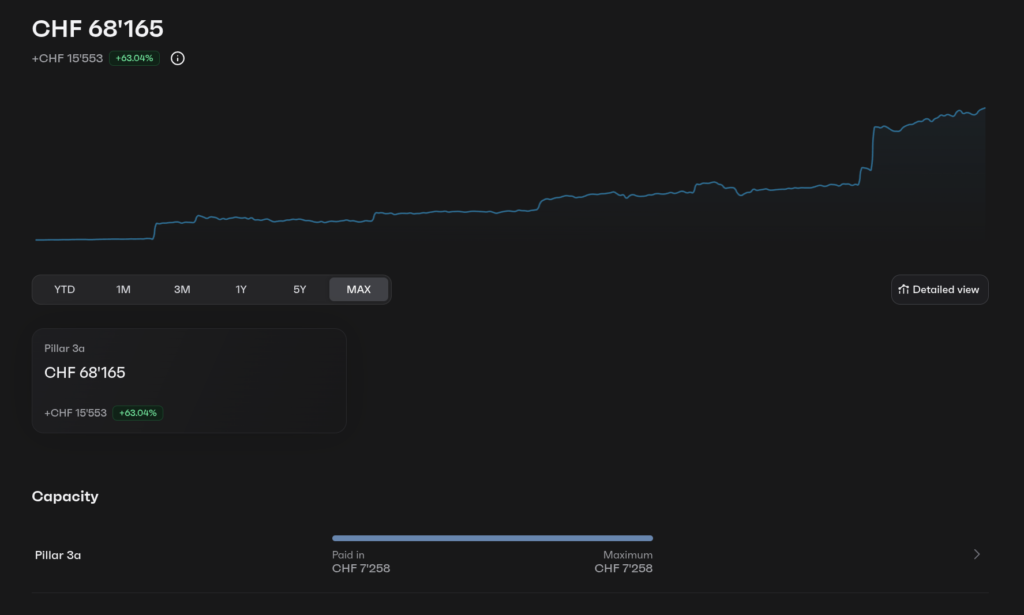
Our 3a strategy is simple. We have all our third pillar at Finpension 3a.
- My own five accounts
- My wife’s five accounts
We have chosen it for the fees first, but they have delivered excellent returns for us over the years.
Each year, we both invest the maximum amount in January (investing each month also works well) in the account that has the lowest amount. That way, our money will get balanced over time.
Conclusion
Finpension 3a is the best third pillar in Switzerland.
Use the FEYKV5 code to get a fee credit of 25 CHF!
- Invest 99% in stocks
Overall, the best third pillar available in Switzerland is Finpension 3a. They offer the highest allocation to stocks and the lowest fees. Moreover, you can create custom portfolios with a high degree of liberty. This makes them an excellent option!
For these reasons, since 2021, we have invested in Finpension 3a instead of VIAC, and I recommend that all aggressive investors do the same. I have five portfolios with Finpension 3a. We now have 10 third pillar accounts (5 for each of us) with Finpension 3a, and we have been happy about the returns.
If you open a Finpension 3a account, please use my code FEYKV5. This code will give you a fee credit of 25 CHF (if you deposit 1000 CHF in the first 12 months) and will help my blog as well.
If you need additional information on these two third pillars, I have an article on VIAC vs Finpension. This article goes more in-depth into the comparison.
What about you? Which is your favorite third pillar?
More reading

VIAC vs Finpension Vested Benefits: Best account in 2026?
Who offers the best return? We compare VIAC and Finpension for vested benefits to see which foundation offers the lowest fees and best strategy.
VZ 3a Review 2026 – Pros & Cons
VZ 3a Review. We analyze the VZ VermögensZentrum 3rd Pillar. Is their active management worth the higher fees compared to VIAC or Finpension?
Selma 3a Review 2026 – Pros & Cons
Selma already offers an interesting Robo-Advisor and they now offer a Selma 3a account. So, we see if you should invest in this third pillar account.
Learn easy ways to optimize your finances and save thousands in Switzerland with our exclusive e-book. Learn about the most cost-effective financial services tailored for savvy residents and expats!
Get Your FREE Swiss Money-Saving Guide
Thanks for your great articles!
If I want to benefit from staggered pillar 3a withdrawals in the future (to minimise the tax), do I need to open several 3a accounts with different providers? Which is ‘next best’ after I’ve reached a reasonable level in a finpension account?!
Hi Mark,
You don’t need multiple providers. You can have 5 accounts with Finpension, this is what I do. You can open a second portfolio from your account.
Hi Baptiste
Thanks. I was reading their FAQ and it’s not clear if they will allow staggered withdrawals:
E.g. here they say you can have multiple portfolios on one account (like you suggest):
https://finpension.ch/en/3a/faq/what-is-the-maximum-number-of-portfolios-allowed/
But here they say only the entire balance can be withdrawn from the account (except for home purchase):
https://finpension.ch/en/3a/faq/can-one-3a-account-be-divided-between-several-3a-accounts/
I suspect this may just be confusing terminology (“portfolio” vs “account”) as they also have a blog post where they discuss staggered withdrawal but I want to be sure I do it correctly.
This is only confusing terminology. Each of the portfolio is its own account. You can only withdraw each “account/portfolio” entirely but you can choose which one you will withdraw and when. Finpension will support staggered withdrawals.
Hi Baptiste, is it worth having multiple 3a accounts, even with different companies? I’ve heard two reasons: taxes when withdrawing money in retirement, diversification. I am assuming one can diversify better using different tools/portfolios, but I am interested mostly in the first argument. Do you have any opinions?
As mentioned in the article, you need 5 accounts but you can (and probably should) have them at the same provider.
Hello! Is there a reason you haven’t addressed the UBS Pillar 3a?
Hi Louis,
There are plenty of bad 3a pillars and very few good pillars available. So I only took a sample of the bad ones and compared it to the good ones. There is no reason to talk about all the bad ones. The custody fee only of the UBS Pillar 3a with funds is 0.65% and that’s without the fees of the funds, so definitely not interesting.
Hi Baptiste,
Why dont you consider in the comparison this find from Raiffeisen? Raiffeisen Futura II – Systematic Invest Equity V
https://www.raiffeisen.ch/content/dam/www/rch/pdf/raiffeisen-anlagefonds/factsheets-fonds/de/systematic-invest-equity-v-de.pdf
hi Alon,
Because it was created after I wrote this article. And with a TER of 0.72%, it is really not great either.
The list I mention here are examples, probably less than 1% of the available 3a in Switzerland.
Hey Baptiste,
General question here. How easy and inexpensive is it to transfer 3a portfolios from one institution to another?
It’s extremely easy. Most recent services can prepare you the letter and then you only have to sign and send the letter.
As for the fees, it’s usually free, but there can be fees. For instance, some services add a fee if you transfer within a year of creating the account. So you have to check the fees of your current 3a.
Dear Mr Wicht
If someone who is employed contributes to the 3rd pillar but does not make a tax declaration (zb because Aufenthaltbewilligung B and <120.000), (how) will he receive the tax benefits? Will the amount that is being deducted from the employer each month be reduced?
Thanks in advance
In that case, he will not receive any tax benefits.
Thanks for your answer. So all in all for those expats with B permit and <120000 is it better to make a tax declaration ( even though it's not obligatory) and contribute to 3rd pillar or just stick with the old fashion DIY investing? What would you suggest?
Unfortunatetely, there is no simple answer to your question: it depends on each situation. Since the tax at source is computed using a different system than a full tax declaration, even with the new 3a deduction, you may end up paying more :(
Overall, I think it makes more sense to wait until you have to fill a tax declaration.
Hi Baptiste. Thank you for your article and the great insights. After reading the article and the comments, I also went down the rabbit hole in regards to the two-tier taxing system that Switzerland has. Oh boy, I never imagined it would be this complicated. Suffice to say, I think you are right. Two great tools that I found and want to share with people are these:
– an ETH calculator to estimate witholding tax: https://ethz.ch/en/the-eth-zurich/working-teaching-and-research/welcome-center/services-and-downloads/salary-calculator.html
– the official federal calculator to estimate how much one would pay in normal taxes with the 3a deduction: https://swisstaxcalculator.estv.admin.ch/#/calculator/income-wealth-tax
I don’t know how accurate my calculations are, so please take it with a bucket of salt, but in most cases, for me (young, single, decently well paid, living in Zurich, EU citizen on B-permit), it seem that paying taxes at source comes out cheeper, and there is not benefit with pillar 3a. Generally, if I maximise all my tax returns (great article on that btw!), I end up almost breaking even between the two systems.
Again, this might be me, and I don’t really know what I’m doing and it is 1am, so it might be different for others, but I just wanted to share this with the community.
Hi Andrei,
Thanks for sharing your findings!
What I have heard before is similar to what you said. You need a lot of tax deductions for the switch to be worht it. As you said, it’s probably different in many situations and cantons. But I think that overall it makes sense.
In the case of the person described above, the tax declaration does not need to be submitted to the canton authorities, but there is a form to declare the pension 3a bank account by the end of March each year, and there are tax benefits.
In Ticino, it takes a while, but the tax benefit I was reimbursed for 2022 is 23% of the individual allowed contribution (6883 CH in 2022). The salary and paid taxes at source are considered, so the tax benefit varies. The TI tax office gave this advice, so the form must also exist in other cantons.
https://www4.ti.ch/dfe/dc/dichiarazione/imposte-alla-fonte-1/richiesta-di-correzione-dellimposizione-alla-fonte
Interesting, I though this was not possible anymore. In the past, it was indeed possible in each canton with a simplified form to claim several tax advantages. But since 2021, they have changed this so that we would have to switch to a full tax declaration.
Here is VIAC talking about this: https://viac.ch/en/article/what-do-pillar-3a-taxpayers-subject-to-withholding-tax-have-to-bear-in-mind/
Are you sure this is still possible in Ticino?
Yes, I am sure. I have just received the letter with my 2022 tax benefit reimbursement. I think Ticino introduced forms in 2021, before they wanted us to submit a letter with several attachments.
Interesting. The change from 2021 was global, but I guess some cantons still offer this choice!
In the Q&A field, there is a question about it in French: https://www.estv.admin.ch/estv/fr/accueil/impot-federal-direct/impot-a-la-source.html
Je vis en Suisse et je suis imposé à la source. J’ai versé des contributions au titre du pilier 3a. Jusqu’en 2020, je pouvais demander une correction de l’impôt à la source. Est-ce que je peux déduire fiscalement ces contributions ?
Oui. Vous devez toutefois déposer une « Demande de taxation ordinaire ultérieure » jusqu’au 31 mars de l’année suivante auprès du service des contributions de votre canton de domicile. Veuillez noter qu’il s’agit d’un délai de péremption donc non prolongeable: si vous remettez votre demande trop tard, il ne sera pas possible d’entrer en matière. Les années suivantes, et jusqu’à la fin de votre assujettissement à l’impôt à la source, les autorités fiscales de votre canton vous enverront automatiquement les formulaires relatifs à la taxation ordinaire ultérieure.
Yes, this is what I mentioned several times. The only way to get deductions I know is to get a full taxation. But you may end up paying more taxes even with the deductions because the two systems are not working exactly the same way.
Hi Baptiste,
i am coming back to you for another question/doubts. For a short term orientation (imaging like to leave Switzerland within next 5 years) Pillar 3a still make sense doing it with Finpension (and exploit tax deduction) or better tu just invest those money (e.g. on Degiro full stocks/ETF)?
Would be the money invested (assuming a +15/20% per year) better than the return of Finpension+Tax recution?
thanks a lot
Hi Alessandro
It all depends on whether you are going to withdraw your 3a or not. If you are not going to withdraw until you are retired, from abroad, then it’s fine.
But if you are going to sell it all in 5 years, it’s probably too short.
It’s impossible to know which is better wtihout knowing your marginal tax rate and your exact portfolio.
Hi Baptiste,
Will I loose any money if I transfer my funds 3a pension from 2022 and 2023 to Finpension?
thank you
Hi Ade,
If you are talking about standard 3a (not life insurance), there are no penalty in general for transferring to another provider. In some cases, there is a penalty if you transfer during the first year of your account.
Regarding Migros Bank:
“They only have three retirement funds for their third pillar offer. The most interesting fund is the Migros Bank Fund 45 V.”
Why you didn’t mention the Migros Bank fund 85 V which has 85% in stocks. Still not great maybe, but why this should be less interesting than 45V?
I did not mention it because it did not exist when I wrote this article.
Hi,
If we were to move out of switzerland, are we able to withdraw our funds from Finpension? We were advised by a tax consultant that SwissLife would be better suited to us over Finpension in the case we leave Switzerland (then we can take out the funds). Also, Swiss Life grants almost 2% for any sitting cash.
Hi Claudia,
Yes, you can take the money out of any 3a. Swiss Life won’t be better for that.
On the other hand, Finpension is not for sitting cash. It’s for investment. If you want to keep cash idle, then you can choose between a plethora of 3a.
Thank you for your thoughts. This is the Factsheet that we were recommended. On first look if we do want to keep some cash idle what are your thoughts on this? The fees are apparently kept at 0.4% and we are told there aren’t any more hidden fees. The funds also seem quite diversified but would love your thoughts on it.
https://www.swisslife.ch/en/private/produkte/vorsorge-vermoegensaufbau/anlegen/fundinfodirect.html
Hi Claudia,
If you want to keep cash idle, use VIAC with 0% fees. Swisslife does not compare with Finpension or VIAC.
Your link points to the list of funds, not to a factsheet.
My apologies. For clarity we are referring to the “Swiss Life Dynamic Elements Portfolio Global Equity”. Fund Info: https://www.swisslife.ch/en/private/produkte/vorsorge-vermoegensaufbau/anlegen/fundinfodirect.html
We could invest 100% but there is the option not to and Uninvested capital gets 1.9% interest. But thanks for clarifying that Finpension and Viac are not comparable to SwissLife.
If you are only paying 0.40% per year (i doubt that with Swisslife), it’s indeed not a bad fund, but held inside a life insurance, it would still be bad in my opinion.
Thanks for a useful article.
I have been contributing the max amount to the Swiss Life FlexSave Duo scheme but cannot figure out how much is being invested in sticks and what their management fee is. Benefits include a guaranteed payout and life and disability benefits in addition to any returns on the performance of the index they invest it. How can I compare this scheme against the two mentioned in your article. Also, is it easy to switch from one provider to another?
Hi Ahmed,
Swiss Life FlexSave Duo is a life insurance policy, I believe. You should read my article about life insurance 3a.
Hi,
It’s a 3A that I have been paying into for several years. May have life insurance and a guaranteed payment built into it but definitely a 3A as I claim a tax reduction for it.
I meant that you cannot compare a life insurance 3a with an invested 3a. They are extremely different products.
Hi Ahmed. I aldo used to have swiss life flex duo. After doing some research I realized it’s a very bad product, I transfered it into VIAC and took my losses. You should to the same.