
How to file your taxes with Swiss and foreign securities in 2026
| Updated: |
(Disclosure: Some of the links below may be affiliate links)
One question I often get is how to file taxes with stocks and dividends. This becomes especially popular when we add foreign stocks and dividends to the mix.
Many people are afraid of investing because they think it will make filing their taxes complicated. But in practice, it is not complicated to file taxes even with a large ETF portfolio.
In this article, we see how to file your taxes with Swiss stocks and dividends, which is very simple. And with US stocks and dividends, which is slightly more complicated.
Filing taxes
In Switzerland, taxes are different for each canton. Each canton has its software and forms to complete your tax form. However, most of the forms are very similar and have similar names. So, if you can file your taxes in one canton, you should not have many issues filing them in another.
Since taxes differ in each canton in Switzerland, I need to take an example. So, I will take Fribourg as an example with the Fritax 2020 software. You can use this example to file your taxes for your canton. The concepts should be the same for each canton, but the software to fill them will differ slightly.
Some Swiss tax apps are better than others. I have not tested many of them, but from what I have seen, Fritax is probably average. It is not always intuitive, but it is relatively easy to use.
Unfortunately, Fritax is not available in English. So I will use the French version for my screenshots. The forms will be the same in German as well.
If you do not know why I am using US ETFs, you may want to learn about the advantages of US ETFs. They are related to how you will file your taxes with US securities.
Swiss Securities
First, we start to see how to declare Swiss securities. These are the securities that are subject to the Swiss dividend withholding taxes. Indeed, the Swiss tax office will withhold 35% of the dividends. Your broker will do this directly.
In your tax declaration, you will have a form to enter all your assets (bank accounts, bonds, stocks, and lottery gains). In my French software, this is called “Etat des titres”, which translates to “Status of the securities”.
Here is the form before filling it:
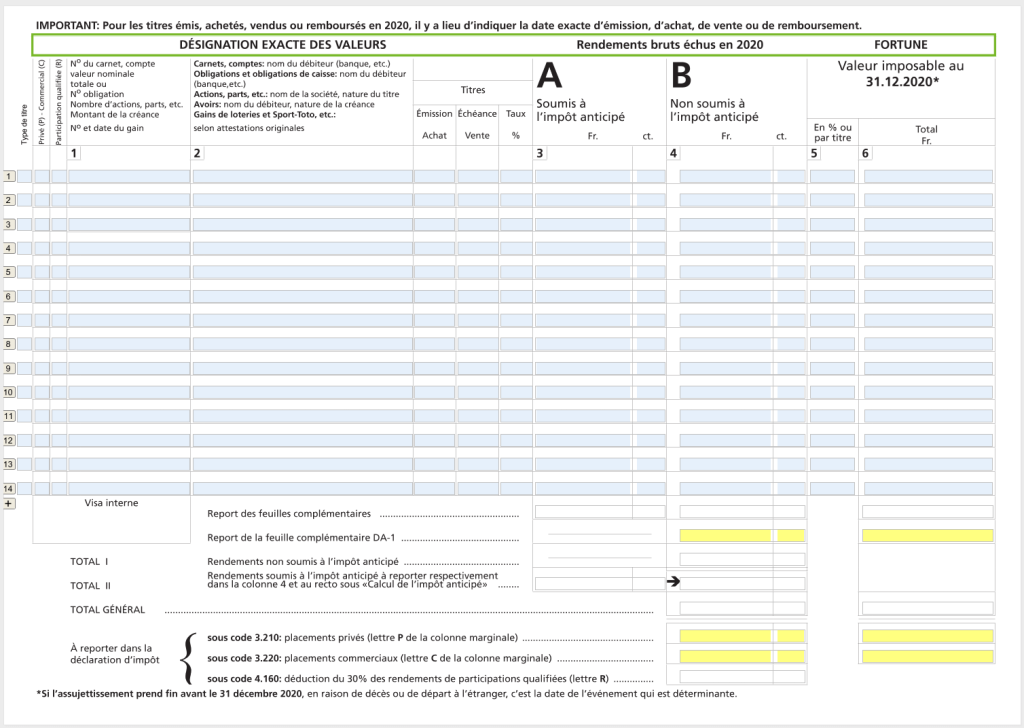
In this form, you must list all of your Swiss securities, whether stocks or ETFs. Since I am recommending investments in ETFs, I will take an ETF as an example. But you would do the same with a stock. For example, I will use CHSPI, the Swiss ETF I use in my portfolio.
You must indicate this is a security (choice 3) in the first column on each line. You must then indicate that this is a private asset (choice P) in the second column.
Then, you can press the “Listes des cours” (Lists of prices) to search for the prices of a security. This assistant will help you with your dividends and prices. You can enter the ISIN number of your ETF and press search (Chercher). For instance, the ISIN number of CHSPI is CH0237935652. You can find the ISIN number of each ETF on the website of the fund provider.
Then, you will see all the taxable income for this security. You can enter the number of shares, the buy date, and the taxable value, and the taxable dividend will be calculated for you. For instance:
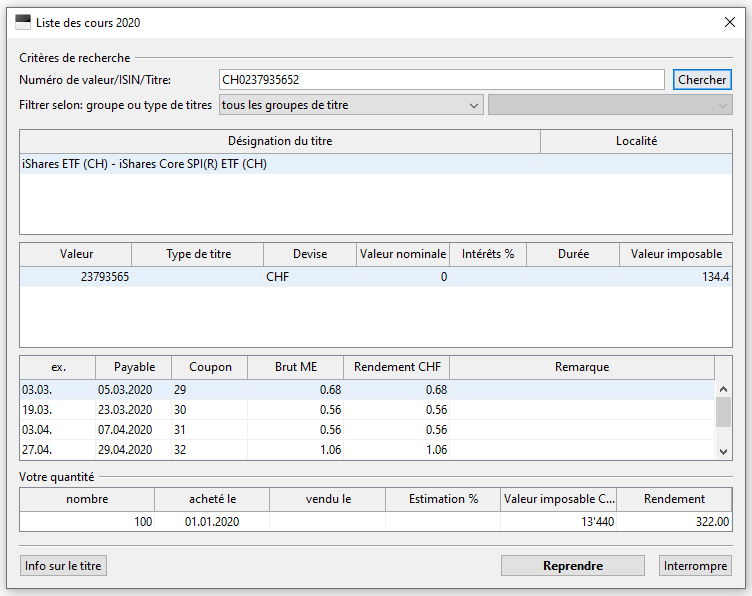
The date will be considered to compute the dividends for this security. If you enter a date that is after some dividends have been issued, they will not be considered. And they will automatically compute the taxable wealth with the security value at the end of the year.
Here is an example of what this could look like.
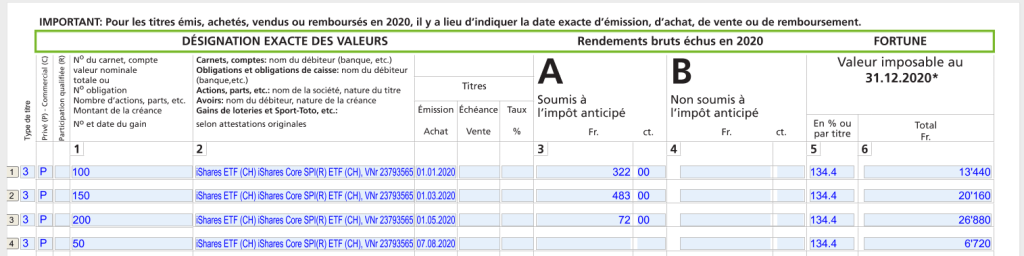
The totals are automatically done at the end of the form. And these values are propagated into the rest of the forms.
If you already have securities before the beginning of the year, you have two options. If you file your taxes right after the year without losing your tax declaration, you can keep all the buy operations from the previous year. Or you can use the total number of shares at the beginning of the year with a single entry and a date like the last year of the previous year. I have already done that in the past, and I have never had any issues.
If you have sold securities during the year, you must also declare them. You can use a purchase date and sold date to let the software compute how many dividends you received before selling the shares. In that case, the software will automatically set the taxable value to zero.
Using ICTax
Unfortunately, not every Swiss tax software allows you to get all these numbers inside the app. So, in this case, you will have to use the ICTax website. This is the reference for all the official end-of-year prices and currency conversions to file your taxes. One good thing is that this website is available in English, contrary to the tax software.
You can go to the website and search for the ISIN again:
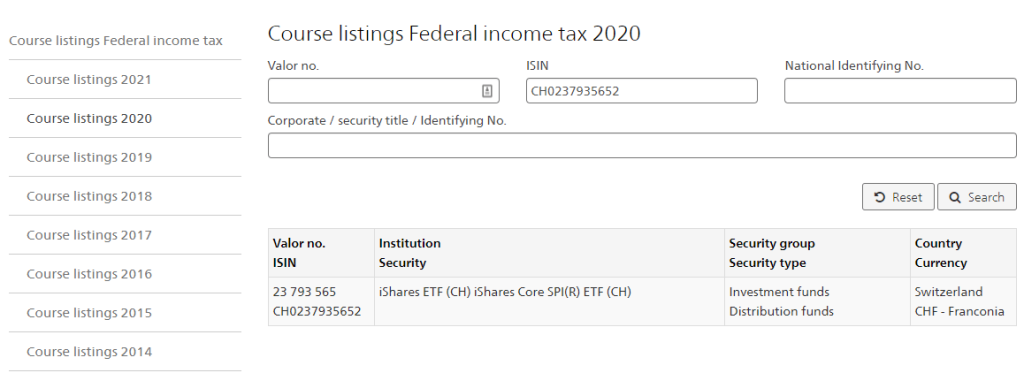
And then, you can click on the ETF of your choosing. After that, you must do the same as before with the tax software. You will be able to enter the number of shares and purchase date. The website will automatically compute the tax value and the gross return. You can then copy these values directly into your tax declaration.
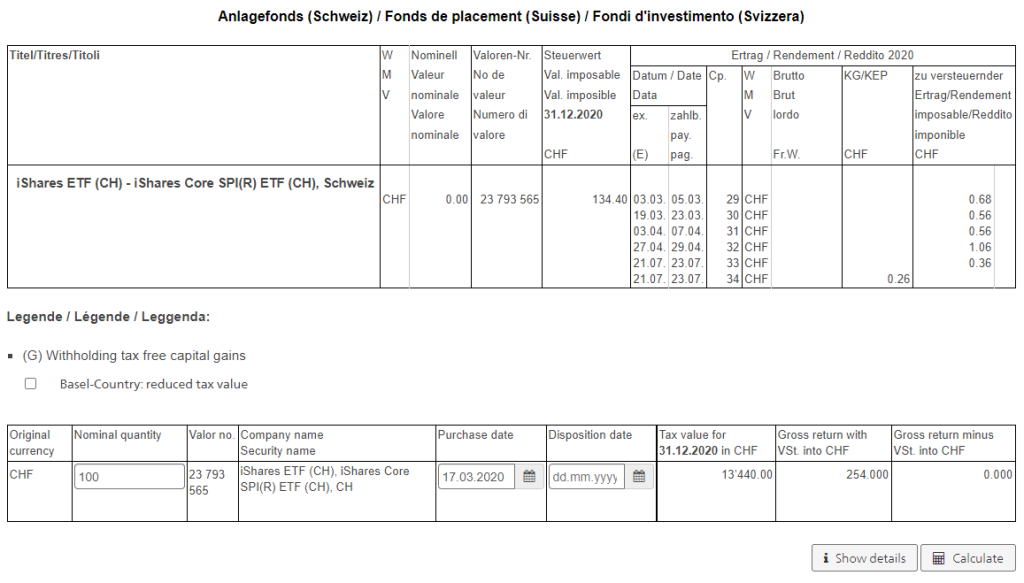
It is much less practical to file taxes like this than having the software do it for you. But in any case, it should not take you long to complete your Swiss securities.
It is also a good reason to keep your trading limited to a few ETFs. If you are buying many securities during the entire year, you will have to enter many lines. But it is not as complicated as many people believe.
If your ETF is not on ICTax, you can ask them to add it to the system. But most well-known ETFs should already be there. I have never had an issue so far.
US ETFs / Securities
For US ETFs and securities, it can get a little more complicated because there are a few possible cases.
First, it will depend on which broker you are using. If you are using a Swiss broker, you will pay two deductions:
- 15% withheld by the Swiss broker
- 15% directly withheld at source by the Internal Revenue Service (IRS)
If you are using a broker like Interactive Brokers, you will only see the IRS’s direct deduction. This is a foreign tax.
You need to use the DA-1 form to claim back foreign tax. You need to use the R-US 164 form to claim back Swiss withholding if you use a Swiss broker.
These forms are attachments to the form we covered in the previous section. And they are extremely similar. The difference will be in setting the percentages that you can claim back.
If you use other foreign securities, the idea remains the same, except that the percentages will differ. You will have to find the percentages for both columns for your situation.
In this case, Fritax did an excellent job since they put DA-1 and R-US 164 together. Therefore, there is only a single form to fill for foreign securities. This is a great idea!
Here is the empty combined DA-1 / R-US 164 form:
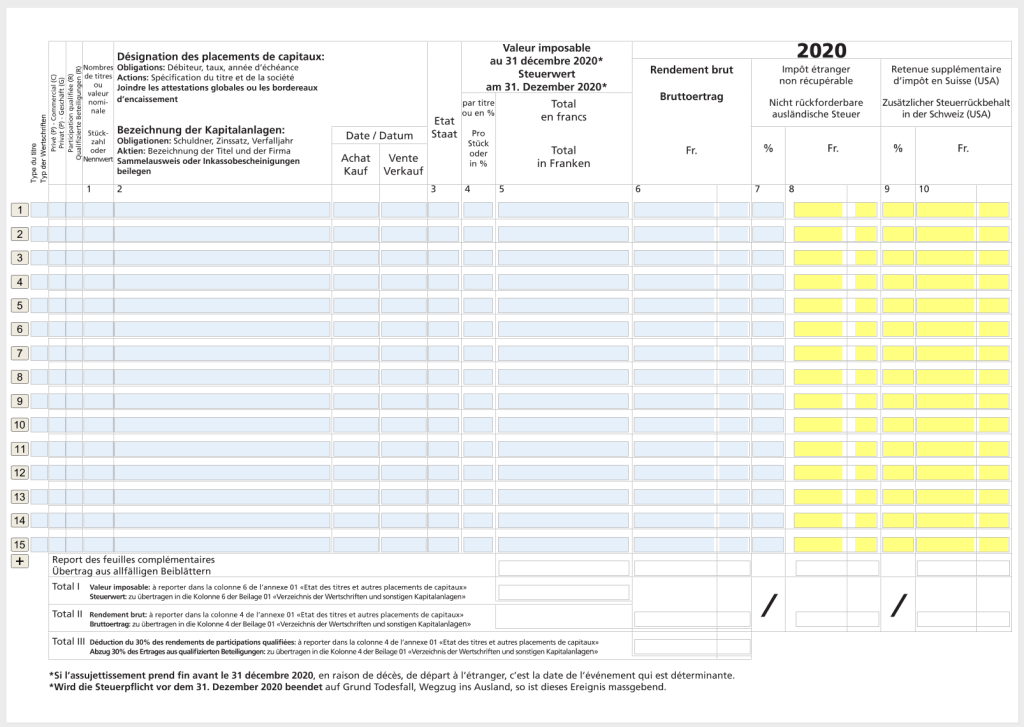
As we can see, it is extremely similar to the previous form. And it works exactly the same way. You must still select that this is an action and part of your private net worth. Then, you can use the same assistant to get all the tax information by pressing the “Liste de cours” button on top of the form.
They have all the information, even for US ETFs, such as Vanguard Total World (VT). Here is an example of how to fill it with VT:
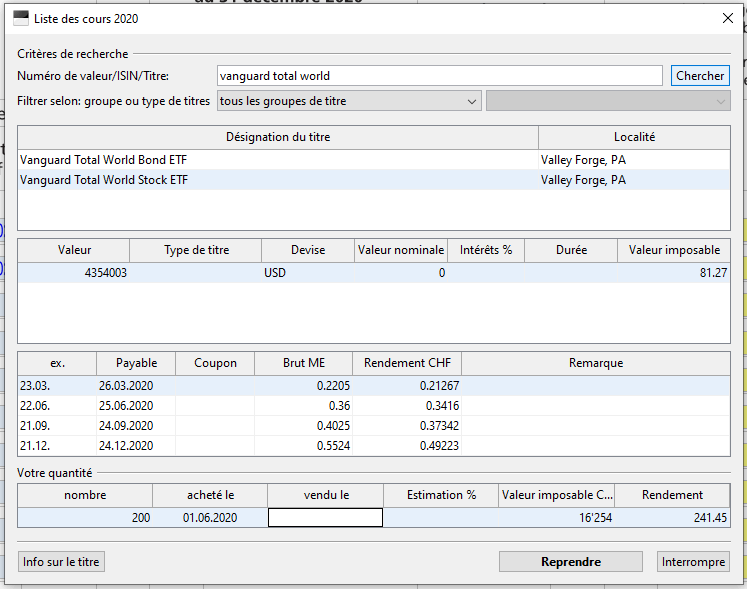
Once you have filled a line, you still need to select the country in column 3. This will be the US in our case.
Then, you need to update columns 7 and 9 with the percentages for your case. If you only fill the DA-1 form (with Interactive Brokers), you must set column 7 to the value 15. If you are filling out the R-US 164 form (with a Swiss broker, for instance), you must set column 9 to the value 15.
Then, the tool will automatically compute how much taxes were withheld in both cases. And Fritax will automatically fill in the total.
Here is a filled DA-1 form with both sides filled:
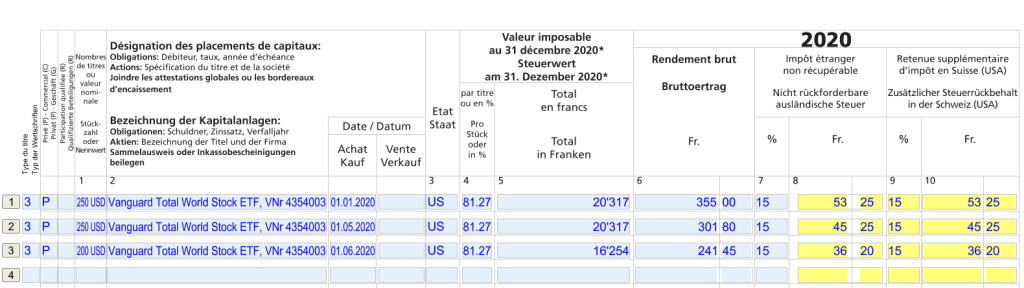
If you use Interactive Brokers and only pay 15% of dividends withholding, you can change column 9 to the value 0.
All the other details are the same as for the Swiss securities, so you can look at the previous sections to get all the information. But with the Fritax software, it is not that bad to file your taxes with foreign securities. As you can see, the DA-1 and R-US 164 forms are almost the same as the standard securities form.
It is important to note that the DA-1 deduction is generally only applied if you have more than 100 CHF in foreign withholding. It does not change how you file your taxes, but knowing this may avoid a surprise when receiving your tax decision.
Using ICTax
If your tax software does not support getting the values directly from it, you can use the ICTax website for foreign securities too. It will give you all the dividends in CHF and the tax value of your securities at the end of the fiscal year.
This will be done exactly like we did for Swiss securities. For instance, you can search for Vanguard Total World on the website:
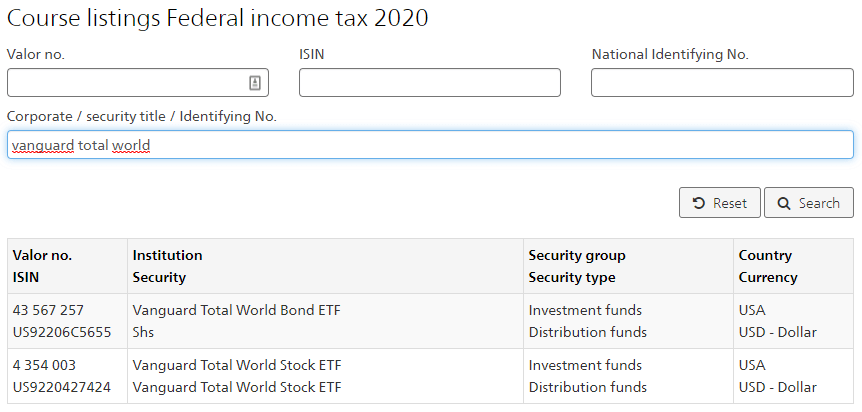
Make sure you choose the Stock version and not the bond version (unless you have both, of course). And then, you can fill it up like before. For instance:
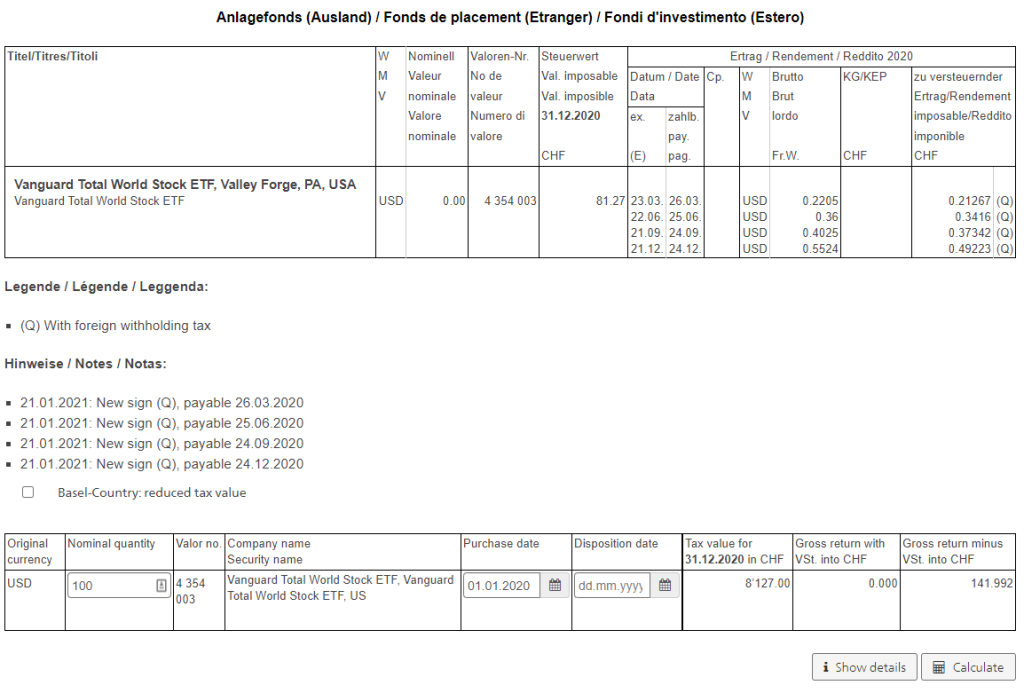
Then, you will only have to copy these values into the DA-1 or R-US 164 form and select the correct withholding percentages. It is not more complicated than for Swiss securities.
Attachments
The tax office will request documents attesting to your dividends, capital gains, and net worth.
Some Swiss brokers will propose some special documents for taxes. And some people believe that only these reports are valid. But that is not correct. Even foreign brokers have documents that Swiss tax offices accept.
For instance, I use an annual activity statement report with Interactive Brokers. This contains all operations, all dividends, and the status of my shares at the end of the year. I have never had any issue with that. You can get this from the Reports tab. In there, you can generate an activity statement for the entire year.
Conclusion
There you have it! Following these simple steps, you can file taxes with Swiss and foreign securities! It is not as complicated as many people believe.
Even for US securities, it is not complicated. You must fill out an extra form (DA-1) in the best case and two in the worst case (DA-1 and R-US 164), but these forms are almost the same as for Swiss securities. So, I do not think this is a big deal.
If you are wondering why we need to fill all these lines, it is for the system to compute exactly how much you got from dividends. Since dividends are taxed as income, this must be precise. And only by indicating each buy and sell date will you get a precise amount.
Hopefully, this will help you file your taxes with securities.
If you want something even simpler, you can use an e-tax statement. Some brokers (Saxo, for instance) will provide it for free. Some other brokers (Swissquote) will charge you for this. And while Interactive Brokers does not provide it directly, there is a nice way to generate e-tax statements from your IB account.
If you want more tax information, I have an in-depth guide about Swiss taxes.
More reading

Investing Fees could cost you your early retirement!
Fees kill returns. Learn how TERS, custody fees, and transaction costs eat your profits and how to minimize them to maximize your wealth.
Financial advisors – Do not get ripped off
Do you need advice? Learn the difference between fee-only and commission-based financial advisors and how to spot a salesperson in disguise.
How to Choose an ETF or an Index Fund
ETF or Index Fund? Learn how to choose the right passive investment vehicle, understand Total Expense Ratios (TER), and build a solid portfolio.
Learn easy ways to optimize your finances and save thousands in Switzerland with our exclusive e-book. Learn about the most cost-effective financial services tailored for savvy residents and expats!
Get Your FREE Swiss Money-Saving Guide
I had the same issue as Laura with Schwyz last year.
Previously my broker was in Europe. I filled in a W8BEN form with them and they deducted 15%.
The cantonal tax office sent me the same message as Laura.
I moved all my US dividend shares to Swissquote and filled in a new W8BEN form with SQ.
Now SQ deduct 2 sets of 15%. I believe if I did not file a W8BEN form with SQ, they would actually take 30% + 15%.
I have found it very hard to actually get to the bottom of this but will see on my next tax return.
I expect that I will get a “credit” from the SZ tax office for the 15% (DA1) and a “refund” of the second (Steuerrückbehalt) 15%. To get the Steuerrückbehalt 15%, I will need to provide the statement from SQ. This would not be possible with an oversease broker who only deducts the DA1 15% but not the “Steuerrückbehalt”.
If they deducted 15%, you can claim 15% withholding tax on your DA-1, not the additional 15% Steuerrückbehalt USA because that never happened… And IBRK only deducts the 15% withholding tax if you have a W8BEN filled out with them. So obviously you can only claim 15% with the tax authorities, not 15 + 15.
In the Zurich tax software if you enter a security in the DA-1 form there is a question “Does the bank statement mention “Steuerrückbehalt USA”? yes or no. If you click yes, it will fill in the column withholding tax AND the column Steuerrückbehalt. If you click no, only the former. Yes would be for example if you invested with Neon. No for anything I bought with IBRK.
Hi PatG,
That’s really weird.
I think that SQ only does 15/15 and then you can reclaim both in DA-1 / R-US forms.
It’s correct that with a foreign broker, you should only get 15% but you should be able to reclaim the 15% entirely in each canton.
Hi Baptist,
The authorities mentioned the following: “Bitte beachten Sie, einen Steuerrückbehalt USA ist beim Interactive Broker Depot nicht möglich zurückzufordern, dies ist nur bei Schweizer Depots möglich.”
Seems like they’re saying I can’t get back the 15% from IB. Would you mind helping me understand where is perhaps the disconnect if you know what they can be meaning?
Thanks so much!
Laura
Hi Laura,
I think that’s wrong. If you use IB, you should be able to reclaim 15% (not 30%) of the dividends with a DA-1 form. I have done that every year in the last five years without any issues.
Maybe some cantons are starting to have other rules, but I don’t think that would be fair.
You should try to contact them to discuss the issue further, maybe it’s a mistake in the tax declaration that led to this misunderstanding.
That’s because in IBRK if you filled in a W8BEN there IS no “Steuerrückbehalt USA”. You can’t get back what was never taken from you. You can only claim the 15% withholding tax from US stocks in IBRK.
Oh, you were trying to reclaim the wrong 15% with IBKR, maybe, Laura?
Thanks you both for helping me understand this. I really appreciate it!!!
So, what happens is that I emailed them to ask how to fill in the etax because the columns did not match exactly the ones you have as example here and I was not sure wether to add on the 15% option (the options are: Anrechnung ausländischer Quellensteuern in %, Anrechnung ausländischer Quellensteuern in CHF, Steuerrückbehalt USA in CHF). My German is not great for this level and the translation was not exactly clear to me.
In their answer they said: “Die Beträge finden Sie auf den Dividendenabrechnungen und sind anhand diesen auszufüllen. Die Dividendenabrechnungen sind ausserdem beizulegen. Ob Sie einen Betrag einfüllen oder das Feld mit den 15% ausfüllen spielt keine Rolle. Wenn Sie die Prozentzahl eingeben, wird der CHF Betrag automatisch ausgefüllt.
Bitte beachten Sie, einen Steuerrückbehalt USA ist beim Interactive Broker Depot nicht möglich zurückzufordern, dies ist nur bei Schweizer Depots möglich.”
Since my question had been where to reclaim this 15% (I never asked about a US tax), I took their answer to mean that I cannot reclaim 15% with IB, but only with Swiss “Depots”.
Do you mind helping me understand if perhaps I am misinterpreting them and how/if I could reclaim this 15%?
Would it be adding 15% under “Anrechnung ausländischer Quellensteuern in %”?
Thanks so much and hope this helps others :)
In your DA-1 form, you should have a column for foreign withholding and you should be able to tell for each of you assets in this form from which country they are in. In this form, you should declare 15% of dividends withholding done by the US on your US assets.
Unfortunately, each canton has its own tax software, so it’s difficult to map out exactly how they work from one to another.
Thanks so much!
Well there are only 3 options to fill in in the “Titel im Formular DA-1/USA deklarieren”:
– Anrechnung ausländischer Quellensteuern in %
– Anrechnung ausländischer Quellensteuern in CHF
– Steuerrückbehalt USA in CHF
Do you think the way to get the 15% refund on the withheld taxes from the US would be 15% under “Anrechnung ausländischer Quellensteuern in %”? Is this what this relates to then?
Many thanks!
I mean, they told you what to do: you can fill in either of the first two columns, it doesn’t make a difference if you put in the exact tax amount or put in the relative amount (15%).
You cannot fill in the third column, that is only applicable if you hold US shares in a Swiss broker account.
I’m not sure what is not to understand about the sentence mentioning specifically one of three column names (Steuerrückbehalt USA) being impossible and why you jump to the conclusion you can’t claim ANYTHING back.
Hi Baptiste! Great article, again.
One question, in your experience filing and submiting the DA-1 , how easy/fast is to get the WHT money back?
Do you usually get it back quickly? And how does it works, is it the IRS who transfer the money to your personal bank account or via the broker?
Thanks
Jaime R
Neither, it gets taken into account on the following years tax returns and are thereby “transferred” by the tax department of your canton.
Hi Jaime
In my experience, it’s very easy and as fast as receiving your taxes (which may be slow). But in my experience, the DA-1 does not add delays.
There is nothing from the IRS, it’s all handled by the canton and you simply have to pay less taxes (this may vary per canton).
I know that some cantons are more complex than others. Vaud seems to have complex rules about it for instance. But at least in Fribourg, it’s easy.
Hi Baptiste,
Thanks so much for your incredibly helpful blog. I have a couple of questions concerning the tax declaration. I use IBKR as a broker as it’s the cheapest. However, I invest in EU-based and not US-based ETFs, namely SSAC, XDEM, XDEQ, XLPE. So, a couple of questions:
– Is there anything to be done specifically in terms of withholding taxes, or is this not necessary as these are EU-based?
– How can I make the dividends appear in the IBKR statement? All of my ETFs are accumulating, but unless I’m wrong, I’d need to declade the dividends nonetheless. In any case, if I put the value of the asset at the end of the year in my tax software (Kt LU), it automatically calculates a “Bruttorendite”. This calculated one is much higher than in reality though, because I DCA and the number of any given asset at the end of the year was not the same throughout. So how do I find out how much I actually received? Does IBKR not show this?
I hope you understand what I mean. Thanks and looking forward to your reply.
Dario
Hi Dario,
1) There is nothing to be done regarding US withholding tax since you cannot reclaim the 15%
2) You cannot make the dividends appear. For IB, the ETF is accumulating, it does not know about the dividends. It is simply is not its responsibility to do that. The tax software should do the necessary computation based on the data for ICTAX if your ETFs are in ICTAX. If you have bought multiple lots, you will need to separate each lot based on the buy date so that the software can compute it properly.
* Do your ETFs appear in ICTAX?
Hi Baptiste,
Thanks so much for this! It helps to get started.
on the “Titel im Formular DA-1/USA deklarieren” (for US ETF), do I need to write 15% under the “Anrechnung ausländischer Quellensteuern in %”? Under this section “Titel im Formular DA-1/USA deklarieren”, I only see 3 options for filling out:
– Anrechnung ausländischer Quellensteuern in %
– Anrechnung ausländischer Quellensteuern in CHF
– Steuerrückbehalt USA in CHF
Thanks a lot for the help!!!
Hi Laura
You are welcome.
Yes, I think you should write 15% there. And then (hopefully), the software should fill up the CHF value based on your shares.
But keep in mind that I am only familiar with the Fribourg software, the tax office can generally help you better than I for other cantons.
Many thanks for the reply :) I will e-mail the tax authorities to enquire.
In case I had some “Chash” left over in interactive brokers which I did not manage yet invest by the end of the year, would you happen to know if I should declare it separately as a normal bank account or should this live somewhere else?
Thanks again!
Hi Baptiste,
When you know that the DA-1 refund amount will be less than 100.-, should you still fill out all this info about DA-1?
Or can one just skip this and do it in a year where the amount is >100.-? As I understand the only reason to fill the DA-1 is to get money back so it should be fine to not claim it, no?
Hi Peter,
I believe you still have to because you are still taxed on the dividends. As long as the dividends are declared, you should be fine though.
Actually, I just witnessed that ZH tax software complains and forces you to move it out of the DA-1 into the WV (Wertschriftenverzeichnis) if the amount is <100. Let's hope that's the last year this problem (<100 WHT) comes up for me. ;)
Very interesting, I had no idea this was the case. In Vaud, this is refused later on but not on software. This makes more sense on the software level to avoid surprises later on.
I hope you will reach the threshold next year!
Dear Baptiste,
First of all, I appreciate the time and effort you put into explaining these complex topics. Your insights have been incredibly helpful, and I’d like to ask for some clarification on a few points.
I am very new to this topic, and my question might contain some incorrect assumptions. I am trying to learn, so please feel free to correct any mistakes in my understanding.
I’m looking for general information about how withholding tax works for U.S.-domiciled ETFs and U.S.-based brokers. However, to illustrate the situation more clearly, I will use the example of VOO (Vanguard S&P 500 ETF) and Interactive Brokers. If my understanding is correct, the same principles should apply to any U.S.-domiciled ETF and any U.S.-based broker.
First, about the W-8BEN form:
– Who fills out the W-8BEN form when investing in VOO through Interactive Brokers?
– Is it filled by each individual investor who buys VOO or who has an account in Interactive Brokers, or is it handled at the fund level by an entity like Vanguard or Interactive Brokers globally covering all individuals?
– As an individual investor, am I required to take an active role in filling out and submitting this form, or is it entirely managed by the broker or ETF issuer?
Now, let’s go step by step with numbers to understand the withholding tax process:
(This is my understanding, and it might contain incorrect information—please correct me where needed.)
– I am a Swiss tax resident, investing in VOO through Interactive Brokers.
– Apple pays a total dividend of $100 per stock this year (just as an example).
– This dividend is paid to Vanguard, which holds Apple stocks inside VOO.
– Since Vanguard is a U.S. entity, no withholding tax is applied at this stage, so Vanguard receives the full $100 per Apple stock in dividends.
Now, when Vanguard distributes this dividend to VOO shareholders, withholding tax may apply. Let’s assume:
– 1 share of VOO contains 0.01 stocks of Apple (just as an example). Therefore, the portion of Apple’s dividend that corresponds to 1 share of VOO is $1.
At this point, withholding tax is applied based on my tax residency:
1) If W-8BEN form is submitted (whoever the entity that is supposed to send it), I should qualify for the U.S.-Switzerland tax treaty rate of 15%.
– When Vanguard distributes the $1 dividend, the IRS applies a 15% withholding tax before the money reaches me.
– The IRS withholds $0.15, and I receive $0.85 in my Interactive Brokers account.
2) If W-8BEN form is NOT submitted (whoever the entity that is supposed to send it), the default 30% withholding tax applies.
– When Vanguard distributes the $1 dividend, the IRS applies a 30% withholding tax before it reaches me.
– The IRS withholds $0.30, and I receive $0.70 in my Interactive Brokers account.
My questions:
1) Is my understanding of the withholding tax process correct?
2) If not, at which exact point in the transaction flow is the withholding tax applied?
3) Are there any other withholding taxes applied at any other stage of the transactions between different entities that I didn’t mention?
Thanks in advance for any clarification!
Can
1) Your understanding is quite correct!
3) No, not for US ETFs.
The W8BEN is filled by you, through the broker. It should only be filed once, but the broker will regularly make sure that it’s up to date so that you are still eligible. But you have to tell the broker (during onboarding or in the settings) that you are eligible for a tax treaty.
Dear Baptiste,
Thank you for confirming my understanding.
I would like to explore another case, which involves a U.S.-domiciled ETF with investments in countries outside the U.S. We can take VXUS (Vanguard FTSE All-World ETF) as an example. Unlike VOO, VXUS holds stocks from companies outside the U.S., such as Toyota from Japan. My question is focused on the dividend payments from companies outside the U.S. (such as Toyota), particularly when those dividends are paid to an ETF that is domiciled in the United States, in this case, VXUS.
In the case of Toyota, for example, when the dividend leaves Japan and is paid to Vanguard, does Japan apply any withholding tax on the dividend before it reaches Vanguard in the U.S.? I am particularly curious because, unlike the U.S.-domiciled companies (like Apple), the transaction is taking place internationally. (As a reminder from my previous post, when a U.S. company paid dividends to a U.S. domestic ETF, no withholding tax was applied in that transaction.)
Here are some more specific questions I’d like to understand:
1) When the dividend leaves Japan and enters the U.S., is there any withholding tax applied (by the Japanese government or any other entity)? If that’s the case, I assume the withholding tax rate would vary from country to country. For example, the rate would likely differ if the dividend is paid from Switzerland or the U.K. to the U.S. Can you please clarify this?
2) If withholding tax is applied, which entity is responsible for requesting a reimbursement? Could it be Vanguard, or is it up to me, as the investor, to request the refund? Or is it impossible to reimburse this withholding tax?
3) If withholding tax is applied, and it’s already deducted before I receive my dividend, is there any way that I can ask for reimbursement of this withholding tax as it passes through multiple borders (Japan -> U.S. -> CH)? If that’s the case, am I responsible for actively requesting reimbursement? If so, is it done via the DA-1 form, or is there another method?
4) If the response to the third question is yes, it is my responsibility as a tax owner to ask for this reimbursement and there is a way to do it, wouldn’t it be a very complicated task because many different countries would apply different withholding tax rates?
I do have another question, but I believe it will be shaped better based on the answers to these questions. Any clarification you can provide would be much appreciated.
Thank you again!
Hi Can
I do not know of the details of this specific case. The reason I focus on US is that they make up 65% of the stock market, so it’s really important to optimize for their dividends.
The only thing I know is that you do not have to reclaim anything for any other country if you use a US ETF. It may not be the most efficient for Japanese stocks, but I have not delved deep into this.
Dear Bapiste,
I’m adding my thanks to others for the huge effort :).
I’ve been following your instructions and I’ve got no issues until I had to declare my VEUR shares (based in Ireland).
In what category would you declare them in your tax form? Any particular thing to take in consideration?
Thanks,
Tommaso
Hi Tommaso
I am glad you like it.
I should add Ireland shares in this article. I have never held them myself.
I would simply put them with the Swiss shares but say they are not subject to withholding tax.
Dear Bapiste,
Thanks a lot for your valuable insights in this complex matter.
I am resident of Switzerland & Swiss taxpayer, I started investing via IBKR. I am mainly investing in VOO, VGT & IJR as ETF. I currently don`t need any dividend income & I am completely fine in reinvesting them to back in ETFs. Do you think with this strategy we could save on withholding taxes on dividends at US?
I quickly checked for options and came across Vanguard S&P 500 UCITS ETF (USD) Accumulating, but it seems this fund is domiciled in Ireland and you have to still pay 15% witholding tax on dividends..
As I said, I currently dont need any dividend income and i am completly fine in reinvesting directly at source, so if you pls have any other suggestions they are very welcome!
Hi Yash
No, you can’t. Reinvesting dividends does not save you any income tax in Switzerland.
Hi!
Thanks for your guide.
I still have a question.
How can I know if for a specific stock the Withholding Tax is refundable with the DA-1?
In particular I have in my portfolio both VOO ETF (US9229083632) and VXUS ETF (US9219097683) and for both of them I see that Interactive Brokers removed 15% from my dividends.
Now I am trying to declare them under DA-1 stocks in Canton ZH. I can do it for VOO but when I try to do the same for VXUS the system tells me “stock not found”. Do you think that VXUS is not refundable using DA-1 or is simply less known?
Thanks a lot for your help!
Enrico
Hi Enrico
The rule should be easy: Every US stock and US ETF, paying a dividend, is impacted.
In this case, it’s not a problem for refund, but a problem of ICTAX. If you search VXUS, you will not find it, but if you search by ISIN, you will find it. At least, I can on the ICTAX website. If you still cannot find it in the ZH software, you will have to ask the ZH Tax Office.
Be also careful that searching for VOO does not yield the proper ETF.
Thanks!
I searched it using ISIN number but I still can’t find it in the da-1 section of the ZH software.
I had doubt since it is a US-ETF trading not US companies. But if you tell me that it has the same tax behavior as VOO I will simply enter it manually!
Thanks for you time and answer.
Interesting. You can always send an email to their office to be sure. But in theory, you should indeed be able to enter it manually. And you can verify the data on ICTAX: https://www.ictax.admin.ch/extern/en.html#/security/US9219097683/20201231