
radicant Review 2026 – Discontinued
| Updated: |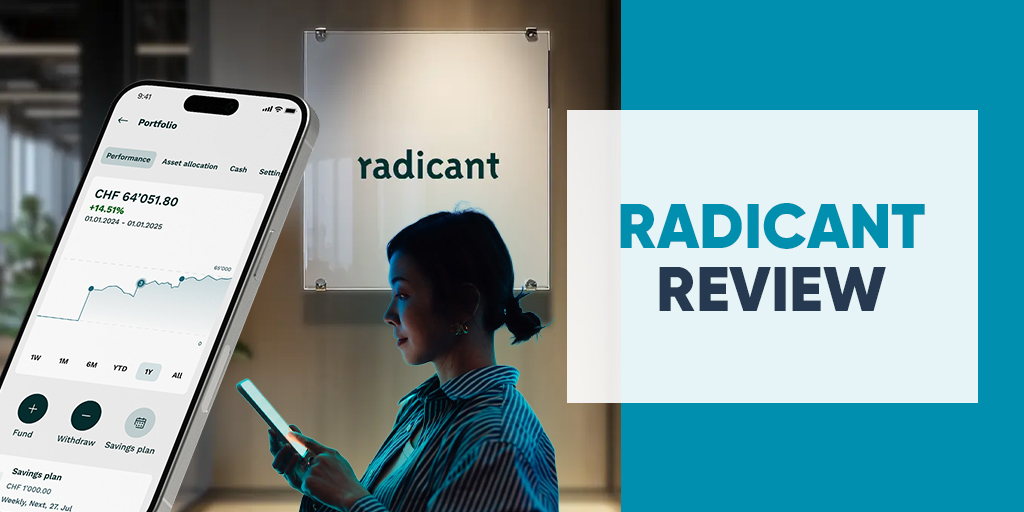
(Disclosure: Some of the links below may be affiliate links)
Update November 2025: Radicant is being closed down and does not accept new customers anymore.
radicant is a new digital bank with banking and investment features. It is a subsidiary of Basel Land Kantonal Bank and aims to be the most sustainable digital bank in Switzerland.
In this review, we will see precisely what radicant is and how it compares with similar offers. By the end of this review, you will know whether you should use radicant.
| Monthly fee | 0 CHF |
|---|---|
| Users | N/A |
| Card | Virtual and Physical Visa Debit on-demand |
| Currencies | CHF and EUR |
| Withdrawals in Switzerland | 12 Free per year, then 2 CHF |
| Withdrawals abroad | 2 CHF |
| Currency exchange fee | 0.00% |
| Investing fees | 0.90% – 1.30% |
| Languages | English, and German |
| Custody bank | radicant |
| Depositor protection | 100’000 CHF |
| Established | 2023 |
| Headquarters | Zürich, Switzerland |
radicant
radicant was created as a subsidiary of the Basel Land Kantonal Bank (BLKB). However, they act independently. In 2022, radicant got a banking license from FINMA.
A beta was launched in March 2023. In August 2023, the app was launched to the public.
radicant is only available as a mobile app on Android and iPhone. They claim they are 100% in the cloud (in Google Cloud, Zürich, with a backup in Frankfurt). They want to break even by 2027/2028.
Currently, the app is only available in German and English. You need to be a Swiss or German resident to open an account. And the account opening is limited to some citizenships (mostly in Europe).
So, let’s see what features and fees this new digital bank account offers its users.
radicant Banking Features
First, we should look at the banking features.
radicant offers all the essential features that each bank account provides:
- Receive money.
- Send money to other bank accounts.
- Pay bills (QR bills and standard transfers).
- View the balance of your account.
- View the transactions from your account.
On top of that, the rest of the features are focused on mobile banking:
- Google Pay
- Apple Pay
- TWINT (with their app)
They are also available on less common mobile payment such as Garmin Pay or SwatchPay and more.
In November 2023, they added support for e-bills.
As of December 2024, radicant added support for EUR. You can get a secondary EUR account with its own IBAN. With that, you can do SEPA transfers in EUR. On the other hand, you cannot do transfer in other currencies than EUR and CHF.
It is interesting to note that this account does not come with a physical card by default. Since they focus on sustainability, the account comes with a virtual Visa debit card. However, you can order a physical Visa debit card, which will be made of recycled plastic.
radicant interest rate is 0.1% (as of April 2025). You get this on your entire account, there is no need to create a savings account for this.
It is also probably worth noting that some cash deposited at this bank will be invested in green bonds. The idea is that your deposits will support sustainable projects worldwide. Moreover, they will restore 1 square meter of mangrove in Kenya whenever you spend 500 CHF with the card.
One feature that is currently missing is the ability to have a joint account. Currently, only individual accounts are available.
radicant proposes all the features most people need in a bank account. However, some people may be blocked by not having international transfers.
Banking fees
The fees for the banking features of radicant are pretty simple.
The good thing is that there are no base management fees. So, you will not pay anything to keep your account open. Paying your bills and doing bank transfers in Switzerland is free, as is mobile payment in CHF in Switzerland.
If you want the physical Visa debit card, you must pay 15 CHF.
If you want to withdraw CHF, you get 12 free annual withdrawals in Switzerland. After this, you will pay 2 CHF per CHF withdrawal in Switzerland. If you withdraw abroad, you will pay 2 CHF, and if you withdraw EUR in Switzerland, you will pay 5 CHF.
If you pay abroad or in foreign currencies with your card (virtual or physical), radicant will use the interbank exchange rate. This is as good as it gets. On top of it, radicant has no surcharge. This is an excellent exchange rate for the card!
On the other hand, if you do a currency conversion within your account (CHF to EUR), you will pay 0.90%. This is average within Swiss banks. But I wished they did better.
These fees are mostly great! I just wish they did a little better for currency transfers.
Other radicant Features
On top of the standard features, radicant also has a few more features.
For instance, you also get a carbon footprint tracker as a small utility. It is not useful for me since it can only track a portion of your expenses. But it is a start, and some people may like these features.
You will also get some travel insurance when you book trips with your card. In this insurance, you will get cover for things such as:
- Trip cancellation
- Assistance abroad
- Medical expenses
- Luggage
- And more
If you book trips in foreign currencies often, it can be interesting to combine this with a travel insurance.
Overall, these features can be interesting. But extra features are only useful to consider if you are using them.
Limits
Since radicant is a fully fledged bank account, there are no limits for the usage within the account. Since they do not allow overdraft, you will only be limited by your funds.
Investing features
radicant offers investing features as well, directly from the app.
radicant focuses solely on sustainable investing. Interestingly, they are using different factors than other companies. Instead of using the standard ESG criteria, radicant uses Sustainable Development Goals (SDGs) as criteria. These criteria are developed by the United Nations (UN). There are 17 SDGs as of this day. Here are a few examples:
- Gender Equality
- Child Health
- Zero Hunger
- Sustainable cities
- Peace
To make sure their investment products are following these goals accurately, radicant has developed its own products. These funds are managed by radicant and issued by other banks, such as the Zurcher Kantonal Bank (ZKB). Currently, they have eight investment products, covering up to 3 SDGs for each fund. Here are a few examples again:
- Societal Progress
- Gender Equality
- Healthy Ecosystems
On top of that, portfolios also invest in wider funds managed by radicant:
- Global Sustainable Equities
- Global Sustainable Bonds
- Swiss Sustainable Equities
Interestingly, they are only using their own funds. Also, all these funds are actively managed by radicant, they are not passive funds.
Portfolios are made based on your impact and investment focuses. You can choose whether to focus on the world or Switzerland. Based on your risk profile, you will be assigned one of five strategies:
- Cautious: 20% stocks
- Conservative: 40% stocks
- Balanced: 60% stocks
- Dynamic: 80% stocks
- Growth: 98% stocks
Investing up to 98% in stocks is a great thing. And you can start to invest with a minimum of 1000 CHF.
If you are investing in their offer, you may then be part of their Saveback program:
- If you have more than 10’000 CHF and invest more than 1000 CHF per month, you will get back 1% on your eligible debit card transactions.
- If you have more than 1’000 CHF and invest more than 150 CHF per month, you will get back 0.25% on your eligible debit card transactions.
The cashback is credited to your investment portfolio. You will only get cashback on spending below 2000 CHF per month and all transactions that are cash transfers are not eligible (TWINT and PayPal for instance).
Overall, the investing features are decent. Since they only focus on sustainable investment, these features are only suited for investors who want to focus on sustainable investing. The SDGs also look a bit too complicated, but they also seem more ambitious than simple ESG goals.
On the other hand, I would have a preferred a more passive approach to investing, because this may yield to higher fees, as we will see in the next section.
Investing fees
We can now look at the investing fees of radicant.
radicant has a management fee based on the invested amount:
- 0.90% per year from 1000 CHF to 24’999 CHF
- 0.80% per year from 25,000 CHF to 99,999 CHF
- 0.65% per year from 100,000 CHF to 249,999 CHF
- 0.50% per year from 250,000 CHF
Moreover, we must add the product costs. Based on your portfolio, these will vary from 0.40% to 0.47%. It is worth mentioning that stamp duty is included in the management fee, contrary to many robo-advisors.
Currently, they offer a 50% discount on the account fees. This only reduces the management fee, not the product costs. We currently do not know when this special offer will help.
Here is a summary of all the total fees, with and without the discount:
| Portfolio | Total Fee without discount | Total Fee with discount |
|---|---|---|
| 1’000 to 24’999 | 1.30% – 1.37% | 0.85% – 0.92% |
| 25’000 to 99’999 | 1.20% – 1.27% | 0.80% – 0.87% |
| 100’000 to 249’999 | 1.05% – 1.12% | 0.725% – 0.795% |
| From 250’000 | 0.90% – 0.97% | 0.65% – 0.72% |
Overall, I feel like the fees with the discount are decent for actively investing sustainably. However, the fees without discount are pretty high. There are many cheaper alternatives, even for sustainable investing.
The good thing about these fees is that they are very transparent and simple.
How to open a radicant account?
Opening a radicant account is simple. You download the app from the App Store. Then, the process is easily followed, step by step.
You will have to verify your identity by scanning an original document with your phone. This step can take a few hours to get activated.
Once your account is validated, you will need to deposit some money to activate it. Again, this may take some time until your account is activated. Once it is activated, you can enter your affiliate code if you have one (use POORCH if you want to support the blog).
From this point, you can start using your account entirely.
Is radicant safe?
We should also check if radicant is safe for your money.
radicant has a banking license in Switzerland. It has the same guarantees as all Swiss banks, with the Swiss deposit guarantee. Your money is insured up to 100,000 CHF in case of bankruptcy.
Technically, radicant appears safe. I am not aware of any security issues with the bank.
So, radicant is technically and regulatorily safe. On the other hand, its future is currently uncertain. As of September 25th, 2025, BLKB announced it wanted to sell radicant. And in November 2025, it announced it did not find any buyer and will close the digital bank instead.
User Reviews
When considering a bank, it is important to look at reviews of other users.
On the App Store, radicant has 4 stars (out of 5) from 183 reviews. On the Play Store, the application got 3.2 stars from 148 reviews.
On the positive side, we can see some main points:
- Easy to use
- Nice interface
- Very low fees
On the negative side, we can see some other main points:
- Difficult to open an account (some people have failed)
- Slow to open an account
- Difficult to get customer service
We can also see that radicant got 4 stars out of 5 on Google, with 71 reviews. The negative and positive are mostly on the same level.
Overall, radicant got decent reviews, but it appears that there are some technical difficulties during onboarding.
Alternatives
We should look at some alternatives and compare them with radicant. It is difficult to compare since radicant is both a digital bank and a provider of actively managed funds. Since I do not know any other service that does both, we will compare it with a digital bank only.
radicant vs Neon

All the services you need to pay, save and invest, in a neat package, with extremely good prices!
Use code poorswiss to get your debit card for free!
- Invest with great fees
First, we can compare radicant with Neon, another digital bank account.
Both bank accounts are free of any monthly charge. And all the basic features are free.
However, radicant has an advantage when spending abroad or in foreign currencies. Indeed, Neon will offer the Mastercard exchange rate with a small surcharge. This makes about 0.75% total markup against no markup for radicant. This makes radicant significantly cheaper for use abroad.
Neon has the advantage of partnering with Wise to make outgoing transfers in foreign currencies. On the other hand, radicant does not even support international transfers.
Neon also offers investing services, but as a broker, so comparing their investing features does not make sense.
Overall, both radicant is better than Neon as a bank account. They both have advantages and disadvantages and will offer a nice bank account. Looking at fees, radicant is better. If you want to invest, Neon is better.
If you woud like more details, you can read our entire comparison of Neon and radicant.
radicant vs Alpian

Alpian is a premium digital bank, aiming to help affluent people with their money without paying the outrageous costs of traditional private banks.
Use the code POORCH to receive up to a 120 CHF reward.
We can also compare radicant and Alpian, another digital bank account.
All basic features are free. Both banks offer some investing features, but they are quite different, so we will focus on comparing the banking features and fees.
Alpian is slightly more expensive when paying abroad and in foreign currencies, with a 0.20% fee, compared to the interbank exchange rate offered by radicant. radicant has some free withdrawals while you would have to pay 2 CHF per withdrawal with Alpian.
While neither bank is profitable, Alpian may have a future advantage since radicant is currently for sale. Also, Alpian has been running for one more year and did not have much controversy.
So, if you would like the cheapest option possible, radicant is better. If you want a decently priced option but want a more stable option, Alpian may be better.
radicant FAQ
What is the minimum amount to invest with radicant?
The minimum is 1000 CHF.
Is radicant a broker?
No, they are proposing access to actively managed sustainable funds.
How much does it cost to pay abroad with radicant?
You should not have to pay any fees for paying abroad or in foreign currencies. radicant uses the interbank exchange rate.
Who is radicant good for?
radicant is quite nice if you want a very cheap bank account, especially to use abroad. And it is among the most sustainable options for banking and investing.
Who is radicant not good for?
radicant is not great if you want the cheapest investing solution.
radicant Summary

radicant is a digital bank with active investing features, focusing on sustainability.
Product Brand: radicant
4
radicant Pros
Let's summarize the main advantages of radicant:
- Transparent pricing
- No monthly management fee for the bank account
- Good discount for starting
- Deep focus on sustainability
- Excellent for paying abroad
- Uses the interbank exchange rate
- Good interest rate
radicant Cons
Let's summarize the main disadvantages of radicant:
- Expensive investing fees without the discount
- Can only invest sustainably
- Limited choices for investing
- The bank is for sale
Conclusion
Update November 2025: radicant is closing down. New accounts cannot be created anymore.
Thanks to using the interbank exchange rate, radicant is a good digital bank account. Using it abroad and in Switzerland is very cheap. It offers all the features necessary for a great bank account. And you can use it without paying any fees.
Overall, it is good to see a new digital bank account with a strong focus on sustainability. It is also interesting to see that it does not focus on ESG but on the UN Sustainable Development Goals instead. The fact that they use actively managed funds makes them different from other robo-advisors.
On the other hand, it only offers sustainable and actively managed. At the price, it is not too bad for sustainable investing. But when compared to index investing, it will be costly. So, everybody will have to balance their investing needs with that.
Currently, the bank is closing down and will not accept new customers.
More reading

What is the Best Swiss Bank in 2026?
Choose the right bank. We compare the best Swiss banks for 2026, looking at fees, interest rates, and digital features for every type of user.
Neon Duo Review 2026 – First digital joint account
Joint account for free? Read our review of Neon Duo. We analyze the features of this partner account to see if it helps couples manage money better.
UBS Bank Review 2026 – Pros & Cons
Is the giant worth it? Read our 2026 review of UBS. We analyze the fees and services of Switzerland's biggest bank to see if it offers good value.
Learn easy ways to optimize your finances and save thousands in Switzerland with our exclusive e-book. Learn about the most cost-effective financial services tailored for savvy residents and expats!
Get Your FREE Swiss Money-Saving Guide
I think you should not recommend radicant anymore. Radicant is in trouble, has many problems.
Currently to be sold or closed.
https://skncbba.com/sell-or-shut-down-blkb-exits-radicant/
Hi,
I have indeed mentioned in the article that they are for sale. This is indeed a disadvantage.
I think the best course of action is to wait to see what happens from the sale process.
Sigh! Another bank which declines US persons. Both Neon and Radicant won’t create accounts for US persons.
Unfortunately, digital banks refuse US citizens to cut on costs :(
Yuh charges 0.95% currency exchange, offers 1 ATM withdrawal per week,
Neon charges 0.35% currency exchange, charges 1.5% for ATM withdrawals,
Radicant charges 0% currency exchange, offers 1 ATM withdrawal per month + free travel insurance
For me Radicant is the best right now.
Yes, right now, they offer the best fees!
Does anybody have experience with their travel insurance offer. To me next to the foreign exchange rate I think their free travel insurance seems a good reason to use Radicant. However, since it is a debit card I wonder how much that actually helps for rental cars for example. Firstly, not all rental car companies allow debit cards (some do not even allow prepaid credit cards). Secondly, in case of issues of fraud or rental car companies disputing something my concnern would be that there is no charge back on debit cards. Anyhow, wonder if anybody has experience with their travel insurance or if there are any alternative options for a free credit card which includes good foreign exchange and travel insurance? So far Migros Cumulus Credit card seems arguably the best with a 1-2% markup.
I don’t have experience with it, but it’s true that debit card are often an issue for cars and sometimes even for hotels. But as you said, credit cards are usually horrible at buying abroad, so you have to strike a balance.
On our end, we never rent cars abroad, so this should be fine. I should try it on our next holiday.
What is the best free card or account to use abroad? I used to use Neon, but now it has fees. Which one is better to switch to — Wise, Radicant, or is there another option?
Hi Bruno
For me, radicant is the best card to use abroad. But WIR Bank Top would also have the interbank exchange rate.
It seems that the fee for the physical debit card went up. It’s currently 15 CHF and not 10 CHF.
Absolutely, thanks for letting me know! I will update the article.
I just opened a Radcant Account. Withdrawals abroad do not cost CHF as you wrote.
Prices:
ATM withdrawal in Switzerland (CHF):
12 per year for free, then CHF 2 per withdrawal
ATM withdrawal in Switzerland (EUR):
CHF 5
ATM withdrawal abroad (local currency):
CHF 2
Thanks for sharing, CHristoph. It appears you are right, they have lowered this fee. I will update the article.
Hello Baptiste,
I will be switching from Neon due to their new fees abroad. I will probably choose radicant.
I noticed that you didn’t publish an affiliate code for radicant. As I want to support your blog, can you provide one?
Thank you for your blog :)
Hi Bastien,
Thanks for sharing.
I don’t have a code, indeed. Thanks for thinking about it :)
I’m coming just to let people know they just opened the new euro account. I like this bank because the seem to be pretty accessible and humble when you write them and ask to add a new feature or function. On the bad side I have to mention that in the opening of the new euro account they mention that fees may apply in the conversion of currencies, something that with the card supposedly does not happen.
What do you people think?
Hi Manu
Thanks for sharing. I will have to update this article to mention. Unfortunately, the currency conversion fee between CHF and EUR is not good at 0.90%. I wish they would have done it better.
I did some currency exchange tests today (Wednesday) in Poland and tbh – I was quite disappointed with Radicant:
– amount: 84 PLN
– Wise: 18.30 CHF
– Revolut: 18.31 CHF
– Radicant: 18.34 CHF
– Neon: 18.35 CHF
Tested all of them practically at the same moment. So generally slightly better than Neon, but still worse than Revolut and Wise (which was even better than Revolut, that was pretty surprising…). I will do some tests during weekend as well, but I guess Wise would be a general winner anyway.
Hi robber,
Thanks for sharing these results. For Wise, did you take the fee into account?
In theory, Radicant should be better than Wise because Wise has fees and Radicant supposedly has none. It is really weird that they would be worse than both Revolut and Wise.
Sure, that was the final price from Wise. Also checked today one more time:
– Wise: 18.34 CHF (18.30 CHF + 0.04 CHF fee)
– Revolut: 18.35 CHF
Revolut, in theory, doesn’t have a fee as well, but it’s still worse. But that shows why they don’t use a term “interbank rates” anymore 😉 But Radicant does, so it seems their interpretation of that term is rather “relaxed”.
Revolut uses the “Revolut Exchange Rate”, which is the marketing way of saying “we do what the hell we want” :)
Agreed that if Radicant advertises interbank and does not deliver, it’s an issue.
Hah, I’ve just asked Radicant and almost immediately received such an answer:
“I’ve reviewed the payment you’re referring to, and it appears that it has not yet been fully processed. If you click on the payment, you’ll notice the status reads “Final booking pending.” As a result, the exchange rate applied is still provisional and includes a Visa mark-up. This mark-up will be removed once the payment is finalized”.
I will provide an update when the final price is established then 😉
Interesting, thanks for sharing! It’s a bit dumb that they do not remove the Visa mark-up in the app itself to avoid the confusion.
Okay, one more update – yesterday (06.12) the payment in Radicant changed its status to “Booking completed” and the amount decreased to 18.31 CHF. So eventually – we have the same amount as in Revolut and slightly worse than in Wise. But what is important – there’s a notice that exchange rate used is “at the time of booking”, so 2 days after the payment. If we tried to convert that amount in Revolut and Wise on 06.12 – we would get sth like 18.32 CHF, so most likely Radicant would win indeed, but because of the 2-day delay – the rate was already worse and that’s why Wise was the best choice in that case.
So to sum up – Radicant delivers their promise to use a market rate, but because there’s a noticeable delay between a payment date and booking date – that could mean it won’t be the best choice in all the cases if the rate would be worse on a booking date than on a payment date (ofc the opposite scenario would be beneficial for Radicant 😉).
I will do additional tests during a weekend, but most likely – I will stay with Wise as the main payment card abroad (because of transparency and decent rates on both weekdays and weekends), with Radicant as a backup on weekends, and Radicant & Revolut as backups on weekdays.
PS I don’t know if that 2-day delay is the standard one – maybe it depends on a day or currency, I will observe.
Hi Robber,
Thanks for sharing all the results!
It’s good indeed that they deliver on their promise. But I think they could improve the app to make it clearer (at least remove the fee and mention that rate can change).
The fact that they use the rate from two days later is not a huge deal because on average, it should be the same as using the rate now on average.