
Yuh vs Swissquote 2026 – Meilleur courtier en 2026
| Mis à jour: |
(Information: certains des liens ci-dessous peuvent être des liens d'affiliation)
En Suisse, Yuh et Swissquote sont deux courtiers populaires. Yuh et Swissquote utilisent tous deux le même système de négociation fourni par Swissquote. Et Yuh est détenu à 100 % par Swissquote.
Comme ils sont tous deux populaires et qu’ils utilisent le même système, j’ai pensé qu’il serait intéressant de les comparer. C’est pourquoi cet article compare en détail Yuh et Swissquote. Je passerai en revue leurs frais, leurs caractéristiques, leurs avantages et leurs inconvénients. À la fin de cet article, vous saurez quel courtier choisir en fonction de vos besoins.
|
Très bien pour commencer à investir

|
Excellent courtier suisse

|
|
Primary Rating:
4.0
|
Primary Rating:
4.5
|
Swissquote
Swissquote est un courtier important et bien établi. Il compte parmi les plus grands courtiers de Suisse et offre de nombreux services.
En tant que courtier, Swissquote offre de nombreuses fonctionnalités et un accès à de nombreux instruments d’investissement, comme nous le verrons plus loin.
Swissquote a été fondée en 1996 et compte plus de 700 employés en 2023. Il s’agit d’un courtier très bien établi qui jouit d’une bonne réputation.
Swissquote dispose elle-même d’une licence bancaire qui lui permet de stocker directement votre argent. Ils comptent actuellement plusieurs centaines de milliers d’utilisateurs.
Yuh
Yuh a commencé comme une coentreprise entre Swissquote et PostFinance. Les deux entreprises détenaient chacune 50 % de Yuh. Et Yuh (comme PostFinance) utilise le backend de négociation fourni par Swissquote. Il y aura donc des similitudes entre Yuh et Swissquote. En 2025, Swissquote a racheté les actions de PostFinance pour devenir l’unique propriétaire de Yuh.
Yuh est un produit récent. Il a démarré en mai 2021 et le service s’est développé très rapidement depuis.
Yuh n’est pas seulement une application de courtage mais également une application bancaire. Ils essaient d’être une application unique pour toutes vos finances. Pour cela, ils disposent actuellement d’un compte de courtier et d’un compte bancaire. Mais ils prévoient également d’étendre leurs activités à d’autres piliers.
Yuh vise à rendre l’investissement très facile et accessible à tous. Par conséquent, ils sont relativement limités en termes de fonctionnalités pour simplifier les choses.
Cependant, Yuh n’a pas de licence bancaire. Ils s’appuient sur Swissquote pour la partie bancaire et commerciale.
Caractéristiques – Yuh vs Swissquote
Nous commençons par une comparaison des caractéristiques de Yuh et de Swissquote. Comme je l’ai déjà mentionné, Yuh est également un compte bancaire, qui offre donc certaines fonctions bancaires, mais je souhaite me concentrer sur les fonctions d’investissement des deux sociétés.
En outre, les deux courtiers proposent des fonctionnalités liées aux crypto-monnaies, mais je ne parlerai que du marché boursier dans cette comparaison entre Yuh et Swissquote.
Ils sont très différents de ce côté-ci. Swissquote dispose d’une application web et d’une application mobile, tandis que Yuh n’a qu’une application mobile.
Swissquote propose des types d’ordres boursiers tels que les ordres de marché, les ordres à cours limité, les ordres stop et les ordres de suivi. D’autre part, Yuh ne fournit que des ordres de marché. Cela convient généralement à la plupart des gens, car les ordres de marché fonctionnent bien pour la plupart des transactions. Cependant, je pense que les commandes limitées seraient un ajout important pour Yuh. Dans certains cas, les ordres à cours limité sont utiles.
Une différence importante réside dans le fait que Yuh limite l’accès à certaines actions et à certains ETF. Ils sélectionnent une liste d’actions et de fonds auxquels chaque investisseur peut avoir accès. L’idée est qu’ils ne veulent pas que leurs utilisateurs soient submergés par le vaste choix de la plupart des courtiers. En revanche, Swissquote vous donnera accès à des milliers d’ETF et d’actions.
Les deux courtiers autorisent le trading fractionné. Ils autorisent même le trading fractionné pour les actions suisses, ce qui est rare en Suisse.
Une caractéristique intéressante de Swissquote est la possibilité de transférer des actions vers et depuis un autre courtier. Cela permet une plus grande flexibilité si vous souhaitez changer de courtier ultérieurement. En revanche, Yuh ne propose rien. Cela signifie que tu devras vendre toutes tes positions si tu souhaites passer de Yuh à un autre courtier.
Enfin, Yuh n’offre qu’un accès aux actions, tandis que Swissquote offre également un accès aux obligations, aux contrats à terme et aux options. Cela peut poser un problème à certains investisseurs, mais dans la plupart des cas, les investisseurs devraient en avoir suffisamment.
Dans l’ensemble, Swissquote offre beaucoup plus de fonctionnalités que Yuh. D’autre part, Yuh peut être plus simple à utiliser, car les utilisateurs ne seront pas submergés par le nombre de fonctions et d’instruments auxquels ils ont accès. Néanmoins, je pense que Yuh est actuellement un peu trop limité.
Frais – Yuh vs Swissquote
Lorsque vous investissez en bourse, les frais sont extrêmement importants. C’est le principal moyen pour les investisseurs d’optimiser leurs rendements en évitant de perdre des fortunes en frais.
Les droits de garde sont très importants car vous les payez quelles que soient les opérations que vous effectuez sur votre compte. Je recommande vivement d’éviter les droits de garde qui représentent un pourcentage de vos fonds, car ils deviennent rapidement incontrôlables.
Yuh n’a pas de droit de garde. Swissquote vous facturera un droit de garde de 0,025% par trimestre (0,10% par an). Mais il y a un minimum de 20 CHF par trimestre et un maximum de 50 CHF par trimestre. De plus, Swissquote facture des frais annuels de 0,03 % sur les actifs supérieurs à 1 000 000 CHF.
Les deux courtiers facturent des frais de conversion de 0,95 %. Cette commission est automatiquement prélevée lorsque vous achetez (ou vendez) un titre dans une autre devise. Par exemple, si vous achetez des actions d’une société américaine, vous devrez payer cette redevance. Cette redevance est importante, mais il n’y a pas de gagnant puisque les deux utilisent les mêmes redevances. J’aimerais simplement que tous deux baissent cette redevance.
Nous pouvons maintenant examiner les prix d’achat et de vente des actions. Yuh et Swissquote facturent des frais très différents et utilisent des systèmes de frais très différents.
Le système de Yuh est extrêmement simple. Vous payez 0,50% du montant total de la transaction, avec un minimum de 1 CHF. Si vous dépassez 10 000 CHF, vous bénéficierez de frais réduits de 0,35 %. Et si vous dépassez 20 000 CHF, vous bénéficierez de frais de 0,25 %.
Chez Swissquote, vous payez des frais différents en fonction de la bourse et de la valeur de la transaction. Par exemple, voici les frais de la Bourse suisse (SWX) :
- 0 – 500 : 3 CHF
- 500,01 – 1000 : 5 CHF
- 1000.01 – 2000 : 10 CHF
- 2000,01 – 10 000 : 29 CHF
- 10 000,01 – 15 000 : 49 CHF
- 15 000,01 – 25 000 : 79 CHF
- 25 000,01 – 50 000 : 129 CHF
- À partir de 50 000,01 : 190 CHF
Et voici les frais pour les bourses américaines (NYSE ou Nasdaq) :
- 0 – 500 : 3 USD
- 500,01 – 1000 : 5 USD
- 1000,01 – 2000 : 10 USD
- 2000,01 – 10 000 : 29 USD
- 10 000,01 – 15 000 : 49 USD
- 15 000,01 – 25 000 : 79 USD
- 25 000,01 – 50 000 : 129 USD
- À partir de 50 000,01 : 190 USD
Enfin, vous pouvez également négocier certains ETF pour un montant forfaitaire de 9 CHF. Mais cela ne concerne que les ETF cotés à la Bourse suisse, et la liste est assez limitée.
Voici une comparaison des frais pour les opérations sur les stocks suisses :
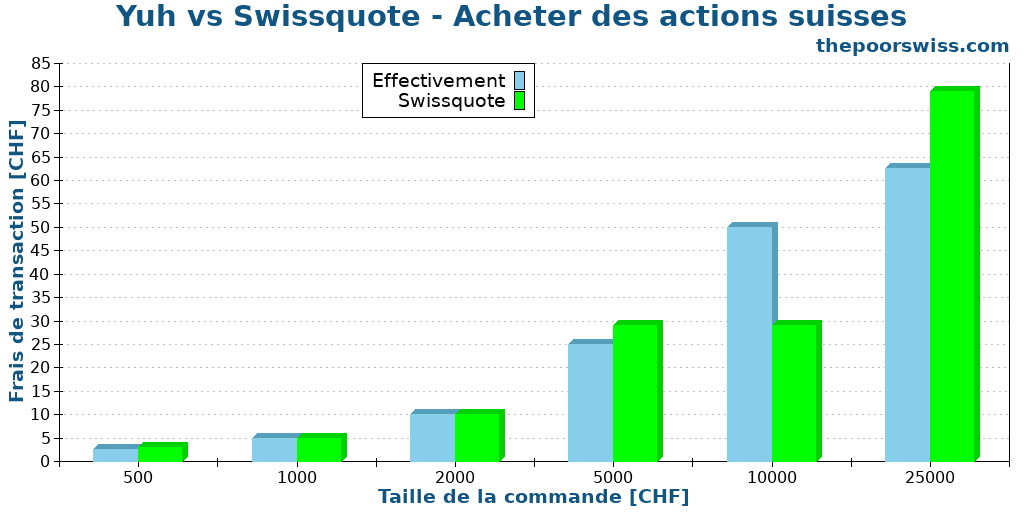
Pour les petites entreprises, Yuh peut être nettement moins cher que Swissquote. Cependant, pour les opérations importantes de plus de 6000 CHF, Yuh devient plus cher que Swissquote. Mais comme ils ont tous deux un système à plusieurs niveaux, il existe certains seuils où les frais varient considérablement. Par exemple, à 10 000 CHF, Yuh est plus cher, mais à 10 001 CHF (1 franc de plus), Yuh est moins cher.
Par souci d’exhaustivité, nous pouvons également montrer la même chose pour les actions américaines :
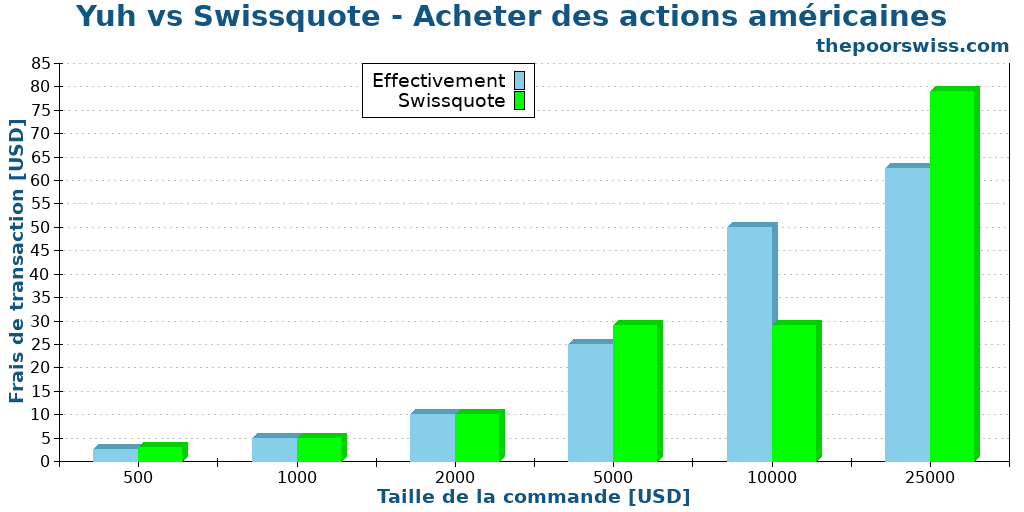
Comme les frais sont les mêmes mais en USD, le graphique est le même que le précédent.
Enfin, nous examinons la comparaison pour un ETF qui fait partie des ETF Leaders de Swissquote :
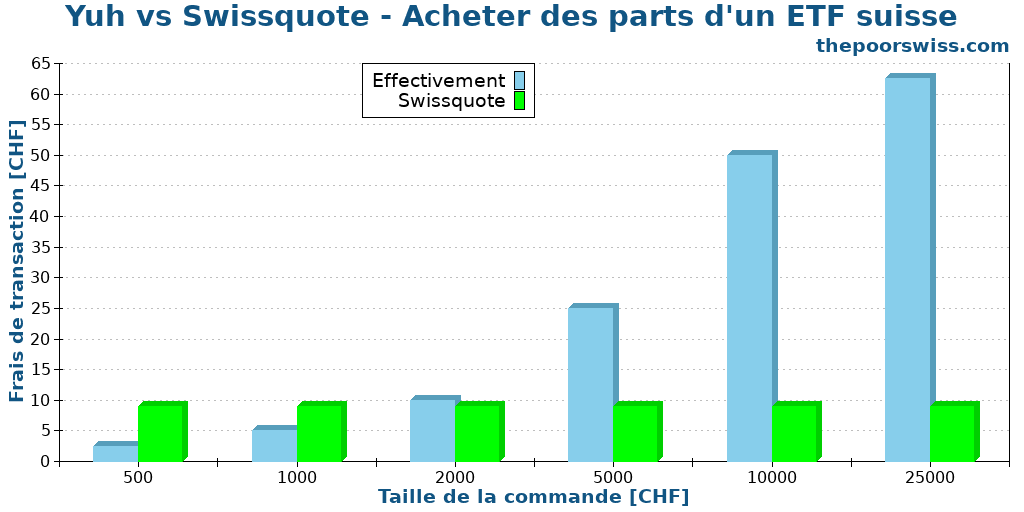
Là encore, Yuh est moins cher pour les petites entreprises, mais le seuil est plus bas. A partir de 1800 CHF, Yuh devient plus cher que Swissquote. Et si vous effectuez des opérations très importantes sur des ETF suisses, Swissquote peut être beaucoup moins cher que Yuh.
Dans l’ensemble, en termes de frais, il est facile de comparer les deux. Si vous effectuez des opérations de grande envergure, Swissquote sera moins chère que Yuh. Cependant, Yuh peut être beaucoup plus abordable que Swissquote pour les petites entreprises.
Si tu négocies souvent des ETF suisses (sur la liste Swissquote ETF Leaders), Swissquote peut être nettement moins cher. Mais, là encore, uniquement si vous effectuez des opérations suffisamment importantes.
De plus, il ne faut pas oublier que Swissquote applique des frais de garde alors que Yuh n’en a pas.
Ainsi, tout se résume à l’ampleur de vos opérations. Si tu effectues régulièrement des transactions de plus de 6000 CHF (ou USD) en une seule opération ou de plus de 2000 CHF sur un ETF Leader, tu devrais opter pour Swissquote. Sinon, Yuh sera moins cher.
Sécurité
Lorsque tu investis, tu vas probablement confier une somme d’argent importante au courtier. C’est pourquoi vous devez assurer la sécurité de ces actifs.
La comparaison est assez simple puisque Yuh utilise Swissquote pour conserver les actions et les liquidités.
Par conséquent, la sécurité des deux courtiers est exactement la même. Tes liquidités sont protégées jusqu’à 100 000 CHF.
Et vos titres sont conservés dans des comptes de dépôt à votre nom. En cas de faillite, vos titres devraient être en sécurité et vous pouvez les récupérer pendant la procédure de faillite. Cela peut prendre un certain temps, mais cela devrait être sans danger.
Réputation
Enfin, nous examinons la réputation de Yuh par rapport à Swissquote.
Bien qu’il ne s’agisse pas d’une source de confiance parfaite, Trustpilot est un excellent endroit pour trouver des avis sur de nombreux services.
Sur Trustpilot, Yuh reçoit une note de 2,6 sur 5, tandis que Swissquote reçoit une note de 3,6 sur 5. A première vue, il semble que Yuh ait une moins bonne réputation que Swissquote.
Lorsque nous examinons les mauvaises critiques de Yuh, nous constatons plusieurs choses intéressantes. Nombreux sont ceux qui se plaignent parce qu’ils reçoivent trop de questions lorsqu’ils reçoivent de l’argent sur leur compte, même s’il s’agit de ventes en ligne. De nombreuses personnes se plaignent également du fait que la sortie de la banque est très compliquée et que les procédures sont lourdes. Certaines personnes se plaignent également de la difficulté à joindre les services clients. Enfin, nous recevons également de nombreuses plaintes concernant des commandes annulées.
Il est intéressant de noter que j’ai également reçu plusieurs plaintes similaires concernant Yuh de la part de mes lecteurs.
Du côté positif, les gens sont plutôt satisfaits de la facilité d’utilisation du service. Nous recevons également des commentaires positifs sur le service à la clientèle.
Du côté de Swissquote, les critiques négatives portent principalement sur les frais élevés. Certaines personnes se plaignent également de la difficulté d’accès au service clientèle. Enfin, les gens disent aussi que l’utilisation de l’interface web est complexe.
D’un autre côté, nous recevons de nombreux commentaires sur la sécurité et la sûreté de la banque. De nombreux commentaires mentionnent également les frais beaucoup moins élevés que ceux des banques traditionnelles.
Dans l’ensemble, il semble que Swissquote jouisse d’une bien meilleure réputation que Yuh. Certains des problèmes techniques signalés par les utilisateurs de Yuh m’inquiètent quelque peu.
Yuh vs Swissquote Résumé
Nous pouvons résumer notre comparaison Yuh vs Swissquote par un bref tableau comparatif :
|
Très bien pour commencer à investir
|
Meilleur courtier suisse
|
|
4.0
|
4.5
|
|
Pas de frais de gestion
|
Très bon marché
|
|
|
|
|
- Courtier Suisse
- Très facile à utiliser
- Frais bas pour les petites opérations
- Négociation d'actions en fractions
- Cher pour les grosses opérations
- Choix en actions et ETFs limité
- Courtier Suisse
- Beaucoup d'instruments d'investissement
- Accès aux ETFs US
- Bonne réputation
- Cher pour les petites opérations
- Pas facile pour commencer à investir
Enfin, nous pouvons résumer Yuh vs Swissquote en quelques points :
- Yuh est plus facile à utiliser que Swissquote.
- Swissquote est moins cher pour les très grosses transactions.
- Yuh est moins cher pour les petites et moyennes transactions.
- Swissquote offre beaucoup plus d’options de négociation.
- Swissquote a des droits de garde importants (Yuh n’en a pas).
- Les deux courtiers utilisent le même système de négociation.
- Les deux courtiers offrent la même sécurité.
- Yuh semble avoir plus de problèmes techniques que Swissquote.
- Swissquote reçoit de meilleures critiques de la part de ses clients.
Conclusion
|
Très bien pour commencer à investir
|
Excellent courtier suisse
|
|
Primary Rating:
4.0
|
Primary Rating:
4.5
|
Dans l’ensemble, Yuh et Swissquote sont des courtiers intéressants. Elles présentent toutes deux des avantages et des inconvénients.
Dans l’ensemble, je préfère Swissquote à Yuh car Swissquote m’offre un accès à l’intégralité du marché boursier, et non simplement à un sous-ensemble.
Cela dit, Yuh est un bon courtier pour les personnes qui débutent en bourse et qui souhaitent une expérience simple. Swissquote est excellent pour les investisseurs avancés qui investissent des sommes importantes.
En ce qui concerne les courtiers suisses, Yuh et Swissquote sont deux excellents courtiers suisses. Vous pouvez consulter les meilleurs courtiers suisses.
Cependant, ils ne sont pas à la hauteur de la comparaison avec les courtiers étrangers. Si vous êtes disposé à recourir aux services d’un courtier étranger, Interactive Brokers constitue un choix excellent et c’est celui que j’utilise en tant que courtier principal. Vous pouvez lire mon avis sur Interactive Brokers pour plus de détails. J’utilise également Saxo en tant que courtier secondaire et Swissquote comme courtier pour ma société à responsabilité limitée.
Et toi ? Que préférez-vous, Yuh ou Swissquote ?
Prochains articles

Neon Invest Review 2026: Avantages et inconvénients
Investis avec Neon. Lis notre évaluation de la fonctionnalité Neon Invest. Les faibles frais de transaction et les ETF sélectionnés sont-ils suffisants pour les investisseurs sérieux ?
Comment les courtiers sans commission gagnent-ils de l’argent ?
Les courtiers gratuits sont-ils réels ? Découvre la vérité sur le trading sans commission, les spreads cachés et comment les courtiers gagnent de l’argent grâce à tes transactions.
Devriez-vous utiliser la tarification fixe ou dégressive d’IB 2026 ?
Économisez sur les frais. Tarification fixe ou dégressive d’IBKR : Nous calculons les seuils de rentabilité pour vous aider à choisir le plan le plus économique pour votre style de trading.
Apprenez des moyens faciles d'optimiser vos finances et d'économiser des milliers de francs en Suisse avec notre e-book exclusif. Découvrez les services financiers les plus rentables adaptés aux résidents avisés et aux expatriés!
Obtenez votre guide suisse d'économies GRATUIT
Bonjour,
Actuellement j’utilise swissquote, mais lequel est le plus intéressant pour un avoir de 15000.- sur VWCE et un DCA de 250.-/mensuel sur cet ETF ? Yuh ou Swissquote? De plus, en terme de document fiscale à transmettre aux AFC lequel est plus simple ?
Bonjour mikael
C’est un bon exercice pour mon comparateur: Outil de comparaison des courtiers
Yuh sera moins cher dans cette configuration. Par contre, avec le temps, Swissquote serait plus intéressant car il permet d’utiliser des ETFs américains.
Swissquote et Yuh seront les deux très simples avec le relevé e-tax.
Bonjour,
Merci pour votre retour.
En effet, après voir utilisé l’outil, voilà le résultat que j’obtiens :
1. Interactive Brokers (Ma Review): 4,73 CHF (par année)
2. Saxo (Savings Plan) (Ma Review): 12,00 CHF (par année)
3. Neon Invest (Savings Plan) (Ma Review): 30,93 CHF (par année)
4. Yuh (Savings Plan) (Ma Review): 59,43 CHF (par année)
5. DEGIRO (Ma Review): 68,85 CHF (par année)
6. Swissquote (Ma Review): 145,04 CHF (par année)
Souhaitant avoir un compte d’investissement en Suisse, en tout cas pour le moment, je vais garder de la liste Neon, Yuh et SQ. Sur cette base Yuh reste plus intéressant de même que Neon Invest. Je réduis encore cette liste car Neon Invest n’as pas les ETF qui m’intéresse. Donc, il me reste plus qu’à choisir de rester chez SQ ou basculé le tout chez Yuh.
On parle ici d’une économie de 165.-/année (80.- différence prix + 85.- prix du relevé fiscale SQ) sur 30 ans d’investissement cela représente presque 5000.-.
1. Est-ce que cette économie est vraiment intéressante pour changer complétement de plateforme, avec les possibles frais que cela peut engendrer etc.. ?
2. Dans mon cas concret, je me demande si avec mon IE00BK5BQT80 et mon seul titre IE00B53SZB19, convient mieux de rester chez SQ?
En soit, je viens de démarrer la dedans il y a quelque mois, donc il m’est difficile de savoir réellement si la plateforme à une réelle importance entre ces deux, car au final, si on veut vraiment une excellente performance dans les frais, il n’y a pas mieux que Interactive Brokers, pour le moment pas prêt à passer le cap sans être encore à l’aise avec tout ça.
Merci pour votre retour.
Mes questions:
* Pourquoi enlever Saxo? C’est en Suisse également.
* Yuh est également limité en ETF. Quels ETFs avez-vous chez Yuh qui n’est pas chez Neon?
1) Oui, à condition que vous adoptiez le nouveau courtier pour le long-terme
2) Difficile à dire, mais pourquoi ne pas les acheter chez Saxo? 100 CHF de moins par année, c’est pas négligeable.
Si vous venez de démarrer, essayez une plateforme pendant une année et ensuite faites la réflexion de ce que vous voulez ensuite. Peut-être dans une année vous serez prêt à passer à IB ou pas du tout :)
Bonjour, je cherche à mettre une partie de mon épargne en Suisse et n’ayant pas une somme exorbitante je pensais à yuh ou swiss quote. Je n’ai pas d’intentions de trader car je ne m’y connais pas du tout. Est ce une bonne solution selon vous? Mon but est de sortir une partie de la zone euro. Quelles sont les frais bancaires dans ce cas là?
Yuh n’a pas de frais pour autant que je sache pour les non-résidents. Yuh est intéressant, mais très limité sur les pays disponibles.
J’ai parlé des des différentes banque pour ce cas: Quelle est la meilleure banque suisse pour les non-résidents ?
Bonjour et merci de vos explications très intéressantes.
Je vais transférer mes CHF de Revolut sur Yuh.
Si je laisse mes CHF sur Yuh, quels sont les frais de garde ou de gestion?
Que devrais je déclarer?
Si je transfère mes CHF de Yuh à swissequote, que devrais je faire?
Quels seront les frais de garde ou de gestion?
Vaut il mieux laisser mes CHF sur Revolut ou Trade Republic?
Merci
Bonjour Steve
Si vous parlez de cash, c’est facile : Yuh n’a pas de frais de garde et Swissquote a des frais de garde comme indiqué dans l’article.
Quant à savoir où les garder, je ne sais pas trop, c’est pas très intéressant de garder beaucoup de CHF. Je ne garderais personnellement pas de CHF sur Revolut ou Trade Republic, je pense que Yuh et SQ sont plus sûrs.
De plus l’ETF World « blue chips » de Yuh est-il capitalisant ou verse-t-il des dividendes soumis à impôts ?
Merci !
Celui en USD est distribuant alors que celui en CHF est accumulant.
Merci, exactement les informations que je cherchais en tant que particulier. Je vais donc continuer avec Yuh même si personnellement, j’apprécierai un site Web de gestion et pas uniquement une application mobile.
Merci du retour! C’est vrai qu’un site web serait une bonne addition!
Merci pour cet excellent article comparatif. Comme je débute en bourse avec des petits montant, je suis satisfaite de Yuh qui est transparent face aux frais et facile d’utilisation. Par contre, c’est frustrant de ne pas trouver d’actions d’entreprises spécifiques ou d’obligations.
Merci de votre retour Nancy! Avez-vous essayé de demander à Yuh d’ajouter ces entreprises?
Hello, merci pour cette analyse.
Je suis chez Swissquote et tu as oublier de dire qu’ils fait aussi les cryptos.
J’en suis très content et je suis aussi chez d’autres courtiers étrangers et même si il est cher (qu’est-ce qui n’est pas cher en Suisse ?) j’aime savoir qu’une partie de mes avoirs est à l’abri en Suisse et protégés par la FINMA.
Bravo pour ton travail et je ne manque aucun de tes posts.
Bonjour Marc,
Je n’ai pas oublié, mon article mentionne que les deux ont les cryptos. Mais ça ne m’intéresse pas.
Merci de ton retour sur Swissquote. Je pense aussi que c’est un bon courtier, même si c’est un peu cher.