
We Just Installed Solar Panels: Process, Costs and Early Results
| Updated: |
(Disclosure: Some of the links below may be affiliate links)
We recently went through the installation of solar panels on our house. I believe that solar panels are a great way to reduce our carbon footprint. And with oil prices rising, solar panels are making a lot of sense financially as well.
From asking for the first quote to the first solar power generated, it took about 6 months. In this article, we wanted to share exactly how we did it, how much it cost us, and an estimation of whether it will be worth it.
Our situation
For comparison, it is important to note a few things about our situation. Solar panels need to be adapted to each situation. Our installation does not make sense for everybody.
We have an individual house with relatively good exposure to the sun on the roof. The orientation is not perfect, but it is good. We have two heat pumps (one for heating and one for the pool). We also have servers at home, so we have a decent power consumption throughout the day.
Currently, we have one gas-powered car (the primary one) and one electric car. We plan to switch the primary car to electric as well in about 3 years.
Since we have a high income and live in a canton with high taxes (Fribourg), we have a high marginal tax rate. This makes any Swiss tax deduction quite interesting.
Phase 1: The research
First, it is important to do some research. You do not need to be a solar expert to get a solar installation. But you need to have a basic idea of how it works and what you want in your system. If you go blind into a discussion with an expert, you will have no power in the discussion. So, do a little research on the state of the market, what is possible, and what is not.
One important thing you need to know is how much power you are consuming in your house. In our case, we have an average of 1500 kWh per month, so 18,000 per year. We rounded that to 20K because we are planning to have both cars electric in the next few years.
Another essential metric is how much money you are ready to invest. You need to set a limit to stay within budget. If the quotes are well above your limit, you will have to reconsider your project and either size it down or wait until your limit is higher.
Obviously, you should also check how much your roof is capable of producing. For this, the Swiss Federal Office of Energy has a solar estimator website. This website works really well and is the reference in Switzerland. This will give you a good idea of what you can install on your roof and what can be produced by it. Unfortunately, if you only have a small part of the roof available and it has a bad orientation, a solar installation may not be worth it. In this case, you might even consider solar panels on the walls or freestanding in your backyard, for instance.
And then, you will need to decide on the options you want for your installation.
- Do you want a battery in your system? A battery helps store the solar power when there is sun and dispatch it to the house when there is none.
- Do you want a backup system? By default, the inverter needs grid power, so if the grid fails, your installation also fails even if your battery is not empty. A backup system is an extra inverter that will switch fully out of the grid if the power from the grid fails.
There is one thing worth knowing: changing a system later will trigger a new electrician audit. So, if you have a 14 kWh battery and want to upgrade to 21 kWh, it is likely that the audit will cost almost as much as the extra 7 kWh. So, it is better to size it properly from the start.
In our case, we wanted a battery, and we also decided on a backup system. For me, it made no sense to have batteries without backup, even though grid failures are really rare here. But it is important to note that adding a backup system makes the installation more expensive and does not have any financial benefit.
Once you have all the information you need, you can switch to the next phase.
Phase 2: Getting quotes
The second phase is to get quotes from different providers. Since it can represent a very significant amount of money, it is important to get multiple quotes. You want to have multiple offers to compare them and possibly to negotiate.
The providers are very different in each region, so I cannot truly recommend any good list to you. I would recommend getting at least three offers for such a project. In our case, we asked for five quotes, and we received four (one provider did not even call us back).
I think you should try to get some variety in your providers. For instance, you can consider:
- Your preferred electrician company
- Your local energy provider
- Your preferred local roofers
- Any company that has been recommended by friends and family
And if that is not enough, you will need to search around in your area.
Once you have asked them, you will need to receive each representative and discuss the project with them. This is where having done your research first will help and speed it up. Then, they will come back with a quote.
Some companies are really fast at getting back with a quote, but others are slow. In our case, this varied from five days to a month.
Phase 3: Choosing the provider
Once you have the quotes, you have to compare them and decide.
Price is an important factor here, but you have to be careful to make it comparable. Not all offers will have the same power, for instance. In our case, I put everything in a spreadsheet and calculated the price per W (of peak power). This allowed me to have a good idea of the price of each offer.
However, you have to be careful about the other details. In our case, one of the four offers had a 14 kWh, while the others had 21 kWh. So I had to get another offer to make them comparable. I also had to make sure that they had all backups and similar inverters.
You also have to make sure that you trust the provider. In our case, there was one provider with whom we did not feel comfortable working. The representative did not feel like a solar expert. If you are going to spend a lot of money, you want to spend it with people you trust.
And you have to be careful about the small print. One of the providers did not include the removal of the old chimney in the offer. So for us, it could not be compared properly with others.
And if you have questions, you should not hesitate to use your contacts there. If you do not get a satisfactory answer, that is also a sign that you may not want that provider.
So, in the end, price is important, but your feeling about the offer is also important (as long as you can stay rational).
Once you have selected an offer, you can usually sign it and send it to the provider.
Phase 4: The installation
Once you have signed an offer, the installer will plan the work for you. For this phase, you have very little to do except be available at your house for the workers if necessary.
The first step is the installation of the scaffolding. In most cases, scaffolding is necessary. For a tiny installation, they could do it with ropes, but any decently sized installation will be done with scaffolding.
Once the scaffolding is installed, the installers should start installing the rails on your roof. They will install some support on your roof framework. Then, they will attach rails to these supports. And finally, they will put the solar panels on the rails.
In parallel, the electricians will install the inverter in your technical room. If you have a battery and backup inverter, this can also be done in parallel with the solar panels. They will also need to install the cables that will go from the panels to the inverter. A surge protector is generally installed as well.
In our case, we also installed snow bars to prevent large snowfalls. So another specialist had to come in at the same time.
Phase 5: The startup
When everything is set up properly, the electrician will set up the system. This is done in several steps.
The first step is to start the inverter and make sure that solar power is generated. Then, they will test the backup system (if you have installed one). In our case, there was an issue with the backup system, but the solar panel setup went rather smoothly.
Then, the system needs to be audited. This ensures that the system is set up according to the norms.
In parallel, they may also have to change the power meter in the house. We did not have a so-called smart meter at home, so they had to change it.
The final step is to get the solar subvention (from Pronovo). Usually, your installer will take care of that. If they do not, they should at least give you the necessary documents to claim the subvention.
At this stage, you should be done with your setup, and you have started to generate power.
Our solar panels installation
So you can have an example, here are the details about our setup.
- Our installer is Groupe E.
- We have 42 solar panels (two-thirds on one side of the roof and the other third on the other side).
- We have a 21 kWh battery.
- We have a backup system
- We made them install snow bars on one side of the roof
- We made them demolish an old chimney (from the previous heating system)
In total, we paid 47,000 CHF for our installation. It is definitely a big investment, but it is also a big installation. We put in as much capacity as our local power would allow. The idea is that we really did not want to change the installation later because it was too small to start with.
To be clear, it is not the best installation financially speaking. If we wanted to improve it financially:
- We should have reduced the number of panels
- We should have opted out of backup
- We should have used a smaller battery
Additionally, we should receive about 7000 CHF from Pronovo for the subvention. And we will be able to deduct the 47,000 CHF from our taxes. At our marginal tax rate of about 35%, that should represent about 16,500 CHF saved on taxes (though this may change after the removal of the imputed rental value). So, in the end, the total net cost is about 23,500 CHF.
My estimations (currently very rough) seem to indicate that this installation will pay for itself over about 10 years. And obviously, there is also the ecological aspect of using much more solar. And there is the pride aspect of being more independent at home. Finally, this also brings some safety in the sense that we do not know what will happen to the energy market in the future.
And before you ask: No, this is not the best investment. If you compare that to simply putting your money in the stock market, I do not think there is any way solar can compete. But as I said above, there are other advantages, and I think it is worth it for us.
The early results
It is, of course, too early to draw real conclusions about our installation. However, we are quite happy about it so far.
When we have a sunny day, we are fully self-sufficient for an entire day and can feed back a significant amount of power to the grid. We have not yet received a bill from our energy provider, so we will have to wait until we see the final results. But we know that they currently buy back our electricity at 0.07 CHF per kWh in summer and 0.09 CHF per kWh in winter.
Here is an example of a good day.
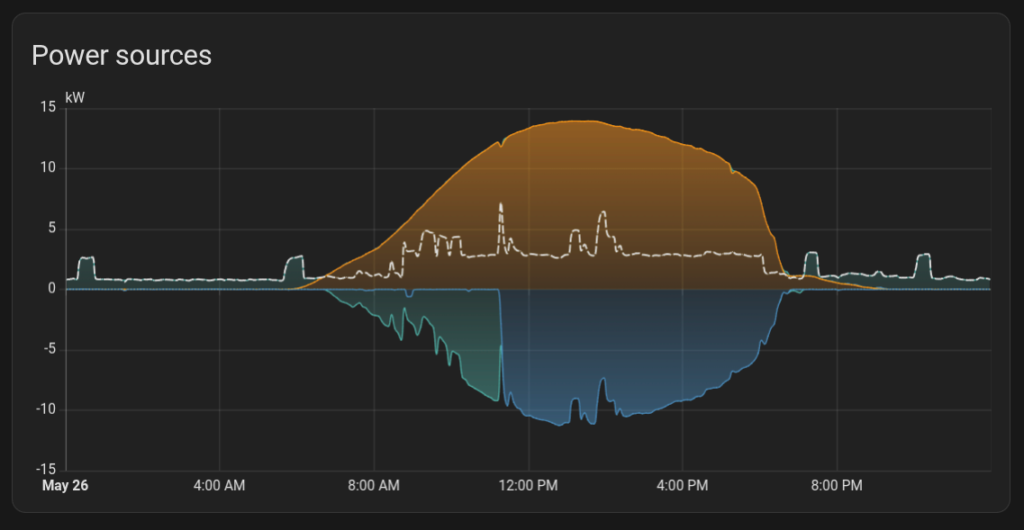
On the left, we can see the battery for our domestic consumption. Then, when the sun starts, the solar panels start their production and refill the battery (the green part under the graph). Once the battery is full, the solar panels are sending power to the grid. At the end of the sunlight, the battery starts being used. On this day, we were 100% self-sufficient.
Here is another example where the day was a mixed batch:
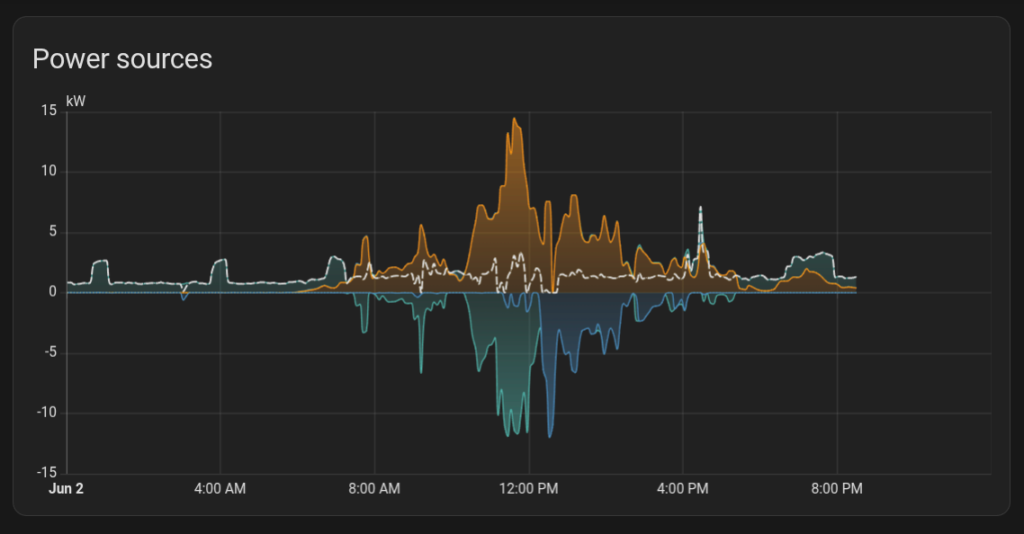
This was still not a bad day, but we can see that the solar results were much less consistent. The recharge of the battery took almost two hours more. And then the battery was already used earlier on. We were still fully self-sufficient on this day, but we consumed most of our solar production.
Of course, we will keep tracking our results and see what happens when there are more bad days. And winter will also be interesting because of more heat pump usage and less sunlight. If you are interested, please let me know, and I may do a full recap after one year.
Conclusion
Installing solar panels on a house is a long process. It requires some research and some thorough analysis. However, if you are serious about it, it is not a very complex project. If you are prepared to spend a significant amount of money on solar panels, it is important to go through the process properly.
So far, we are thrilled about our solar installation. We are not yet drawing many conclusions on it since it is a recent addition to our house. But it is starting as expected.
I plan to write another article to go through the financials of installing solar panels. And if you are interested, I could write an update on results after a year.
What about you? Do you have solar at home? What do you think about solar panels?
More reading

Geo Arbitrage in Switzerland – Improve your finances by moving
In Switzerland, there are huge disparities between cantons and cities. Here is how to use geo arbitrage in Switzerland to optimize your finances!
How to work out at home for free in 2026
I have now started to work out at home, almost for free! Find out why and how I am working out at home!
How should you finance a car in 2026?
Leasing or Buying? We analyze the cheapest way to finance a car in Switzerland and why paying cash is almost always the best financial decision.
Learn easy ways to optimize your finances and save thousands in Switzerland with our exclusive e-book. Learn about the most cost-effective financial services tailored for savvy residents and expats!
Get Your FREE Swiss Money-Saving Guide
Thank you, I’m also planning for a similar installation, but without the battery. The ROI on the battery is much higher compared to the solar panels. I’m also betting on battery prices to continue going down in the upcoming year.
One correction, I believe the marginal tax is applied on the net investment (47’000 – Pronovo).
Yes, I think you are right about the net investment!
As for the battery, just make sure you plan ahead. You will have to pay some costs twice, but if you plan some space and extra cabling in advance for the battery, you will save money in the second installation.
Any XLS cost/ROI analysis would be appreciated ;-)
Unfortunately, I have not done something very clean, only very specific to our installation :)
So you have fixed price for the sold kWh for the whole day? That is not very sustainable and will probably change sooner or later as there are many days in Europe where production during sunny summer days is too big and electricity prices go into negative. So they will need to penalize even households if they will be producing during negative prices.
You can for example sell on the morning, charge battery around noon and sell again in the afternoon (ideally automated with some weather forecast to be sure battery has enough time to charge till evening). If I was planning solar today, I would opt to position the panels not south, but east+west for this reason.
Also there are already companies who can profit on stabilizing the network and it is planned to allow it also for households – you could be payed to charge battery during noon’s negative prices and payed again to discharge battery when prices are high.
I totally expect that the price will go down, unfortunately. As there is more and more solar installations, the price will go down. I just hope that the price for users will also go down, but I am not so confident about that.
And it should be easy to program these systems based on a dynamic price.
Very interesting investment and it will be useful to have a dedicated post at the end of the year to follow the ROI on the investment through the season.
It will be also interesting to know how you optimized the use of the battery.
Thanks for your feedback, Josh! I will plan an article about that!
In some cantons (e.g. AG), the Pronovo subvention you receive will be added to your income and you pay tayes on it. D’oh!
Some input from my experience: Install as many panels as possible on the roof from the very beginning. They don’t cost much and at a later time it needs scaffolding and cabling again. If someone wants to save money, rather skip the “backup” (UPS / Notstrom) functionality than reduce panel count (in winter an almost empty battery won’t keep your house running for a long time).
Having as many panels as possible will help in winter to get a few kilowatts to run the heat pump, even in foggy Mittelland without sunshine. Also don’t forget to change your heat pump and water boiler schedule to run during the day instead of night!
There is also a limit on how many panels an inverter can handle. In my case I had to install two inverters. Also keep in mind that inverters generate heat. With inverters running at 24kw PV max. input in the summer, this can heat up the room where they are installed to 30+ degrees in summer!
It also makes sense to use excess energy to heat up the water boiler with the electric heating element, by adding a relais and some logic in the software or BMS.
Hi Richie
Yes, I was wrong in my calculations; we should deduct 40k from our taxes, not 47k. I think this should be the same in most cantons.
Thanks for your advice! We are thinking of doing some electrical water heating indeed, but have not started on that. We installed the maximum number of panels for our inverter and the installation is also maxed out based on our power introduction. Any more and we would have to increase the current going to the house, which would be costlier.
Thanks for sharing this detailed breakdown, Baptiste.
Following up on our discussion under your other article, your decision makes much more sense to me now. The key difference is your situation: very high annual consumption, two heat pumps, servers running during the day, one EV already and probably a second one later, plus a high marginal tax rate.
In my case, the numbers are quite different. My annual consumption is much lower, around 6,100 kWh in 2025, and the local incentives plus the tax deduction seem much less powerful than in your case. So even if the installation is technically interesting, the pure financial return becomes much harder to justify.
Another key point for me is the battery. Over 10 to 15 years, battery efficiency and usable capacity will decline, and at some point there may be maintenance or replacement costs. That matters a lot if the goal is to reduce expenses over time. From an environmental point of view, solar can be justified, even if batteries themselves will eventually have to be dealt with at end of life. But from a personal finance point of view, I still feel the system should at least break even at some point with realistic assumptions.
Your example also confirms something important for me: solar with battery can make sense as a long term house upgrade, for resilience, comfort and partial independence, but it is probably not the best “investment” if compared with passive investing. The tax impact, the real self consumption profile and long term battery performance seem to be the deciding factors.
Thanks again, this was very useful.
Don’t be afraid of batteries. In EVs, you have batteries 10 years old with 200-500.000 km driven and still at 70-85% of original capacity. And those sa batteries with technology from 10 years, not today’s technology.
Hi Wave
Totally agree with your points!
* I also found it disappointing that solar was not a great investment. We should encourage solar installations more. In our case, without the tax deductions, I am not sure we would have done it. I really like the technology, but it has to make sense financially. If cantons do not keep the possibility of solar deductions after the removal of the imputed rental value, we may see a significant reduction in these installations.
* Battery can make sense, but they do not greatly improve the financial aspects unless you use a lot of power during the night.
*
Excellent Baptiste. After a very long delay we finally complete our house purchase at the end of this week, and I’ve lined up a firm for installing 31 panels, really cannot wait. The house has ground source heat pump so fingers crossed it will be a good system. Hoping to do battery next year before the tax changes.
Hi Will
Well done! Good luck with your own installation.
Make sure the installer knows you want a battery later so that everything is ready. Otherwise, you will have to redo some things and it will be more expensive later.
any thoughts on solar panel systems for apartment balconies?
I have not really thought about it, but they sound like a good compromise for renters. Obviously, you would still have to check with your owner, because it could be against the rules.
But they could work really well depending on your solar coverage. That with a good battery like EcoFlow could significantly cover your needs.
Hi Baptiste,
I think that you should deduct the pronovo subsidy from your investment. It should be 47k-7k = 40k, minus taxes -> 40k*0.65 = 26k
Or count the subsidy as revenue next year. You should also tell that in Fribourg, you should be taxed on the net energy that you are selling. Let’s say that you consum 15’000 kWh, and sells 25’000 kWh, you should be taxed on 10’000 kWh. I know that no one care about that in the state, but maybe oneday they’ll ask about it :)
Let’s speak about the benifits: it’s very easy to get an EV-Charger that “follows” ur production, so you’re sure to maximise your self-consumption, and so increasing your revenues.
Next year, you’ll be paid hourly for the energy production, you can get in touch with me if you want more information about it (so that you can optimise your battery usage and capture rate).
thank you for your work !
Thank you – appreciated, very timely for us. Could you share more about your thinking around battery/inverter (sizing, tech stack)? And what do you mean by ‘backup’?
Hi Julie,
it means that Baptise house can get power even if there is a blackout. To be noted, most system aren’t automatic. You need to unplug your home from the grid and restart from the battery.
Also to be noted, not every electrician wire the entire houe, sometimes it’s juste 1 phase, or some plug. Something to be aware when comparing the offers.
Hi Samy
Exactly.
Our system is automatic. The Huawei backup inverter is surprisingly fast; it takes about 1 second to switch. I am surprised that not all systems are automatic.
And you are absolutely right that you can be flexible in the wiring of the backup system.
Hi Julie
For the tech stack, we went with full Huawei because they have a lot of experience in this market.
For size of the inverter, this is mostly up to the technician. In our case, a 15kVA was a good fit for our installation. We could not go much higher anyway given the size of our base power introduction.
Backup allows us to be independent from the grid. If there is a grid failure, we still have power with the our battery and solar installation.