
We Just Installed Solar Panels: Process, Costs and Early Results
| Updated: |
(Disclosure: Some of the links below may be affiliate links)
We recently went through the installation of solar panels on our house. I believe that solar panels are a great way to reduce our carbon footprint. And with oil prices rising, solar panels are making a lot of sense financially as well.
From asking for the first quote to the first solar power generated, it took about 6 months. In this article, we wanted to share exactly how we did it, how much it cost us, and an estimation of whether it will be worth it.
Our situation
For comparison, it is important to note a few things about our situation. Solar panels need to be adapted to each situation. Our installation does not make sense for everybody.
We have an individual house with relatively good exposure to the sun on the roof. The orientation is not perfect, but it is good. We have two heat pumps (one for heating and one for the pool). We also have servers at home, so we have a decent power consumption throughout the day.
Currently, we have one gas-powered car (the primary one) and one electric car. We plan to switch the primary car to electric as well in about 3 years.
Since we have a high income and live in a canton with high taxes (Fribourg), we have a high marginal tax rate. This makes any Swiss tax deduction quite interesting.
Phase 1: The research
First, it is important to do some research. You do not need to be a solar expert to get a solar installation. But you need to have a basic idea of how it works and what you want in your system. If you go blind into a discussion with an expert, you will have no power in the discussion. So, do a little research on the state of the market, what is possible, and what is not.
One important thing you need to know is how much power you are consuming in your house. In our case, we have an average of 1500 kWh per month, so 18,000 per year. We rounded that to 20K because we are planning to have both cars electric in the next few years.
Another essential metric is how much money you are ready to invest. You need to set a limit to stay within budget. If the quotes are well above your limit, you will have to reconsider your project and either size it down or wait until your limit is higher.
Obviously, you should also check how much your roof is capable of producing. For this, the Swiss Federal Office of Energy has a solar estimator website. This website works really well and is the reference in Switzerland. This will give you a good idea of what you can install on your roof and what can be produced by it. Unfortunately, if you only have a small part of the roof available and it has a bad orientation, a solar installation may not be worth it. In this case, you might even consider solar panels on the walls or freestanding in your backyard, for instance.
And then, you will need to decide on the options you want for your installation.
- Do you want a battery in your system? A battery helps store the solar power when there is sun and dispatch it to the house when there is none.
- Do you want a backup system? By default, the inverter needs grid power, so if the grid fails, your installation also fails even if your battery is not empty. A backup system is an extra inverter that will switch fully out of the grid if the power from the grid fails.
There is one thing worth knowing: changing a system later will trigger a new electrician audit. So, if you have a 14 kWh battery and want to upgrade to 21 kWh, it is likely that the audit will cost almost as much as the extra 7 kWh. So, it is better to size it properly from the start.
In our case, we wanted a battery, and we also decided on a backup system. For me, it made no sense to have batteries without backup, even though grid failures are really rare here. But it is important to note that adding a backup system makes the installation more expensive and does not have any financial benefit.
Once you have all the information you need, you can switch to the next phase.
Phase 2: Getting quotes
The second phase is to get quotes from different providers. Since it can represent a very significant amount of money, it is important to get multiple quotes. You want to have multiple offers to compare them and possibly to negotiate.
The providers are very different in each region, so I cannot truly recommend any good list to you. I would recommend getting at least three offers for such a project. In our case, we asked for five quotes, and we received four (one provider did not even call us back).
I think you should try to get some variety in your providers. For instance, you can consider:
- Your preferred electrician company
- Your local energy provider
- Your preferred local roofers
- Any company that has been recommended by friends and family
And if that is not enough, you will need to search around in your area.
Once you have asked them, you will need to receive each representative and discuss the project with them. This is where having done your research first will help and speed it up. Then, they will come back with a quote.
Some companies are really fast at getting back with a quote, but others are slow. In our case, this varied from five days to a month.
Phase 3: Choosing the provider
Once you have the quotes, you have to compare them and decide.
Price is an important factor here, but you have to be careful to make it comparable. Not all offers will have the same power, for instance. In our case, I put everything in a spreadsheet and calculated the price per W (of peak power). This allowed me to have a good idea of the price of each offer.
However, you have to be careful about the other details. In our case, one of the four offers had a 14 kWh, while the others had 21 kWh. So I had to get another offer to make them comparable. I also had to make sure that they had all backups and similar inverters.
You also have to make sure that you trust the provider. In our case, there was one provider with whom we did not feel comfortable working. The representative did not feel like a solar expert. If you are going to spend a lot of money, you want to spend it with people you trust.
And you have to be careful about the small print. One of the providers did not include the removal of the old chimney in the offer. So for us, it could not be compared properly with others.
And if you have questions, you should not hesitate to use your contacts there. If you do not get a satisfactory answer, that is also a sign that you may not want that provider.
So, in the end, price is important, but your feeling about the offer is also important (as long as you can stay rational).
Once you have selected an offer, you can usually sign it and send it to the provider.
Phase 4: The installation
Once you have signed an offer, the installer will plan the work for you. For this phase, you have very little to do except be available at your house for the workers if necessary.
The first step is the installation of the scaffolding. In most cases, scaffolding is necessary. For a tiny installation, they could do it with ropes, but any decently sized installation will be done with scaffolding.
Once the scaffolding is installed, the installers should start installing the rails on your roof. They will install some support on your roof framework. Then, they will attach rails to these supports. And finally, they will put the solar panels on the rails.
In parallel, the electricians will install the inverter in your technical room. If you have a battery and backup inverter, this can also be done in parallel with the solar panels. They will also need to install the cables that will go from the panels to the inverter. A surge protector is generally installed as well.
In our case, we also installed snow bars to prevent large snowfalls. So another specialist had to come in at the same time.
Phase 5: The startup
When everything is set up properly, the electrician will set up the system. This is done in several steps.
The first step is to start the inverter and make sure that solar power is generated. Then, they will test the backup system (if you have installed one). In our case, there was an issue with the backup system, but the solar panel setup went rather smoothly.
Then, the system needs to be audited. This ensures that the system is set up according to the norms.
In parallel, they may also have to change the power meter in the house. We did not have a so-called smart meter at home, so they had to change it.
The final step is to get the solar subvention (from Pronovo). Usually, your installer will take care of that. If they do not, they should at least give you the necessary documents to claim the subvention.
At this stage, you should be done with your setup, and you have started to generate power.
Our solar panels installation
So you can have an example, here are the details about our setup.
- Our installer is Groupe E.
- We have 42 solar panels (two-thirds on one side of the roof and the other third on the other side).
- We have a 21 kWh battery.
- We have a backup system
- We made them install snow bars on one side of the roof
- We made them demolish an old chimney (from the previous heating system)
In total, we paid 47,000 CHF for our installation. It is definitely a big investment, but it is also a big installation. We put in as much capacity as our local power would allow. The idea is that we really did not want to change the installation later because it was too small to start with.
To be clear, it is not the best installation financially speaking. If we wanted to improve it financially:
- We should have reduced the number of panels
- We should have opted out of backup
- We should have used a smaller battery
Additionally, we should receive about 7000 CHF from Pronovo for the subvention. And we will be able to deduct the 47,000 CHF from our taxes. At our marginal tax rate of about 35%, that should represent about 16,500 CHF saved on taxes (though this may change after the removal of the imputed rental value). So, in the end, the total net cost is about 23,500 CHF.
My estimations (currently very rough) seem to indicate that this installation will pay for itself over about 10 years. And obviously, there is also the ecological aspect of using much more solar. And there is the pride aspect of being more independent at home. Finally, this also brings some safety in the sense that we do not know what will happen to the energy market in the future.
And before you ask: No, this is not the best investment. If you compare that to simply putting your money in the stock market, I do not think there is any way solar can compete. But as I said above, there are other advantages, and I think it is worth it for us.
The early results
It is, of course, too early to draw real conclusions about our installation. However, we are quite happy about it so far.
When we have a sunny day, we are fully self-sufficient for an entire day and can feed back a significant amount of power to the grid. We have not yet received a bill from our energy provider, so we will have to wait until we see the final results. But we know that they currently buy back our electricity at 0.07 CHF per kWh in summer and 0.09 CHF per kWh in winter.
Here is an example of a good day.
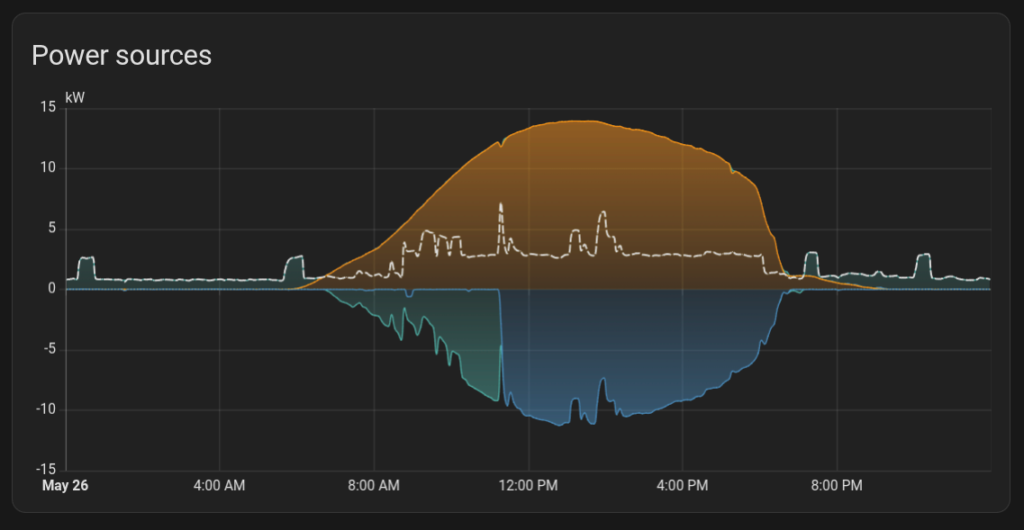
On the left, we can see the battery for our domestic consumption. Then, when the sun starts, the solar panels start their production and refill the battery (the green part under the graph). Once the battery is full, the solar panels are sending power to the grid. At the end of the sunlight, the battery starts being used. On this day, we were 100% self-sufficient.
Here is another example where the day was a mixed batch:
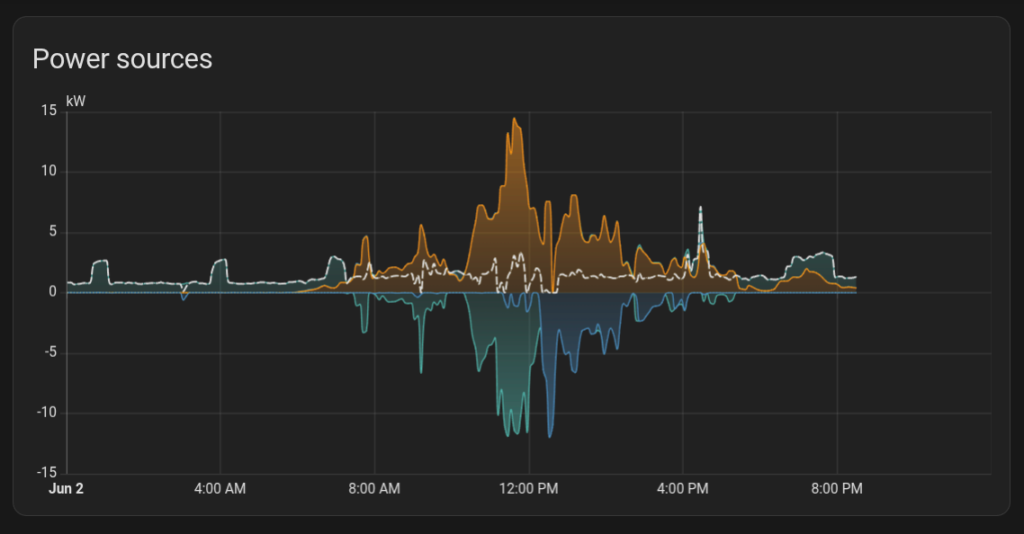
This was still not a bad day, but we can see that the solar results were much less consistent. The recharge of the battery took almost two hours more. And then the battery was already used earlier on. We were still fully self-sufficient on this day, but we consumed most of our solar production.
Of course, we will keep tracking our results and see what happens when there are more bad days. And winter will also be interesting because of more heat pump usage and less sunlight. If you are interested, please let me know, and I may do a full recap after one year.
Conclusion
Installing solar panels on a house is a long process. It requires some research and some thorough analysis. However, if you are serious about it, it is not a very complex project. If you are prepared to spend a significant amount of money on solar panels, it is important to go through the process properly.
So far, we are thrilled about our solar installation. We are not yet drawing many conclusions on it since it is a recent addition to our house. But it is starting as expected.
I plan to write another article to go through the financials of installing solar panels. And if you are interested, I could write an update on results after a year.
What about you? Do you have solar at home? What do you think about solar panels?
More reading

How to Save More Than 50% on One Amazon Purchase
Learn how I was able to save 50% on one of my Amazon purchases by ordering it to a different country!
Reasons to Start a Vegetable Garden
Grow your own food. Read about our experience starting a vegetable garden in Switzerland, the costs involved, and the joy of home-grown produce.
Cheap International Transfers with Neon
Send money cheaper. Learn how to use Neon for international transfers, how it compares to Wise, and why it saves you money on fees.
Learn easy ways to optimize your finances and save thousands in Switzerland with our exclusive e-book. Learn about the most cost-effective financial services tailored for savvy residents and expats!
Get Your FREE Swiss Money-Saving Guide
I am looking to do similar in the next year. However the Swiss prices are outrageous. Got offers from 50k to 80k. Found foreign company doing the same for 16k totally. Sure, I won’t get the state subvention and I would need an electrician to do the final connection after it’s approved so there are another 2k.
I understand that you cannot recommend a provider, but would you be ready to divulge the name of the one you went for at the end? (we are currently looking into putting solar panels up on our roof in the Fribourg area, and are presently considering groupe-E, but thought their battery option a bit expensive).
We went with Groupe E. They were not the cheapest and not the most expensive, but had a well-rounded offer. They also sounded like they knew what they were talking about in depth when I asked specific questions.
Hi Baptiste
did you consider using your EV car as a battery using V2H or V2G? That could have saved you the cost of the battery.
But the technology doesn’t seem to be completely standardized yet.
I would love to hear your thoughts on this.
Hi Patrik
Yes, we did. But all providers said it was currently not possible in Switzerland. But looking it more deeply, I don’t think that’s right.
Currently, our secondary car (a Renault Zoé) does not support bidirectional charger. And we have not yet installed a fast charger. Once we switch our primary car, in about 2 years, we will look for V2H technology.