
Equity glidepaths à la retraite
| Mis à jour: |
(Information: certains des liens ci-dessous peuvent être des liens d'affiliation)
Sur ce blog, j’ai effectué de nombreuses simulations de retraite dans lesquelles la répartition entre les actions et les obligations restait inchangée. Cependant, on pense que la modification des allocations peut conduire à de meilleurs résultats.
Un equity glidepath est une méthode qui permet de modifier la répartition des actions au fil du temps. Ils peuvent être utilisés pendant les phases d’accumulation et de retraite.
Dans cet article, nous simulerons des equity glidepaths pendant la retraite et nous verrons si cela peut améliorer nos résultats.
Equity glidepaths
En tant qu’investisseur préférant une approche passive, j’évite de modifier mon portefeuille au fil du temps. Cependant, j’ai reçu de nombreuses demandes de la part de mes lecteurs concernant les equity glidepaths, ce qui a éveillé mon intérêt. Je suis curieux d’explorer leur application pratique.
Un equity glidepath est un moyen de modifier la répartition des actions au fil du temps. Par exemple, vous pouvez passer de 80 % d’actions à 60 % d’actions en cinq ans. Il s’agit d’un exemple d’equity glidepath.
Si cela vous semble familier, c’est peut-être parce que vous avez lu des articles sur les fonds de retraite cibles. Ces fonds sont proposés par tous les grands fournisseurs de fonds et utilisent une répartition décroissante des actions. Lorsque vous atteignez l’âge de la retraite, votre allocation d’actions diminue. Une fois la date cible atteinte, la répartition des actions reste généralement inchangée. C’est un exemple d’equity glidepath dans la phase d’accumulation.
L’autre solution consiste à opter pour un equity glidepath à la retraite. Dans ce cas, nous modifions la répartition des actions au fil du temps après la retraite. C’est sur ce point que je souhaite me concentrer dans cet article.
Les obligations et les actions sont toutes deux intéressantes dans un portefeuille. Les actions sont excellentes pour le rendement, ce qui contribue aux résultats à long terme d’une retraite (la faire durer plus longtemps). De plus, les obligations sont très efficaces contre la volatilité, ce qui permet de lutter contre le risque lié aux séquences de rendement.
Puisque nous nous intéressons à la retraite anticipée, nous devons envisager des périodes longues, jusqu’à 50, voire 60 ans. Pour ce faire, nous aurons besoin d’une part importante d’actions.
En théorie, une augmentation de la part des actions serait la meilleure solution, car elle offrirait une protection à long terme et à court terme. Mais nous testerons les deux.
Simulations
Au fil du temps, j’ai fait de nombreuses simulations sur mon blog pour la retraite. Les simulations sont effectuées selon l’étude Trinity.
J’utilise les mêmes données que pour les autres simulations. Nous utiliserons des données sur les actions américaines de 1871 à 2022 et des obligations américaines à 10 ans pour les mêmes périodes. Dans chaque cas, nous utilisons des rendements mensuels. Chaque simulation commence à chaque mois possible de la période de retraite.
Dans la présente simulation, j’adapterai la répartition des actions tous les mois avant le retrait. Chaque adaptation se fera par étapes (par exemple, 0,1 % par mois). L’étape définit la vitesse à laquelle le glidepath se déroule.
Pour cet article, j’ai dû calculer le succès de plusieurs millions de simulations.
Equity glidepath vers 100 % d’actions
Nous commençons par un equity glidepath, en augmentant l’allocation d’actions à 100 %.
Le problème avec les glidepaths, c’est qu’il en existe une infinité. Vous pouvez commencer à n’importe quel point de départ et n’importe quel point d’arrivée. En outre, l’étape de chaque ajustement mensuel peut également être quelconque. Nous devons donc faire des choix.
Tout d’abord, nous testerons des glidepaths simples, de 80 % d’actions à 100 % d’actions, avec différentes étapes. Nous pouvons comparer cela avec des portefeuilles statiques à 80 % et 100 % d’actions. Nous commencerons avec 30 ans de retraite.
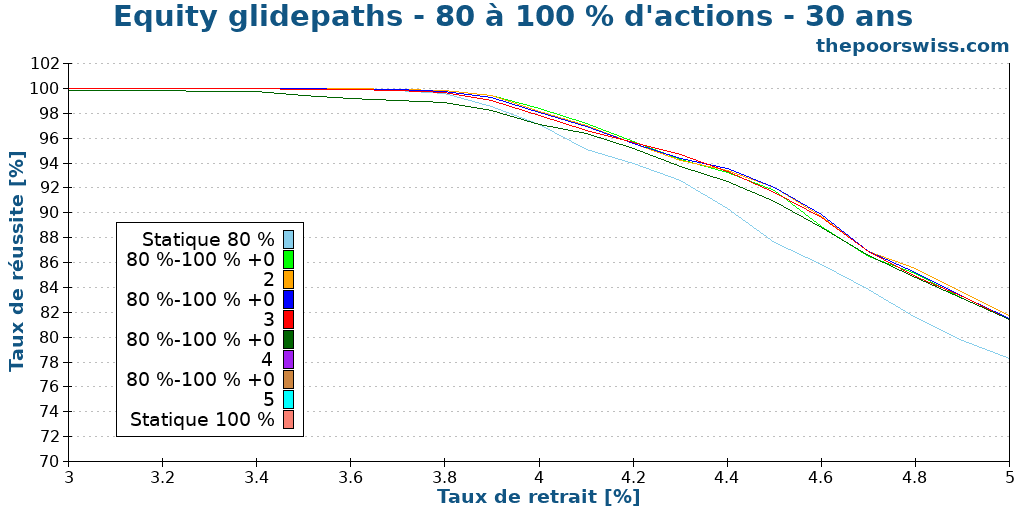
Nous pouvons constater plusieurs choses intéressantes. Tout d’abord, un glidepath constitue une nette amélioration par rapport à un portefeuille statique à 80 %. Cela permet d’augmenter considérablement le taux de réussite. Plus intéressant encore, un glidepath de 80 % à 100 % constitue également une amélioration par rapport à un portefeuille statique composé à 100 % d’actions.
Même sur une courte période, comme 30 ans de retraite, les equity glidepaths sont déjà intéressants.
Pour mieux voir les différences, nous pouvons examiner les taux de retrait à sûreté absolue de ces différentes simulations. Le taux de retrait à sûreté absolue est le taux le plus élevé qui n’aurait jamais échoué historiquement. Je peux également calculer les taux de retrait les plus élevés pour différents taux d’échec.
| Portefeuille | Sécurité maximale | 1% | 5% | 10% | 25% |
|---|---|---|---|---|---|
| Statique 80 % | 3.56 | 3.86 | 4.11 | 4.41 | 5.22 |
| 80%-100% +0.2 | 3.63 | 3.94 | 4.23 | 4.57 | 5.40 |
| 80%-100% +0.3 | 3.61 | 3.93 | 4.25 | 4.59 | 5.43 |
| 80%-100% +0.4 | 3.53 | 3.92 | 4.26 | 4.59 | 5.43 |
| 80%-100% +0.5 | 3.45 | 3.91 | 4.26 | 4.58 | 5.45 |
| Statique 100 % | 2.84 | 3.70 | 4.21 | 4.54 | 5.47 |
Une fois de plus, ces résultats sont très intéressants. Nous pouvons constater qu’un equity glidepath permet d’obtenir un taux de retrait à sécurité intégrée nettement plus élevé qu’un portefeuille statique à 100 %. Ils sont également meilleurs que le portefeuille fixe à 80 %. Vous pouvez donc utiliser un taux de retrait plus élevé et prendre votre retraite plus tôt (puisque vous devez accumuler moins d’argent).
Cependant, 30 ans est une période de retraite courte si l’on considère la retraite anticipée et elle est relativement facile à atteindre. Il faut donc voir ce qui se passe avec 40 ans de retraite.
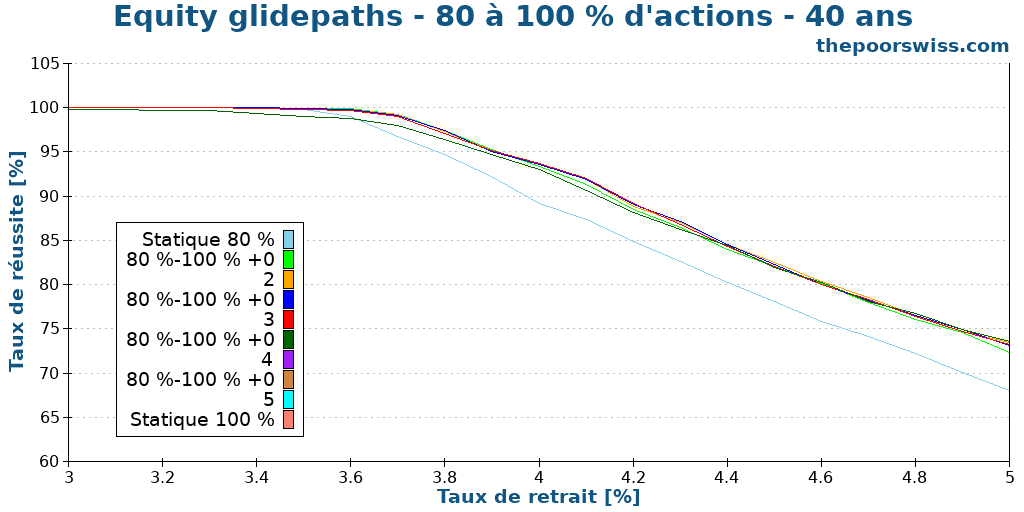
Ici, nous pouvons voir que les résultats sont assez différents. Tout d’abord, nous pouvons observer que le portefeuille statique de 80 % d’actions commence déjà à être à la traîne pour tout ce qui est supérieur à 3,6 %. Un equity glidepath constitue donc une amélioration intéressante par rapport à un portefeuille statique.
Nous pouvons également observer que les différences entre les différents glidepaths et le portefeuille statique à 100 % sont moins prononcées. Nous pouvons maintenant examiner les taux de retrait à sûreté absolue.
| Portefeuille | Sécurité maximale | 1% | 5% | 10% | 25% |
|---|---|---|---|---|---|
| Statique 80 % | 3.35 | 3.60 | 3.77 | 3.97 | 4.65 |
| 80%-100% +0.2 | 3.49 | 3.71 | 3.92 | 4.14 | 4.86 |
| 80%-100% +0.3 | 3.47 | 3.71 | 3.90 | 4.16 | 4.88 |
| 80%-100% +0.4 | 3.40 | 3.71 | 3.91 | 4.16 | 4.89 |
| 80%-100% +0.5 | 3.31 | 3.70 | 3.91 | 4.17 | 4.88 |
| Statique 100 % | 2.73 | 3.52 | 3.89 | 4.12 | 4.89 |
Si vous visez un taux de retrait à sûreté absolue, un equity glidepath vous apportera des améliorations significatives. Sans autoriser un taux d’échec important, des taux de retrait plus élevés sont obtenus avec les equity glidepaths.
Enfin, notre dernière période de simulation est de 50 ans.
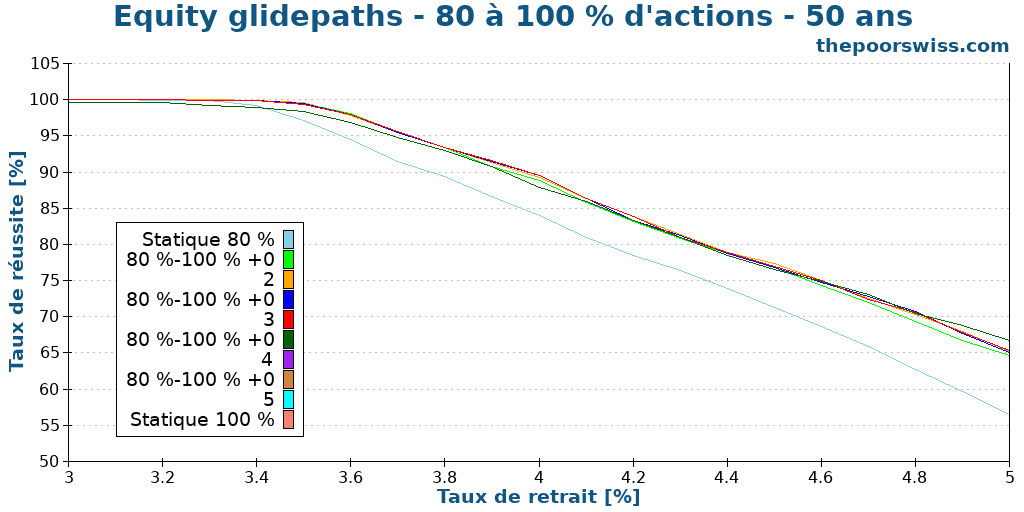
Ces résultats sont très similaires à ceux obtenus pour 40 ans, mais tous les chiffres sont légèrement inférieurs. Nous pouvons examiner directement les taux de retrait à sûreté intégrée pour les comparer.
| Portefeuille | Sécurité maximale | 1% | 5% | 10% | 25% |
|---|---|---|---|---|---|
| Statique 80 % | 3.19 | 3.41 | 3.57 | 3.78 | 4.35 |
| 80%-100% +0.2 | 3.37 | 3.55 | 3.72 | 3.96 | 4.57 |
| 80%-100% +0.3 | 3.35 | 3.54 | 3.72 | 3.95 | 4.60 |
| 80%-100% +0.4 | 3.28 | 3.54 | 3.72 | 3.96 | 4.59 |
| 80%-100% +0.5 | 3.20 | 3.54 | 3.72 | 3.96 | 4.60 |
| Statique 100 % | 2.63 | 3.35 | 3.69 | 3.93 | 4.59 |
Il est intéressant de noter que ces equity glidepaths apportent une amélioration significative par rapport aux portefeuilles statiques. Avec un faible taux d’échec, ces glidepaths vous permettent de retirer plus d’argent de votre portefeuille.
Nous pouvons également examiner ce qui se passe lorsque nous commençons à 60 % au lieu de 80 %.
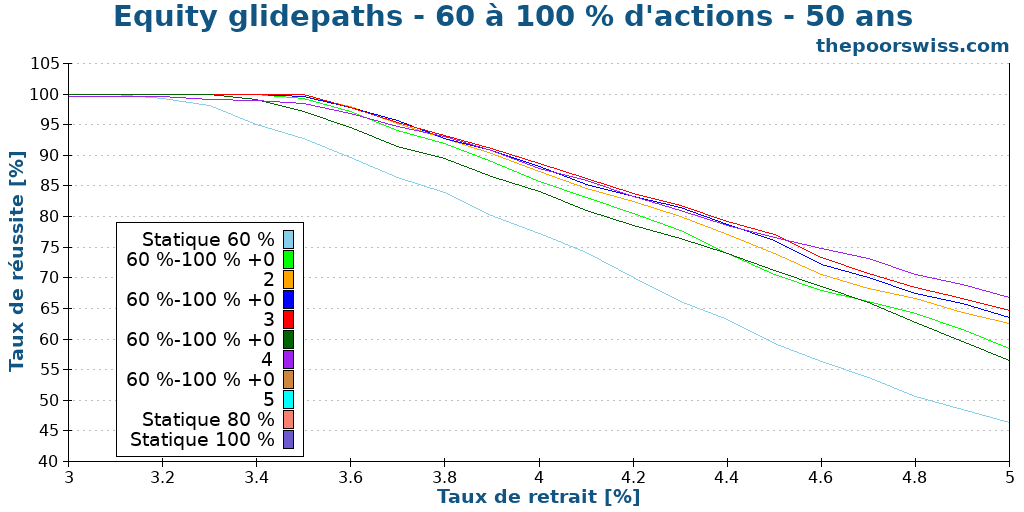
Ces résultats sont bien meilleurs que ce que j’attendais pour 60 % des actions. Un equity glidepath améliore sensiblement les performances par rapport à un portefeuille statique composé à 60 % d’actions.
Nous examinons les taux de retrait à sûreté absolue et les comparons au point de départ de 80 %.
| Portefeuille | Sécurité maximale | 1% | 5% | 10% | 25% |
|---|---|---|---|---|---|
| Statique 60 % | 3.09 | 3.24 | 3.40 | 3.59 | 4.08 |
| 60%-100% +0.2 | 3.38 | 3.51 | 3.66 | 3.88 | 4.36 |
| 60%-100% +0.3 | 3.46 | 3.55 | 3.70 | 3.91 | 4.47 |
| 60%-100% +0.4 | 3.45 | 3.53 | 3.72 | 3.92 | 4.54 |
| 60%-100% +0.5 | 3.46 | 3.55 | 3.71 | 3.94 | 4.56 |
| Statique 80 % | 3.19 | 3.41 | 3.57 | 3.78 | 4.35 |
| 80%-100% +0.2 | 3.37 | 3.55 | 3.72 | 3.96 | 4.57 |
| 80%-100% +0.3 | 3.35 | 3.54 | 3.72 | 3.95 | 4.60 |
| 80%-100% +0.4 | 3.28 | 3.54 | 3.72 | 3.96 | 4.59 |
| 80%-100% +0.5 | 3.20 | 3.54 | 3.72 | 3.96 | 4.60 |
| Statique 100 % | 2.63 | 3.35 | 3.69 | 3.93 | 4.59 |
Là encore, ces résultats sont très intéressants. Je ne m’attendais pas à ce qu’un point de départ de 60 % soit aussi bon. Un equity glidepath de 60 à 100 % est plus performant qu’un equity glidepath de 80 à 100 % dans certaines situations, notamment en matière de sécurité absolue.
Equity glidepath vers 80 % d’actions
Nous pouvons également tester un deuxième objectif, à savoir 80 % de stocks au lieu de 100 %. Cette fois-ci, nous commencerons directement à 50 ans de retraite, qui est la durée de retraite la plus intéressante.
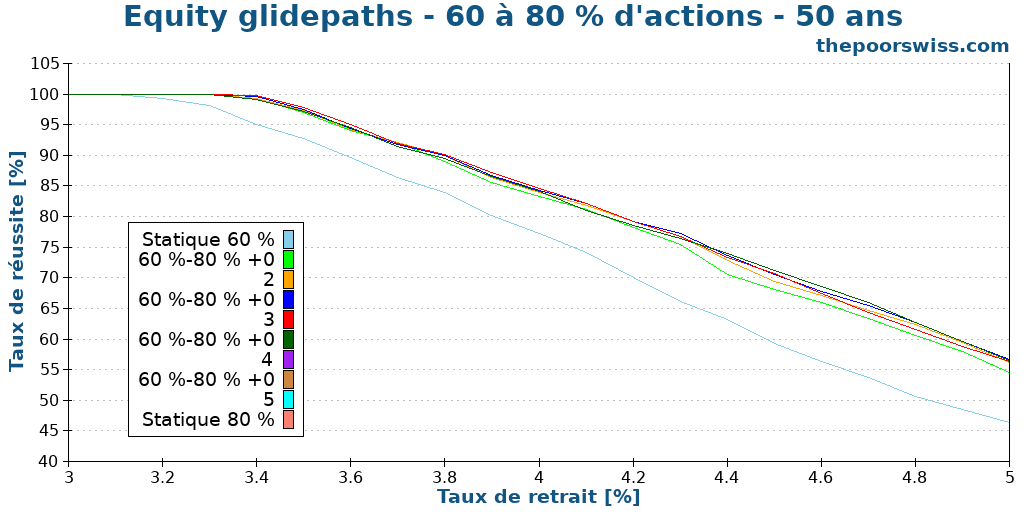
Nous pouvons observer que les glidepaths augmentent de manière significative le taux de réussite du portefeuille statique de 60 % d’actions. Dans certains cas, en passant d’un portefeuille statique à un glidepath, nous pouvons augmenter notre taux de réussite de 10 %.
Les taux de retrait à sûreté absolue sont à nouveau visibles pour ces résultats.
| Portefeuille | Sécurité maximale | 1% | 5% | 10% | 25% |
|---|---|---|---|---|---|
| Statique 60 % | 3.09 | 3.24 | 3.40 | 3.59 | 4.08 |
| 60%-80% +0.2 | 3.28 | 3.42 | 3.56 | 3.77 | 4.31 |
| 60%-80% +0.3 | 3.32 | 3.42 | 3.57 | 3.79 | 4.34 |
| 60%-80% +0.4 | 3.36 | 3.41 | 3.57 | 3.79 | 4.36 |
| 60%-80% +0.5 | 3.37 | 3.44 | 3.60 | 3.80 | 4.36 |
| Statique 80 % | 3.19 | 3.41 | 3.57 | 3.78 | 4.35 |
Ces résultats sont encore meilleurs que ceux observés précédemment. En effet, le meilleur taux de retrait est toujours obtenu avec un equity glidepath. En moyenne, le meilleur glidepath est le plus rapide.
Nous pouvons voir ce qui se passe si nous utilisons un point de départ de 40 %.
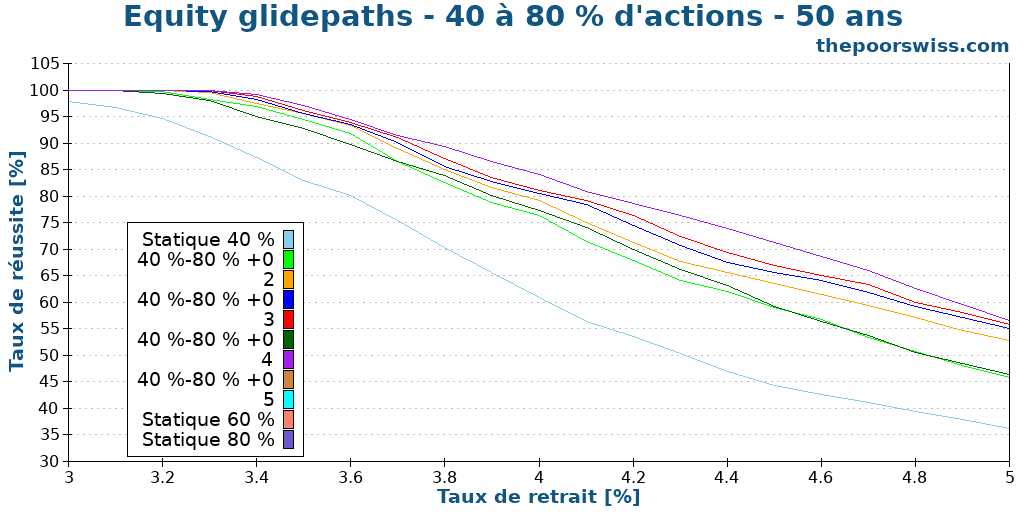
Nous pouvons observer deux choses ici. Tout d’abord, comme nous l’avons vu dans d’autres articles, 40 % est insuffisant pour les longues périodes de retraite. Deuxièmement, les equity glidepaths s’améliorent toujours par rapport au portefeuille statique de 40 %. C’est logique puisque ce portefeuille a une bonne volatilité mais de mauvais rendements.
Là encore, nous examinons les taux de retrait à sûreté absolue.
| Portefeuille | Sécurité maximale | 1% | 5% | 10% | 25% |
|---|---|---|---|---|---|
| Statique 40 % | 2.80 | 2.96 | 3.19 | 3.32 | 3.71 |
| 40%-80% +0.2 | 3.11 | 3.26 | 3.48 | 3.62 | 4.03 |
| 40%-80% +0.3 | 3.17 | 3.32 | 3.52 | 3.67 | 4.10 |
| 40%-80% +0.4 | 3.25 | 3.37 | 3.52 | 3.70 | 4.18 |
| 40%-80% +0.5 | 3.28 | 3.38 | 3.54 | 3.71 | 4.24 |
| Statique 60 % | 3.09 | 3.24 | 3.40 | 3.59 | 4.08 |
| Statique 80 % | 3.19 | 3.41 | 3.57 | 3.78 | 4.35 |
Les equity glidepaths améliorent de manière significative les portefeuilles statiques à 40 % et même à 60 %. Toutefois, ces résultats sont encore insuffisants par rapport aux résultats précédents. En pratique, 40 % d’actions sont insuffisants pour une longue retraite anticipée.
Glidepaths inversés
Nous devrions vérifier notre hypothèse selon laquelle le glidepath devrait augmenter notre allocation d’actions. Pour ce faire, j’ai également testé quelques equity glidepaths inversés. La différence est que nous passons de 100 % d’actions à 80 % d’actions.
Voici les résultats pour 50 ans de retraite.
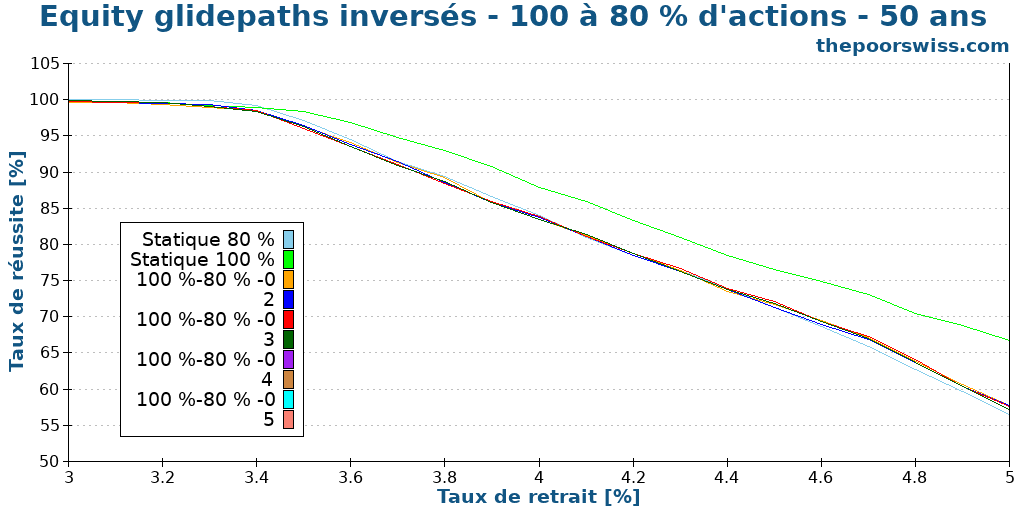
Comme prévu, le meilleur portefeuille reste le portefeuille statique à 100 %. L’ajout d’obligations à un portefeuille d’actions n’est d’aucune utilité pour la retraite. Nous pouvons à nouveau examiner les taux de sécurité.
| Portefeuille | Sécurité maximale | 1% | 5% | 10% | 25% |
|---|---|---|---|---|---|
| Statique 80 % | 3.19 | 3.41 | 3.57 | 3.78 | 4.35 |
| Statique 100 % | 2.63 | 3.35 | 3.69 | 3.93 | 4.59 |
| 100%-80% -0.2 | 2.61 | 3.29 | 3.55 | 3.77 | 4.35 |
| 100%-80% -0.3 | 2.66 | 3.32 | 3.54 | 3.75 | 4.37 |
| 100%-80% -0.4 | 2.69 | 3.32 | 3.53 | 3.74 | 4.37 |
| 100%-80% -0.5 | 2.77 | 3.32 | 3.54 | 3.74 | 4.35 |
Les equity glidepaths sont légèrement meilleurs que le portefeuille statique 100 % actions pour le taux de retrait à sûreté absolue, mais ils sont strictement moins bons que le portefeuille statique 80 % actions. Dans tous les autres cas, les portefeuilles statiques sont meilleurs.
Encore une fois, cela est logique car nous utilisons les obligations pour le long terme alors qu’elles devraient être utilisées pour le court terme. Par conséquent, il ne faut pas utiliser les equity glidepaths inversés.
Résumé
Enfin, nous pouvons examiner tous les glidepaths dans un tableau récapitulatif et tirer quelques conclusions.
| Portefeuille | Sécurité maximale | 1% | 5% | 10% | 25% |
|---|---|---|---|---|---|
| Statique 40 % | 2.80 | 2.96 | 3.19 | 3.32 | 3.71 |
| 40%-80% +0.2 | 3.11 | 3.26 | 3.48 | 3.62 | 4.03 |
| 40%-80% +0.3 | 3.17 | 3.32 | 3.52 | 3.67 | 4.10 |
| 40%-80% +0.4 | 3.25 | 3.37 | 3.52 | 3.70 | 4.18 |
| 40%-80% +0.5 | 3.28 | 3.38 | 3.54 | 3.71 | 4.24 |
| 40%-100% 0.2 | 3.15 | 3.27 | 3.52 | 3.66 | 4.09 |
| 40%-100% +0.3 | 3.27 | 3.43 | 3.60 | 3.77 | 4.16 |
| 40%-100% +0.4 | 3.35 | 3.48 | 3.65 | 3.81 | 4.27 |
| 40%-100% +0.5 | 3.43 | 3.51 | 3.65 | 3.83 | 4.35 |
| Statique 60 % | 3.09 | 3.24 | 3.40 | 3.59 | 4.08 |
| 60%-80% +0.2 | 3.28 | 3.42 | 3.56 | 3.77 | 4.31 |
| 60%-80% +0.3 | 3.32 | 3.42 | 3.57 | 3.79 | 4.34 |
| 60%-80% +0.4 | 3.36 | 3.41 | 3.57 | 3.79 | 4.36 |
| 60%-80% +0.5 | 3.37 | 3.44 | 3.60 | 3.80 | 4.36 |
| 60%-100% +0.2 | 3.38 | 3.51 | 3.66 | 3.88 | 4.36 |
| 60%-100% +0.3 | 3.46 | 3.55 | 3.70 | 3.91 | 4.47 |
| 60%-100% +0.4 | 3.45 | 3.53 | 3.72 | 3.92 | 4.54 |
| 60%-100% +0.5 | 3.46 | 3.55 | 3.71 | 3.94 | 4.56 |
| Statique 80 % | 3.19 | 3.41 | 3.57 | 3.78 | 4.35 |
| 80%-100% +0.2 | 3.37 | 3.55 | 3.72 | 3.96 | 4.57 |
| 80%-100% +0.3 | 3.35 | 3.54 | 3.72 | 3.95 | 4.60 |
| 80%-100% +0.4 | 3.28 | 3.54 | 3.72 | 3.96 | 4.59 |
| 80%-100% +0.5 | 3.20 | 3.54 | 3.72 | 3.96 | 4.60 |
| Statique 100 % | 2.63 | 3.35 | 3.69 | 3.93 | 4.59 |
Pour moi, le résultat le plus intéressant est qu’un equity glidepath est toujours une amélioration par rapport au portefeuille statique du point de départ. En outre, il s’agit souvent d’une amélioration par rapport au portefeuille statique du point d’arrivée.
Je suis surpris par l’efficacité des equity glidepaths de 60 à 100 %. Je ne m’attendais pas à ce qu’ils soient aussi performants. Je m’attendais à ce que les taux de 80 % à 100 % soient meilleurs. Mais elles ne sont meilleures que si vous prévoyez des taux d’échec plus élevés dans votre planification.
Si la différence entre vos points de départ et d’arrivée est importante, vous aurez besoin d’un glidepath rapide. À l’avenir, j’envisagerai peut-être d’augmenter les vitesses de glidepath.
Un autre fait intéressant est que si vous êtes intéressé par les stratégies à sécurité intégrée, vous pouvez suivre un glidepath relativement lent. Mais si vous autorisez un taux d’échec plus élevé, vous pouvez adopter un glidepath plus lent.
Nous devrions également nous demander si un equity glidepath est toujours meilleur. Les glidepaths sont excellents lorsque nous commençons à un mauvais moment. Les pires moments pour prendre sa retraite sont les pics du marché. Dans ce cas, vous souhaitez que les obligations aient une faible volatilité afin que votre portefeuille ne s’effondre pas trop.
Mais un equity glidepath sera nettement moins performant qu’un portefeuille statique comportant plus d’actions lorsque nous commençons à un bon moment. Les meilleurs moments pour prendre sa retraite se situent au plus bas des marchés. Dans ce cas, il est préférable d’opter pour un portefeuille d’actions important afin de faire fructifier rapidement votre portefeuille.
Les equity glidepaths sont donc très utiles pour améliorer le taux de réussite moyen, mais ils présentent encore des inconvénients dans certains cas. Néanmoins, si vous souhaitez bénéficier d’une stratégie de retraite sûre, ces equity glidepaths méritent d’être pris en considération.
Conclusion
Les equity glidepaths sont un excellent moyen d’améliorer votre taux de réussite à la retraite. Au lieu d’avoir une répartition fixe des actions, nous pouvons l’augmenter à partir d’un point de départ au fil du temps. Par exemple, un equity glidepath allant de 60 % d’actions à 100 % d’actions donne de bons résultats si vous souhaitez vous concentrer sur des taux de retrait à sûreté absolue.
Les obligations et les actions présentent toutes deux des avantages uniques. Les obligations constituent une excellente option pour se protéger contre le risque lié aux séquences de rendement en raison de leur faible volatilité. Les actions, quant à elles, permettent d’éviter de se retrouver à court d’argent grâce à des rendements plus élevés. Par conséquent, il est judicieux d’envisager de s’appuyer sur les obligations au cours des premières années, lorsque le risque lié aux séquences de rendement est préoccupant, tandis que les actions peuvent être plus avantageuses au cours des dernières années, afin d’assurer la longévité de votre portefeuille.
Par conséquent, il est très judicieux de commencer par les obligations et de réduire progressivement leur allocation. Ainsi, les obligations et les actions font ce qu’elles savent faire de mieux. Par conséquent, nous obtenons de meilleurs taux de réussite et nous pourrions utiliser un taux de retrait plus élevé pour le même taux d’échec cible.
Les personnes qui envisagent de prendre leur retraite avec une allocation fixe en obligations devraient envisager un equity glidepath. Il en résultera probablement une retraite plus sûre.
Ces résultats m’incitent à reconsidérer mon portefeuille d’actions à 100 % pour la retraite. Ce portefeuille est excellent pour la phase d’accumulation mais peut être sous-optimal à la retraite. Il faudra que j’y réfléchisse davantage.
Il est intéressant de noter que nous pouvons également faire un glidepath plus simple en vendant uniquement des obligations à la retraite. De cette façon, nous aurons un glidepath où la partie obligations disparaîtra lentement, et nous nous retrouverons ensuite avec des actions uniquement. Et si vous aimez avoir des paramètres dynamiques à la retraite, vous pourriez apprécier les taux de retrait dynamiques.
Prévoyez-vous de prendre votre retraite avec des obligations ? Envisagez-vous un equity glidepath ?
Si le sujet vous intéresse, je pourrais mener d’autres expériences sur les equity glidepaths, car il y a plus de paramètres à explorer.
Prochains articles

Le risque de séquence de rendements peut ruiner votre retraite
Protégez votre retraite. Découvrez ce qu’est le risque lié à l’ordre des rendements et comment un krach boursier au début de la retraite peut détruire votre portefeuille.
Comment calculer votre ratio d’indépendance financière?
Comment calculer votre ratio d'indépendance financière. Comment utiliser le taux de retrait sûr pour savoir combien vous devez épargner.
Devriez-vous vendre des actions ou des obligations à la retraite ?
Stratégie de retrait. Faut-il vendre d’abord des actions ou des obligations à la retraite ? Nous simulons différentes stratégies pour trouver celle qui préserve votre capital.
Apprenez des moyens faciles d'optimiser vos finances et d'économiser des milliers de francs en Suisse avec notre e-book exclusif. Découvrez les services financiers les plus rentables adaptés aux résidents avisés et aux expatriés!
Obtenez votre guide suisse d'économies GRATUIT
C’est bon, j’ai tout capté. Merci d’avoir mentionné le « risque de séquence de retours ». J’ai relu ton article à ce sujet (https://thepoorswiss.com/fr/risque-sequence-rendements/) et c’est la pièce du puzzle qui me manquait. Tu devrais faire un lien entre tes 2 articles, ça aidera beaucoup tes lecteurs. Encore merci pour ta patience.
Super :)
Excellent point, je vais ajouter un lien, ça va aider en effet!
Bonjour,
merci pour cet article. Si on est investi 100% actions, le conseil serait de passer à 20% obligations et 80% actions combien de temps avant la retraite? Pour ensuite être à cet exposition au début de retraite et faire un equity glidepath de 80 à 100% au cours de la retraite.
Les obligations sont aussi soumises à changement de cours, comme lors de l’inflation comme actuellement, donc cela peut ne pas forcément être une protection si le marché est baissier + inflation, c’est juste?
Dans un des articles du blog sur comparaison obligation-cash, il était finalement conclu que cela valait aussi de finalement garder ce « 20% » par exemple en cash au lieu d’acheter des obligations.
Les obligations qui ne sont pas sur le cours du marché et sont redonnés au même montant après le temps prévu sont difficiles à acquérir car chère à l’achat et peu disponible pour les particuliers ou je me trompe?
J’avais lu dans un article que l’argent du 2e pilier peut être considéré comme une obligation donc à compter en pourcentage dans son allocation totale. Cela représente en principe une grande somme.
Bonjour Mel,
Alors, ça n’est pas strictement nécessaire de faire un glidepath. C’est possible de faire 100% en actions à la retraite, le problème étant les risuqes les premières années.
Mais si vous voulez passez de 100% en accumulation à un glidepath 80->100 à la retraite, c’est suffisant je pense de changer le jour de début de la retraite.
C’est correct que les actions ont leur propre risques (surtout les fonds en action).
Garder 20% en cash n’est pas une mauvaise idée non plus. On pourrait d’ailleurs faire un glidepoath en cash également.
Non, vous ne vous trompez pas. Les obligations de caisses vendues par les banques sont souvent très inférieures aux taux directeurs et du coup peu efficaces malheureusement.
En effet, je considère le second pilier comme des obligations. Mais il ne faut pas oublier que le jour ou vous touchez le second pilier, vous allez devoir l’investir et du coup, ça ne sera plus 100% en actions.
Bonjour Baptiste,
Merci pour cette article fort intéressant mais une chose m’échappe. Quel est le réel intérêt du glidepath? Je veux dire, on sait déjà qu’un FIRE a plus de chance de succès en se rapprochant d’une stratégie 100% actions toutefois une part d’obligation (20% par exemple) permet de limiter le risque d’effondrement du marché et une perte de notre capital. Du coup, de mon point de vue, le glidepath est juste un changement de stratégie en fonction de notre aversion aux risques mais je ne vois pas l’intérêt de modifier la répartition des actions au fil du temps. Autant faire la modification en un coup et passer en 100% actions et dès aujourd’hui, les chances de succès du FIRE serait bien plus élevées.
Bonjour Greg,
Comme tu l’as dit, les actions permettent de tenir plus longtemps à cause de leurs performance et les obligations permettent de se protéger contre les risques.
Ce qui est important, c’est que le risque majeur est un gros effondrement des actions au début de la retraite (5 premières années environ). Après ça, c’est moins risqué car le capital aura probablement déjà augmenté.
Avec un glidepath, tu commences avec des obligations les premières années. Elles te protègent donc en cas de gros crash et petit à petit, tu les convertis en actions, ce qui va augmenter ta performance pour le long-terme.
Du coup, tu profites des obligations et des actions au bon moment.
Bonjour Baptiste,
Merci pour les infos supplémentaires. Je crois avoir saisi l’info qu’il me manquait. Il vaut mieux partir en early retirement avec 20% d’obligations que 100% actions.
Mais Il y a toujours une part du concept qui m’échappe.
je comprends très bien le risque d’effondrement des actions mais quand on est en early retirement, le risque est présent et impactant pas seulement les 5 premières années de early retirement mais sur plus de temps. Imaginons un départ en early retirement à 50 ans (ce qui est mon objectif), un effondrement de la bourse à mes 55 ans ou 60 ans sera très impactant sur mon capital et mon taux de retrait (Note: Je ne considère pas la période au delà de mes 65 ans car je devrais toucher en plus le 2ème et 3ème pilier en rente ce qui sera une sécurité supplémentaire en cas d’effondrement du marché). Et faire du glidepath à des taux de 0.1 ou 0.5 par mois me semble trop timide, la crise sera déjà passé avant d’arriver à 100% actions…et une nouvelle crise arrivera à ce moment là, damned!
Bien entendu, le risque est toujours présent. Mais il est bien plus grand au début parce que votre portefeuille va grandir.
Si les 5 premières années vous avez 10%+ de perforamnce par année, et après vous avez un crash, vous êtes dans une bien meilleure situation que si le crash arrive la première année. C’est ce qu’on appelle le risque de séquence de retours.