
Equity Glidepaths im Ruhestand
| Aktualisiert: |
(Offenlegung: Einige der unten aufgeführten Links können Affiliate-Links sein)
In diesem Blog habe ich zahlreiche Ruhestandssimulationen durchgeführt, bei denen die Aufteilung auf Aktien und Anleihen unverändert blieb. Es besteht jedoch die Überzeugung, dass eine Änderung der Zuweisungen zu besseren Ergebnissen führen kann.
Ein Equity Glidepath ist eine Methode zur Änderung der Aktienallokation im Laufe der Zeit. Sie können sowohl in der Anspar- als auch in der Rentenphase genutzt werden.
In diesem Artikel werden die Gleitpfade für Aktien im Ruhestand simuliert, um zu sehen, ob dies unsere Ergebnisse verbessern kann.
Aktien-Gleitpfade
Als Anleger, der einen passiven Ansatz bevorzugt, vermeide ich es, mein Portfolio im Laufe der Zeit zu verändern. Ich habe jedoch zahlreiche Anfragen von meinen Lesern zu Equity Glidepaths erhalten, die mein Interesse geweckt haben. Ich bin neugierig darauf, ihre praktische Anwendung zu erkunden.
Ein Equity Glidepath ist eine Möglichkeit, Ihre Aktienallokation im Laufe der Zeit zu ändern. Sie könnten zum Beispiel innerhalb von fünf Jahren von 80 % Aktien auf 60 % Aktien umsteigen. Dieses Beispiel wäre ein Equity Glidepath.
Wenn Ihnen das bekannt vorkommt, liegt das vielleicht daran, dass Sie schon einmal über Zielrentenfonds gelesen haben. Diese Fonds werden von allen großen Fondsanbietern angeboten und verwenden eine abnehmende Aktienquote. Wenn Sie das Rentenalter erreichen, sinkt Ihr Aktienanteil. Nach Erreichen des Zieldatums wird die Aktienzuteilung im Allgemeinen nicht mehr geändert. Dies ist ein Beispiel für einen Equity Glidepath in der Akkumulationsphase.
Die andere Alternative ist ein gleitender Aktienpfad im Ruhestand. In diesem Fall ändern wir die Aktienallokation im Laufe der Zeit nach der Pensionierung. Darauf möchte ich mich in diesem Artikel konzentrieren.
Anleihen und Aktien sind beide in einem Portfolio attraktiv. Aktien sind großartig für Renditen, die für die langfristigen Ergebnisse eines Ruhestands hilfreich sind (damit er länger dauert). Und Anleihen sind gut gegen Volatilität, was gut ist, um das Risiko von Renditefolgen zu bekämpfen.
Da wir uns für den Vorruhestand interessieren, müssen wir lange Zeiträume, bis zu 50 oder sogar 60 Jahren, in Betracht ziehen. Dazu brauchen wir einen hohen Anteil an Aktien.
Theoretisch würde eine steigende Aktienquote am besten funktionieren, da sie sowohl langfristigen als auch kurzfristigen Schutz bieten würde. Aber wir werden beides testen.
Simulationen
Im Laufe der Zeit habe ich in meinem Blog viele Simulationen für den Ruhestand durchgeführt. Die Simulationen werden in Anlehnung an die Trinity-Studie durchgeführt.
Ich verwende die gleichen Daten wie bei anderen Simulationen. Wir verwenden US-Aktiendaten von 1871 bis 2022 und 10Y US-Anleihen für die gleichen Zeiträume. Wir verwenden in jedem Fall monatliche Renditen. Und jede Simulation beginnt bei jedem möglichen Monat des Ruhestandszeitraums.
In der vorliegenden Simulation werde ich die Aktienzuteilung monatlich vor der Entnahme anpassen. Jede Anpassung erfolgt schrittweise (z. B. 0,1 % pro Monat). Der Schritt bestimmt, wie schnell der Gleitpfad verläuft.
Für diesen Artikel musste ich den Erfolg von mehreren Millionen von Simulationen berechnen.
Gleitpfad zu 100% Aktien
Wir beginnen mit einem gleitenden Aktienpfad und erhöhen den Aktienanteil auf 100 %.
Das Problem bei Gleitpfaden ist, dass es unendlich viele davon gibt. Sie können an einem beliebigen Startpunkt und einem beliebigen Endpunkt beginnen. Darüber hinaus kann auch der Schritt jeder monatlichen Anpassung beliebig sein. Wir müssen also einige Entscheidungen treffen.
Zunächst werden wir einfache Gleitpfade testen, von 80 % Aktien zu 100 % Aktien, mit verschiedenen Schritten. Wir können dies mit statischen Portfolios mit 80 % und 100 % Aktienanteil vergleichen. Wir werden mit 30 Jahren Ruhestand beginnen.
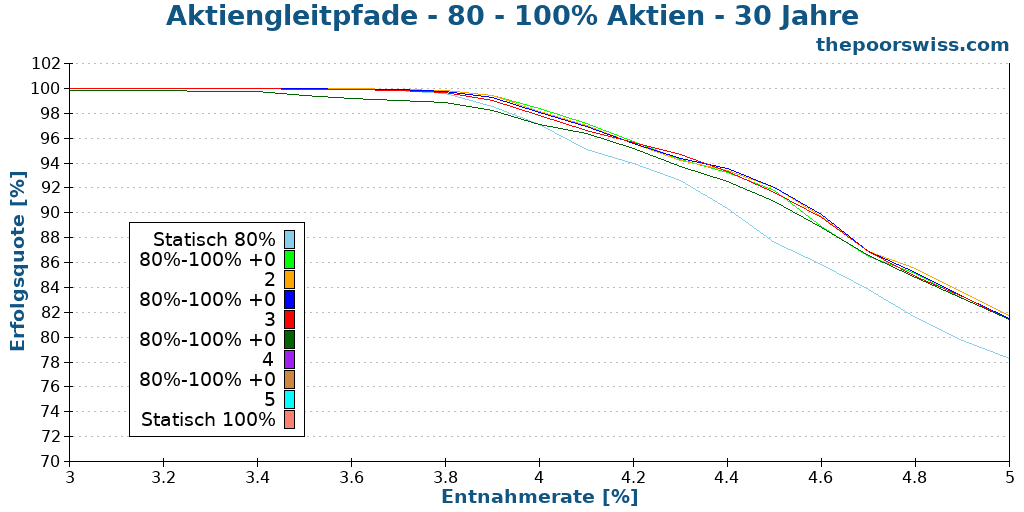
Wir können mehrere interessante Dinge sehen. Erstens ist ein Gleitpfad eine eindeutige Verbesserung gegenüber einem statischen 80 %-Portfolio. Dadurch lässt sich die Erfolgsquote erheblich steigern. Und noch interessanter ist, dass ein gleitender Pfad von 80 % auf 100 % auch eine Verbesserung gegenüber einem statischen 100 %-Aktienportfolio darstellt.
Selbst über einen kurzen Zeitraum, etwa 30 Jahre im Ruhestand, sind die Gleitpfade für Aktien bereits interessant.
Um die Unterschiede besser zu erkennen, können wir die ausfallsicheren Entnahmeraten dieser verschiedenen Simulationen betrachten. Die ausfallsichere Entnahmequote ist die höchste, die in der Vergangenheit nie ausgefallen wäre. Ich kann auch die höchsten Entnahmeraten für verschiedene Ausfallraten berechnen.
| Portfolio | Ausfallsicher | 1% | 5% | 10% | 25% |
|---|---|---|---|---|---|
| Statisch 80% | 3.56 | 3.86 | 4.11 | 4.41 | 5.22 |
| 80%-100% +0.2 | 3.63 | 3.94 | 4.23 | 4.57 | 5.40 |
| 80%-100% +0.3 | 3.61 | 3.93 | 4.25 | 4.59 | 5.43 |
| 80%-100% +0.4 | 3.53 | 3.92 | 4.26 | 4.59 | 5.43 |
| 80%-100% +0.5 | 3.45 | 3.91 | 4.26 | 4.58 | 5.45 |
| Statisch 100% | 2.84 | 3.70 | 4.21 | 4.54 | 5.47 |
Auch diese Ergebnisse sind sehr interessant. Wir sehen, dass ein Equity Glidepath eine deutlich höhere ausfallsichere Entnahmerate bietet als ein statisches 100%-Portfolio. Und sie sind auch besser als das Portfolio mit festen 80 %. Sie könnten also eine höhere Entnahmerate verwenden und früher in Rente gehen (da Sie weniger ansparen müssen).
30 Jahre sind jedoch eine kurze Rentenzeit, wenn man den Vorruhestand in Betracht zieht, und sie sind relativ leicht zu erreichen. Deshalb müssen wir sehen, was mit 40 Jahren Ruhestand passiert.
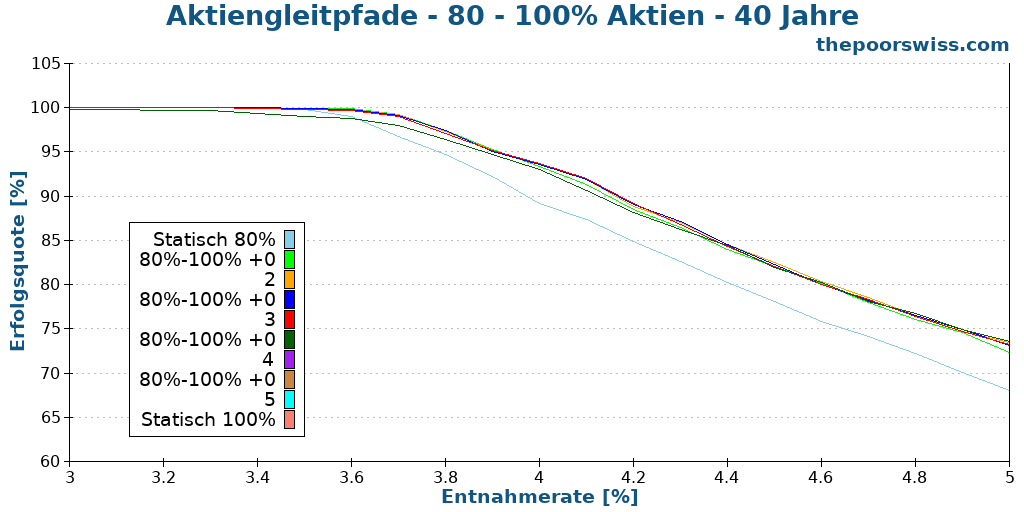
Hier können wir sehen, dass die Ergebnisse ziemlich unterschiedlich sind. Erstens können wir feststellen, dass das statische 80 %-Aktienportfolio bereits bei einem Wert von mehr als 3,6 % ins Hintertreffen gerät. Somit stellt ein Equity Glidepath eine interessante Verbesserung gegenüber dem statischen Portfolio dar.
Außerdem ist zu beobachten, dass die Unterschiede zwischen den verschiedenen Gleitpfaden und dem statischen 100%-Portfolio weniger ausgeprägt sind. Wir können uns jetzt die ausfallsicheren Entnahmeraten ansehen.
| Portfolio | Ausfallsicher | 1% | 5% | 10% | 25% |
|---|---|---|---|---|---|
| Statisch 80% | 3.35 | 3.60 | 3.77 | 3.97 | 4.65 |
| 80%-100% +0.2 | 3.49 | 3.71 | 3.92 | 4.14 | 4.86 |
| 80%-100% +0.3 | 3.47 | 3.71 | 3.90 | 4.16 | 4.88 |
| 80%-100% +0.4 | 3.40 | 3.71 | 3.91 | 4.16 | 4.89 |
| 80%-100% +0.5 | 3.31 | 3.70 | 3.91 | 4.17 | 4.88 |
| Statisch 100% | 2.73 | 3.52 | 3.89 | 4.12 | 4.89 |
Wenn Sie eine ausfallsichere Entnahmerate anstreben, wird ein Equity Glidepath erhebliche Verbesserungen bringen. Ohne eine hohe Ausfallquote zuzulassen, werden mit Equity Glidepaths höhere Entnahmeraten erzielt.
Schließlich gehen wir zu 50 Jahren als letztem Simulationszeitraum über.
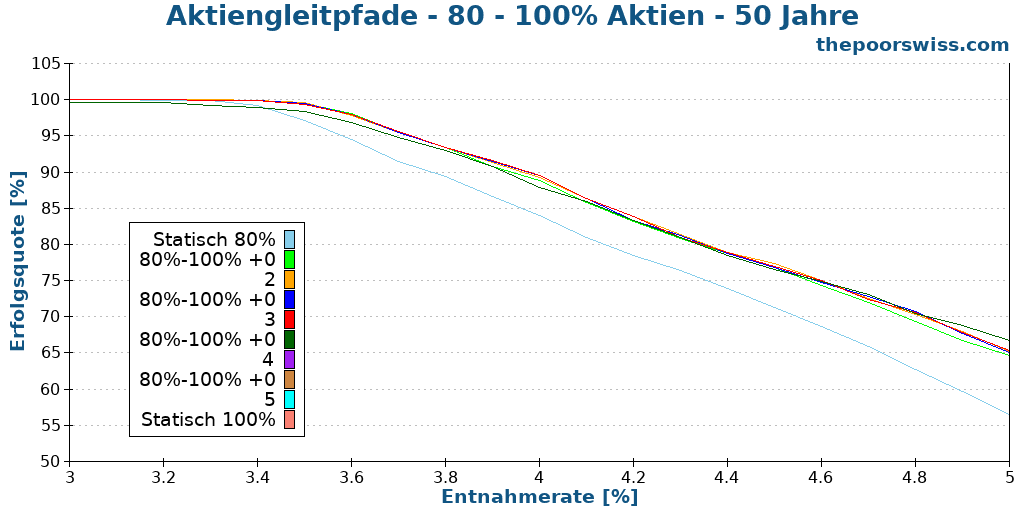
Diese Ergebnisse sind denen für 40 Jahre sehr ähnlich, aber alle Zahlen sind etwas niedriger. Wir können die ausfallsicheren Entnahmeraten direkt betrachten, um sie zu vergleichen.
| Portfolio | Ausfallsicher | 1% | 5% | 10% | 25% |
|---|---|---|---|---|---|
| Statisch 80% | 3.19 | 3.41 | 3.57 | 3.78 | 4.35 |
| 80%-100% +0.2 | 3.37 | 3.55 | 3.72 | 3.96 | 4.57 |
| 80%-100% +0.3 | 3.35 | 3.54 | 3.72 | 3.95 | 4.60 |
| 80%-100% +0.4 | 3.28 | 3.54 | 3.72 | 3.96 | 4.59 |
| 80%-100% +0.5 | 3.20 | 3.54 | 3.72 | 3.96 | 4.60 |
| Statisch 100% | 2.63 | 3.35 | 3.69 | 3.93 | 4.59 |
Interessanterweise bieten diese gleitenden Aktienpfade eine deutliche Verbesserung gegenüber statischen Portfolios. Diese Gleitpfade haben eine niedrige Ausfallquote und ermöglichen es Ihnen, mehr Geld aus Ihrem Portfolio zu entnehmen.
Wir können uns auch ansehen, was passiert, wenn wir bei 60 % statt bei 80 % beginnen.
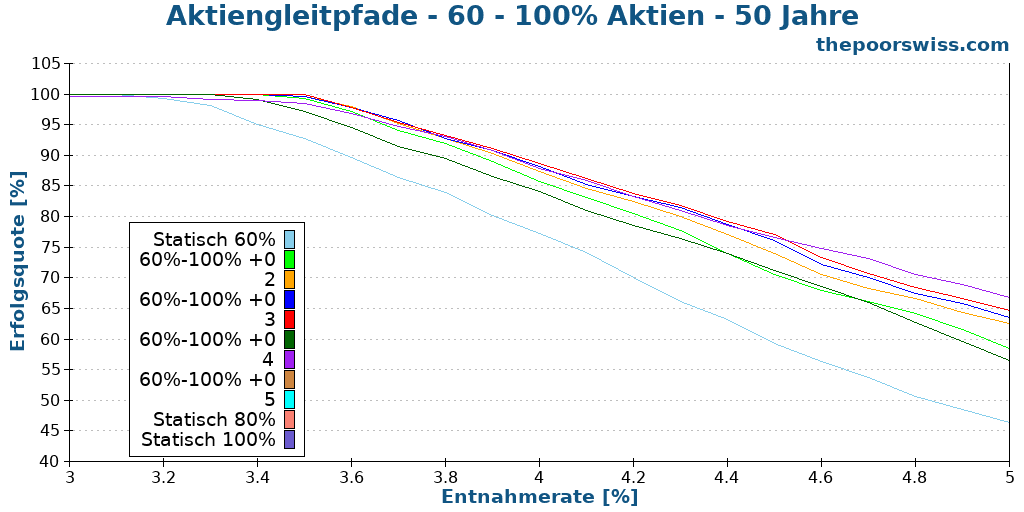
Diese Ergebnisse sind viel besser, als ich für 60 % der Aktien erwartet hatte. Ein Aktiengleitpfad verbessert die Leistung signifikant gegenüber einem statischen 60% Aktienportfolio.
Wir betrachten die ausfallsicheren Entnahmeraten und vergleichen sie mit der Ausgangsbasis von 80 %.
| Portfolio | Ausfallsicher | 1% | 5% | 10% | 25% |
|---|---|---|---|---|---|
| Statisch 60% | 3.09 | 3.24 | 3.40 | 3.59 | 4.08 |
| 60%-100% +0.2 | 3.38 | 3.51 | 3.66 | 3.88 | 4.36 |
| 60%-100% +0.3 | 3.46 | 3.55 | 3.70 | 3.91 | 4.47 |
| 60%-100% +0.4 | 3.45 | 3.53 | 3.72 | 3.92 | 4.54 |
| 60%-100% +0.5 | 3.46 | 3.55 | 3.71 | 3.94 | 4.56 |
| Statisch 80% | 3.19 | 3.41 | 3.57 | 3.78 | 4.35 |
| 80%-100% +0.2 | 3.37 | 3.55 | 3.72 | 3.96 | 4.57 |
| 80%-100% +0.3 | 3.35 | 3.54 | 3.72 | 3.95 | 4.60 |
| 80%-100% +0.4 | 3.28 | 3.54 | 3.72 | 3.96 | 4.59 |
| 80%-100% +0.5 | 3.20 | 3.54 | 3.72 | 3.96 | 4.60 |
| Statisch 100% | 2.63 | 3.35 | 3.69 | 3.93 | 4.59 |
Auch diese Ergebnisse sind sehr interessant. Es war unerwartet, dass ein 60%-Ausgangspunkt so gut abschneidet. Ein 60% bis 100% Gleitpfad zeigt in einigen Situationen eine bessere Leistung als der 80% bis 100% Gleitpfad, insbesondere im ausfallsicheren Szenario.
Gleitpfad zu 80% Aktien
Wir können auch ein zweites Ziel testen, nämlich 80 % Aktien anstelle von 100 % Aktien. Dieses Mal beginnen wir direkt mit dem 50. Lebensjahr, der interessantesten Dauer des Ruhestands.
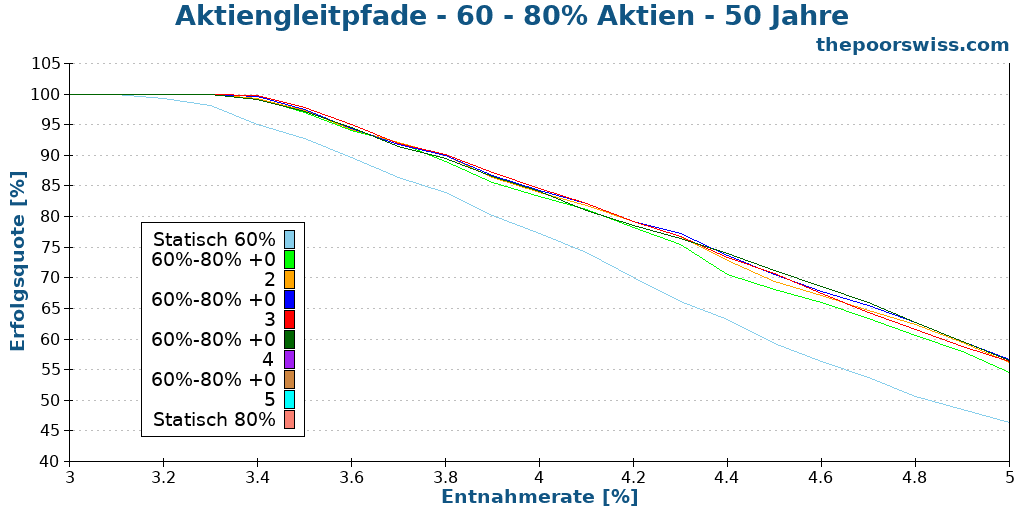
Wir können beobachten, dass die Gleitpfade die Erfolgsrate des statischen 60% Aktienportfolios signifikant erhöhen. In einigen Fällen können wir durch den Wechsel von einem statischen Portfolio zu einem Gleitpfad unsere Erfolgsquote um 10 % erhöhen.
Für diese Ergebnisse können wir wieder die ausfallsicheren Entnahmeratesehen.
| Portfolio | Ausfallsicher | 1% | 5% | 10% | 25% |
|---|---|---|---|---|---|
| Statisch 60% | 3.09 | 3.24 | 3.40 | 3.59 | 4.08 |
| 60%-80% +0.2 | 3.28 | 3.42 | 3.56 | 3.77 | 4.31 |
| 60%-80% +0.3 | 3.32 | 3.42 | 3.57 | 3.79 | 4.34 |
| 60%-80% +0.4 | 3.36 | 3.41 | 3.57 | 3.79 | 4.36 |
| 60%-80% +0.5 | 3.37 | 3.44 | 3.60 | 3.80 | 4.36 |
| Statisch 80% | 3.19 | 3.41 | 3.57 | 3.78 | 4.35 |
Diese Ergebnisse sind sogar noch besser als das, was wir zuvor beobachtet haben. In der Tat wird die beste Entnahmerate stets mit einem Aktiengleitpfad erzielt. Im Durchschnitt ist der beste Gleitpfad der schnellste.
Wir können sehen, was passiert, wenn wir eine Ausgangsbasis von 40 % verwenden.
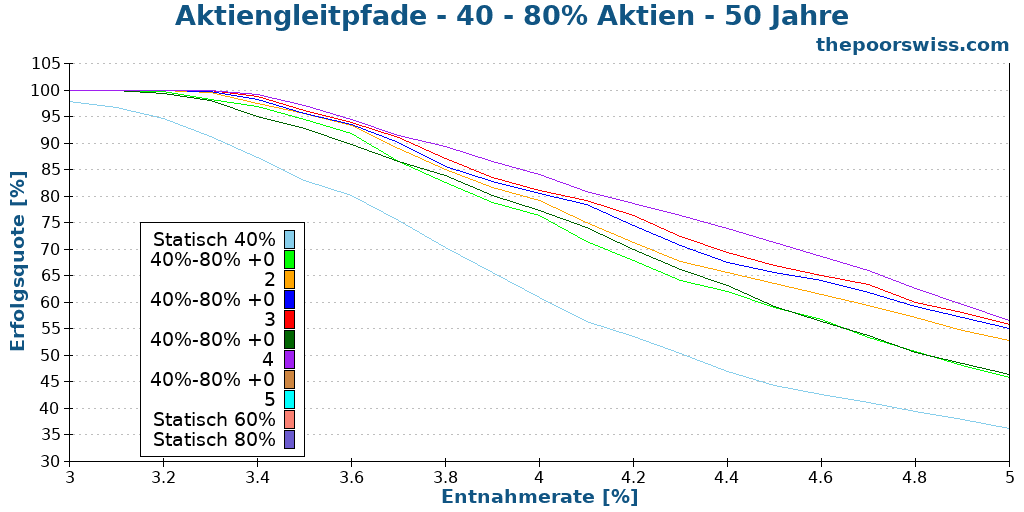
Wir können hier zwei Dinge beobachten. Erstens sind, wie wir in anderen Artikeln gesehen haben, 40 % für lange Rentenzeiten nicht ausreichend. Zweitens verbessern sich die Gleitpfade bei Aktien gegenüber dem statischen 40%-Portfolio immer. Dies ist sinnvoll, da dieses Portfolio eine hohe Volatilität, aber eine geringe Rendite aufweist.
Auch hier betrachten wir die ausfallsicheren Entnahmeraten.
| Portfolio | Ausfallsicher | 1% | 5% | 10% | 25% |
|---|---|---|---|---|---|
| Statisch 40% | 2.80 | 2.96 | 3.19 | 3.32 | 3.71 |
| 40%-80% +0.2 | 3.11 | 3.26 | 3.48 | 3.62 | 4.03 |
| 40%-80% +0.3 | 3.17 | 3.32 | 3.52 | 3.67 | 4.10 |
| 40%-80% +0.4 | 3.25 | 3.37 | 3.52 | 3.70 | 4.18 |
| 40%-80% +0.5 | 3.28 | 3.38 | 3.54 | 3.71 | 4.24 |
| Statisch 60% | 3.09 | 3.24 | 3.40 | 3.59 | 4.08 |
| Statisch 80% | 3.19 | 3.41 | 3.57 | 3.78 | 4.35 |
Die Equity Glidepaths verbessern die statischen 40%- und sogar die statischen 60%-Portfolios erheblich. Allerdings sind diese Ergebnisse im Vergleich zu den vorherigen Ergebnissen immer noch nicht sehr gut. In der Praxis sind 40 % der Vorräte für einen langen Vorruhestand nicht ausreichend.
Gleitpfade umkehren
Wir sollten unsere Hypothese überprüfen, dass der Gleitpfad unsere Aktienquote erhöhen sollte. Zu diesem Zweck habe ich auch einige umgekehrte Equity Glidepaths getestet. Der Unterschied besteht darin, dass wir von 100 % Aktien zu 80 % Aktien übergehen.
Hier sind die Ergebnisse für 50 Jahre im Ruhestand.
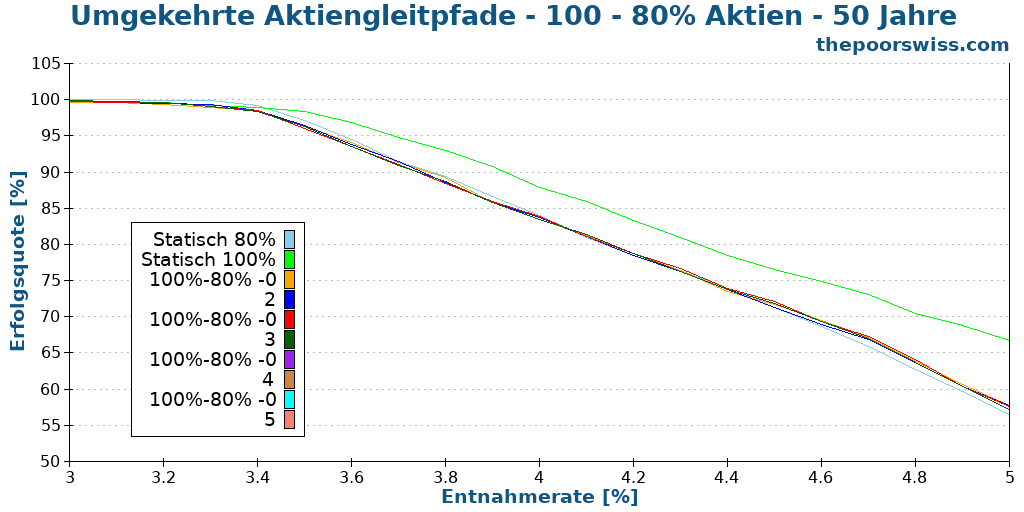
Wie erwartet, bleibt das beste Portfolio das statische 100%-Portfolio. Die Beimischung von Anleihen zu einem Aktienportfolio ist im Ruhestand nicht hilfreich. Wir können uns die Failsafe-Raten erneut ansehen.
| Portfolio | Ausfallsicher | 1% | 5% | 10% | 25% |
|---|---|---|---|---|---|
| Statisch 80% | 3.19 | 3.41 | 3.57 | 3.78 | 4.35 |
| Statisch 100% | 2.63 | 3.35 | 3.69 | 3.93 | 4.59 |
| 100%-80% -0.2 | 2.61 | 3.29 | 3.55 | 3.77 | 4.35 |
| 100%-80% -0.3 | 2.66 | 3.32 | 3.54 | 3.75 | 4.37 |
| 100%-80% -0.4 | 2.69 | 3.32 | 3.53 | 3.74 | 4.37 |
| 100%-80% -0.5 | 2.77 | 3.32 | 3.54 | 3.74 | 4.35 |
Die gleitenden Aktienpfade verbessern sich geringfügig gegenüber dem statischen 100 %-Aktienportfolio für die ausfallsichere Entnahmerate, aber sie sind durchweg schlechter als das statische 80 %-Aktienportfolio. In allen anderen Fällen sind die statischen Portfolios besser.
Auch dies ist sinnvoll, denn wir verwenden Anleihen langfristig, während sie eher kurzfristig eingesetzt werden sollten. Daher sollten umgekehrte Equity Glidepaths nicht verwendet werden.
Zusammenfassung
Schließlich können wir alle Gleitpfade in einer zusammenfassenden Tabelle betrachten und einige Schlussfolgerungen ziehen.
| Portfolio | Ausfallsicher | 1% | 5% | 10% | 25% |
|---|---|---|---|---|---|
| Statisch 40% | 2.80 | 2.96 | 3.19 | 3.32 | 3.71 |
| 40%-80% +0.2 | 3.11 | 3.26 | 3.48 | 3.62 | 4.03 |
| 40%-80% +0.3 | 3.17 | 3.32 | 3.52 | 3.67 | 4.10 |
| 40%-80% +0.4 | 3.25 | 3.37 | 3.52 | 3.70 | 4.18 |
| 40%-80% +0.5 | 3.28 | 3.38 | 3.54 | 3.71 | 4.24 |
| 40%-100% 0.2 | 3.15 | 3.27 | 3.52 | 3.66 | 4.09 |
| 40%-100% +0.3 | 3.27 | 3.43 | 3.60 | 3.77 | 4.16 |
| 40%-100% +0.4 | 3.35 | 3.48 | 3.65 | 3.81 | 4.27 |
| 40%-100% +0.5 | 3.43 | 3.51 | 3.65 | 3.83 | 4.35 |
| Statisch 60% | 3.09 | 3.24 | 3.40 | 3.59 | 4.08 |
| 60%-80% +0.2 | 3.28 | 3.42 | 3.56 | 3.77 | 4.31 |
| 60%-80% +0.3 | 3.32 | 3.42 | 3.57 | 3.79 | 4.34 |
| 60%-80% +0.4 | 3.36 | 3.41 | 3.57 | 3.79 | 4.36 |
| 60%-80% +0.5 | 3.37 | 3.44 | 3.60 | 3.80 | 4.36 |
| 60%-100% +0.2 | 3.38 | 3.51 | 3.66 | 3.88 | 4.36 |
| 60%-100% +0.3 | 3.46 | 3.55 | 3.70 | 3.91 | 4.47 |
| 60%-100% +0.4 | 3.45 | 3.53 | 3.72 | 3.92 | 4.54 |
| 60%-100% +0.5 | 3.46 | 3.55 | 3.71 | 3.94 | 4.56 |
| Statisch 80% | 3.19 | 3.41 | 3.57 | 3.78 | 4.35 |
| 80%-100% +0.2 | 3.37 | 3.55 | 3.72 | 3.96 | 4.57 |
| 80%-100% +0.3 | 3.35 | 3.54 | 3.72 | 3.95 | 4.60 |
| 80%-100% +0.4 | 3.28 | 3.54 | 3.72 | 3.96 | 4.59 |
| 80%-100% +0.5 | 3.20 | 3.54 | 3.72 | 3.96 | 4.60 |
| Statisch 100% | 2.63 | 3.35 | 3.69 | 3.93 | 4.59 |
Für mich ist das interessanteste Ergebnis, dass ein Equity Glidepath immer eine Verbesserung gegenüber dem statischen Portfolio der Ausgangssituation darstellt. Und es ist auch oft eine Verbesserung gegenüber dem statischen Portfolio des Endpunkts.
Ich bin überrascht von der Effizienz der Gleitpfade von 60 % bis 100 % Aktienanteil. Ich hatte nicht erwartet, dass sie so gut abschneiden würden. Ich hatte erwartet, dass 80 % bis 100 % besser sein würden. Aber sie sind nur dann besser, wenn Sie bei Ihrer Planung höhere Ausfallraten einkalkulieren.
Wenn der Unterschied zwischen Start- und Zielpunkt sehr groß ist, brauchen Sie einen schnellen Gleitpfad. In Zukunft werde ich vielleicht mehr Gleitgeschwindigkeiten in Betracht ziehen.
Eine weitere interessante Tatsache ist, dass Sie, wenn Sie an ausfallsicheren Strategien interessiert sind, einen relativ langsamen Gleitpfad einschlagen können. Wenn Sie jedoch eine höhere Fehlerquote zulassen, könnten Sie einen langsameren Gleitpfad einschlagen.
Wir sollten uns auch fragen, ob ein Equity Glidepath immer besser ist? Gleitpfade sind großartig, wenn wir zu einem schlechten Zeitpunkt starten. Die schlechtesten Zeiten für den Ruhestand sind die Spitzenzeiten des Marktes. In diesen Fällen sollten Anleihen eine niedrige Volatilität aufweisen, damit Ihr Portfolio nicht zu stark schwankt.
Aber ein gleitender Aktienpfad wird deutlich schlechter abschneiden als ein statisches Portfolio mit mehr Aktien, wenn wir zu einem guten Zeitpunkt starten. Die besten Zeitpunkte für den Ruhestand sind am Tiefpunkt der Märkte. In diesen Fällen wollen Sie ein starkes Aktienportfolio, um Ihr Portfolio schnell zu vergrößern.
Equity Glidepaths sind also hervorragend geeignet, um die durchschnittliche Erfolgsquote zu verbessern, haben aber in einigen Fällen auch Nachteile. Wenn Sie eine sichere Ruhestandsstrategie anstreben, sind diese Gleitpfade für Aktien jedoch eine Überlegung wert.
Fazit
Equity Glidepaths sind eine gute Möglichkeit, Ihre Erfolgsquote im Ruhestand zu verbessern. Anstatt eine feste Aktienquote zu haben, können wir sie von einem Ausgangspunkt aus im Laufe der Zeit erhöhen. Ein Gleitpfad von 60 % Aktien auf 100 % Aktien ist beispielsweise gut geeignet, wenn Sie sich auf ausfallsichere Entnahmeraten konzentrieren wollen.
Sowohl Anleihen als auch Aktien bieten einzigartige Vorteile. Anleihen sind aufgrund ihrer geringeren Volatilität eine hervorragende Option zur Absicherung des Renditerisikos. In der Zwischenzeit können Aktien mit höheren Renditen dazu beitragen, dass das Geld nicht ausgeht. Daher ist es ratsam, in den ersten Jahren auf Anleihen zu setzen, wenn das Risiko der Renditeentwicklung ein Problem darstellt, während Aktien in späteren Jahren vorteilhafter sein können, um die Langlebigkeit Ihres Portfolios zu gewährleisten.
Daher ist es sehr sinnvoll, mit Anleihen zu beginnen und deren Anteil langsam zu verringern. Auf diese Weise tun Anleihen und Aktien das, was sie am besten können. Infolgedessen erhalten wir bessere Erfolgsquoten und könnten bei gleicher angestrebter Misserfolgsquote eine höhere Entnahmerate verwenden.
Personen, die in Erwägung ziehen, mit einer festen Allokation in Anleihen in den Ruhestand zu gehen, sollten unbedingt einen Equity Glidepath in Betracht ziehen. Dies wird wahrscheinlich zu einem sichereren Ruhestand führen.
Diese Ergebnisse veranlassen mich, mein 100%iges Aktienportfolio im Ruhestand zu überdenken. Dieses Portfolio eignet sich hervorragend für die Ansparphase, kann aber im Ruhestand suboptimal sein. Darüber werde ich noch einmal nachdenken müssen.
Interessanterweise können wir auch einen einfacheren Glidepath erstellen, indem wir im Ruhestand nur Anleihen verkaufen. Auf diese Weise erhalten wir einen Glidepath, bei dem der Anleihenanteil langsam verschwindet und wir dann nur noch Aktien haben. Und wenn Sie dynamische Parameter im Ruhestand mögen, könnten Ihnen dynamische Entnahmeraten gefallen.
Planen Sie, sich mit Anleihen zur Ruhe zu setzen? Ziehen Sie einen Equity Glidepath in Betracht?
Wenn Sie sich für das Thema interessieren, könnte ich weitere Experimente zu Equity Glidepaths durchführen, da es mehr Parameter zu untersuchen gibt.
Mehr zum Lesen

Backtesting vs. Bootstrapping für FIRE in 2026
Entdecke, wie Bootstrapping im Vergleich zu Backtesting für FIRE-Simulationen abschneidet. Erfahre, welche Methode bessere Schätzungen für sichere Entnahmeraten liefert.
Wie kann man in der Schweiz vorzeitig in Rente gehen?
FIRE in der Schweiz? Ein umfassender Leitfaden für den vorzeitigen Ruhestand in der Schweiz, einschließlich Lebenshaltungskosten, Steuern und Überlegungen zur Gesundheitsversorgung.
Die 6 Arten von FIRE: Welche sind Sie?
Lean, Fat oder Barista FIRE? Entdecke die verschiedenen Arten der finanziellen Unabhängigkeit und finde heraus, welcher FIRE-Stil am besten zu deinen Lebenszielen passt.
Erfahren Sie, wie Sie Ihre Finanzen ganz einfach optimieren und in der Schweiz Tausende sparen können, mit unserem exklusiven E-Book. Entdecken Sie die kostengünstigsten Finanzdienstleistungen, maßgeschneidert für clevere Einwohner und Expats!
Ihren KOSTENLOSEN Schweizer Sparratgeber
Hy! Sehr spannender in deep Artikel. Eine Frage die mich beschäftigt ist, wie man equity glidepaths praktisch umsetzt. Empfehlen Sie ein solches Vorgehen auch für die 3a Säule?
Ich würde sagen, nein. Sie sollten diese Technik auf Ihr gesamtes Portfolio anwenden. Aber wenn Ihre 3a nicht einen sehr großen Teil Ihres Portfolios ausmacht, was bei einem Vorruhestand unwahrscheinlich ist, denke ich, dass es ausreicht, die Methode nur auf das Aktienportfolio anzuwenden.