
Devriez-vous utiliser la tarification fixe ou dégressive d’IB 2026 ?
| Mis à jour: |
(Information: certains des liens ci-dessous peuvent être des liens d'affiliation)
Jusqu’à récemment, je pensais que la tarification dégressive d’Interactive Brokers était toujours la meilleure pour la plupart des investisseurs. Mais après avoir effectué d’autres simulations, ce n’est peut-être pas le cas !
J’ai donc effectué davantage de tests pour déterminer exactement quand nous devrions utiliser la tarification fixe ou dégressive. Cet article présente les différences entre ces deux structures de tarification et indique si vous devez utiliser la tarification fixe ou dégressive.
Tarification d’Interactive Brokers

Le courtier dont vous avez besoin pour acheter des actions et ETFs avec des frais incroyablement bas! Investissez dans des compagnies américaines dès 0.50 USD!
- Très bon marché
- Exécution sans faute
Interactive Brokers est le courtier que j’utilise et que je recommande. C’est un excellent courtier avec des prix très abordables et une excellente exécution.
Contrairement à de nombreux courtiers, Interactive Brokers (IB) propose deux modèles de tarification différents :
- Tarification fixe
- Tarification dégressive
Et beaucoup de gens me demandent s’ils doivent utiliser la tarification fixe ou dégressive. Nous allons donc comparer ces deux options en détail et le découvrir !
La tarification fixe est le modèle le plus simple, vous payez un pourcentage fixe, avec un minimum et un maximum, et c’est généralement tout. Ce modèle est standard chez la plupart des courtiers.
D’autre part, la tarification dégressive est composée de plusieurs sous-frais :
- Frais réglementaires
- Frais de bourse
- Frais de transaction
- Frais de compensation
Certains de ces frais sont par action, tandis que d’autres sont forfaitaires, et d’autres encore sont basés sur la valeur totale. Et la tarification dégressive est très différente d’une bourse à l’autre.
La principale différence entre ces deux options est donc que la tarification fixe est simple et prévisible, tandis que la tarification dégressive est complexe et varie considérablement d’une bourse à l’autre.
Notez que lorsque vous modifiez la méthode de tarification, l’application prend généralement un jour.
Le prix qu’ils paieront pour chaque transaction est ce qui compte le plus pour chaque investisseur. Nous allons donc comparer les systèmes de tarification fixe et dégressive pour plusieurs bourses. Il est important de noter que l’emplacement des investisseurs n’est pas pertinent, la tarification est effectuée pour chaque bourse. Par exemple, un investisseur suisse paiera le même prix pour une action américaine qu’un investisseur français.
J’ai sélectionné différentes bourses : la Bourse suisse (SIX), la Bourse européenne (Euronext Paris) et la Bourse de New York (NYSE). Ce sont les bourses les plus utilisées par un investisseur suisse ou européen.
Dans certains cas, il existe de légères différences entre l’achat d’actions et d’ETF. Lorsque cela se produit, les résultats suivants utiliseront la tarification des ETF.
Bourse suisse (SIX)
Nous commençons par les opérations sur la Bourse suisse et voyons si la tarification fixe ou dégressive diffère.
Avec la tarification fixe, vous paierez 0,05 % de la valeur de la transaction sur SIX, avec un minimum de 5 CHF et pas de maximum.
Avec la tarification dégressive, vous paierez 0,05 % de la valeur de la transaction sur SIX, avec un minimum de 1,50 CHF et un maximum de 49 CHF. En plus de cela, vous paierez des frais de déclaration de transaction de 1 CHF et des frais de compensation de 0,38 CHF. Enfin, vous paierez des frais de bourse de 0,015 % de la valeur de la transaction plus 1,50 CHF.
Avec la tarification dégressive, vous paierez des frais encore plus bas si vous avez un volume mensuel important. En effet, à partir de 50 millions d’EUR de volume mensuel, les frais diminuent, et plusieurs seuils existent. Mais nous allons ignorer cela, car cela ne concerne pas la plupart des gens.
Voici donc les frais totaux pour quelques tailles d’ordre :
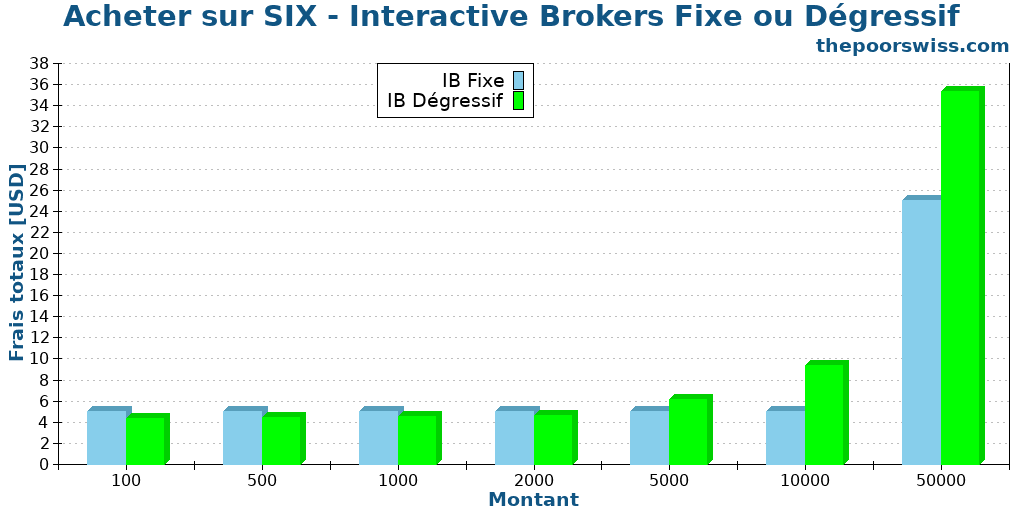
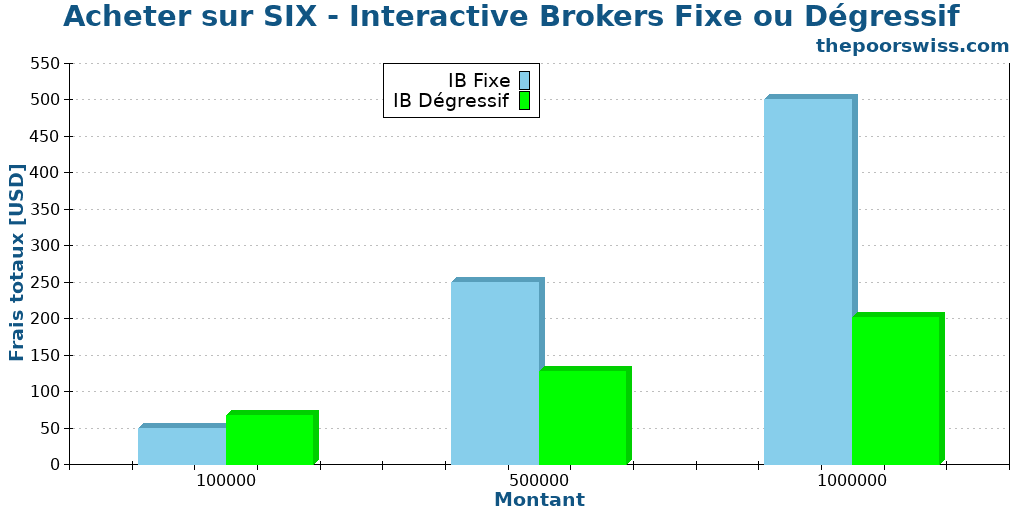
Ces résultats sont assez intéressants. Nous pouvons voir que pour les petites opérations, la tarification dégressive est légèrement moins chère que la tarification fixe. Mais une fois que nous atteignons les ordres de 5 000 CHF, la tarification fixe devient moins chère. Et à mesure que la taille des ordres augmente, l’écart entre les deux systèmes de tarification se creuse. Lorsque nous dépassons 500 000, la tarification dégressive redevient moins chère. Et pour les opérations importantes, la tarification dégressive peut être beaucoup moins chère.
Donc, la façon la moins chère d’acheter sur SIX est :
- Tarification dégressive pour les petites opérations
- Tarification fixe pour les opérations moyennes à importantes
- Tarification dégressive pour les opérations massives
Mais il convient de mentionner que les deux modèles sont assez abordables.
Bourse européenne (Euronext)
Ensuite, nous examinons la bourse Euronext Paris, l’une des bourses les plus utilisées par les investisseurs européens.
Avec la tarification fixe, vous paierez 0,05 % de la valeur de la transaction sur Euronext Paris, avec un minimum de 3 EUR et pas de maximum.
Avec la tarification dégressive, vous paierez 0,05 % de la valeur de la transaction sur SIX, avec un minimum de 1,25 EUR et un maximum de 29 EUR. Après cela, vous devez payer des frais de bourse de 0,006 % de la valeur de la transaction, avec un minimum de 0,75 EUR et pas de maximum. Vous devez également payer des frais de compensation de 0,10 EUR.
Encore une fois, voici les frais totaux pour quelques tailles d’ordre :
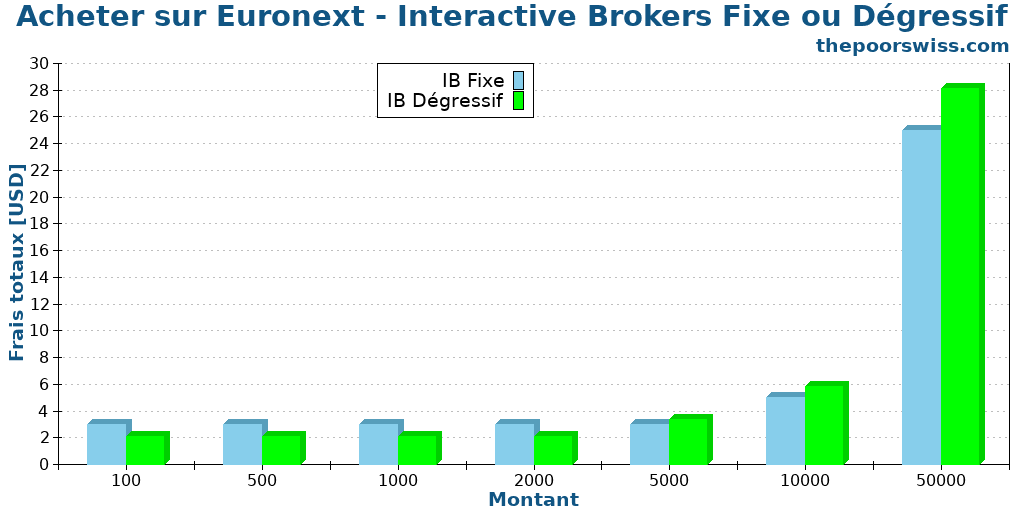
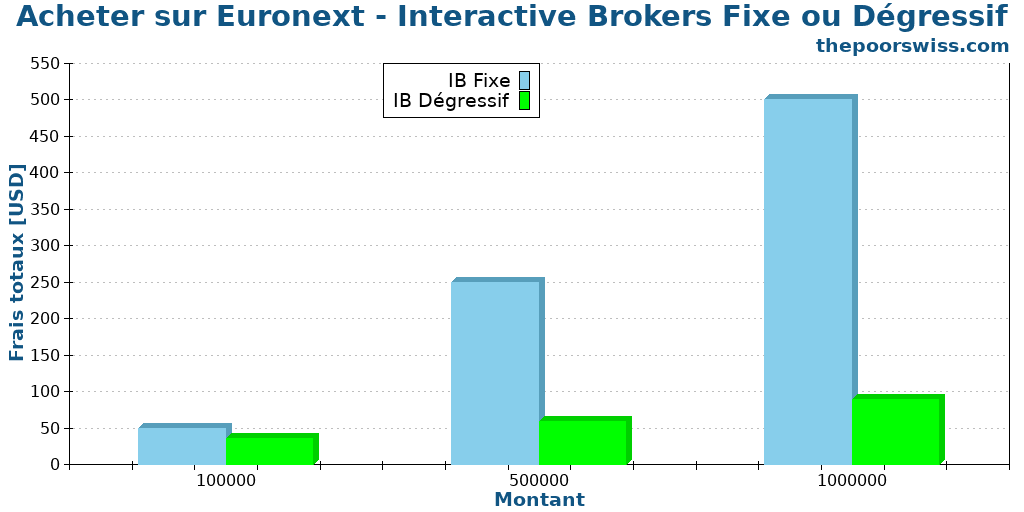
Ces résultats sont très intéressants. En dessous de 5 000 EUR, la tarification dégressive est moins chère que la tarification fixe. En effet, le minimum de la tarification dégressive est plus petit. Ensuite, entre 5 000 et 50 000 EUR, la tarification fixe est légèrement plus abordable. Enfin, pour 100 000 EUR, la tarification dégressive est à nouveau moins chère. En effet, il existe un maximum pour les commissions, tandis que la tarification fixe n’a pas de maximum pour les commissions.
Donc, pour acheter sur Euronext Paris, vous devriez commencer à utiliser la tarification dégressive pour les petites opérations, la tarification fixe pour les opérations moyennes, et, encore une fois, la tarification dégressive pour les opérations importantes.
Bourse de New York (NYSE)
Enfin, nous devrions examiner la Bourse de New York (NYSE), la bourse des meilleurs ETF disponibles.
Il est intéressant de noter que les commissions sur le NYSE sont exprimées par action. Pour cela, je supposerai que nous achetons un ETF avec des actions d’une valeur de 100 USD. Donc, si nous achetons 1 000 USD, nous achetons dix actions.
Il est également intéressant de noter que cette fois, les frais diffèrent entre l’achat et la vente. Nous allons donc d’abord couvrir les frais d’achat.
Avec la tarification fixe, vous paierez 0,005 USD par action, avec des frais minimums de 1 USD et des frais maximums de 1 % de la valeur de la transaction.
Avec la tarification dégressive, vous paierez 0,0035 USD par action sur le NYSE, avec des frais minimum de 0,35 USD et des frais maximum de 1 % de la valeur de la transaction. De plus, vous devrez payer des frais de compensation de 0,0002 par action. Vous paierez également des frais de bourse NYSE de 0,003 par action. Enfin, vous paierez des frais répercutés. Pour le NYSE, ces frais répercutés correspondent à 0,000175 fois le total des autres frais.
En résumé, cela nous donne ces frais pour l’achat sur le NYSE :
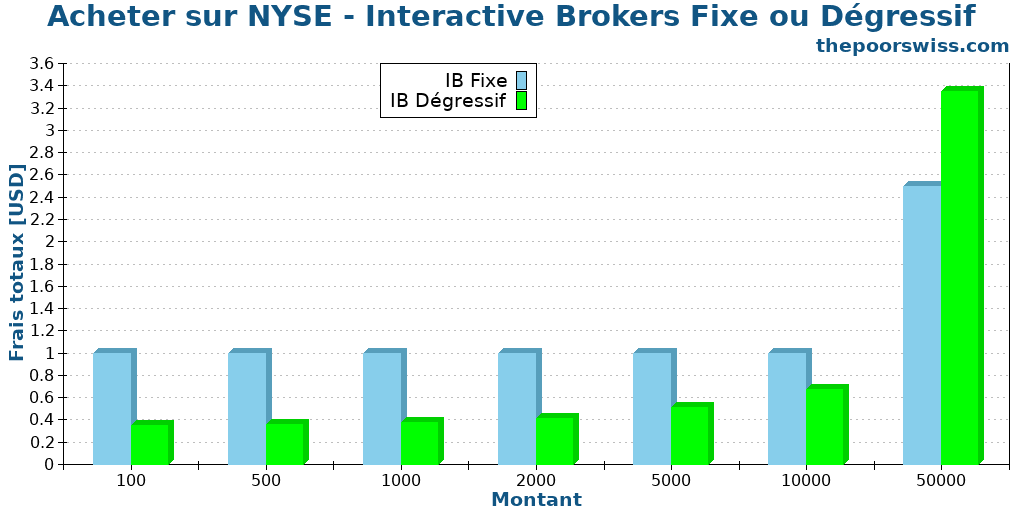
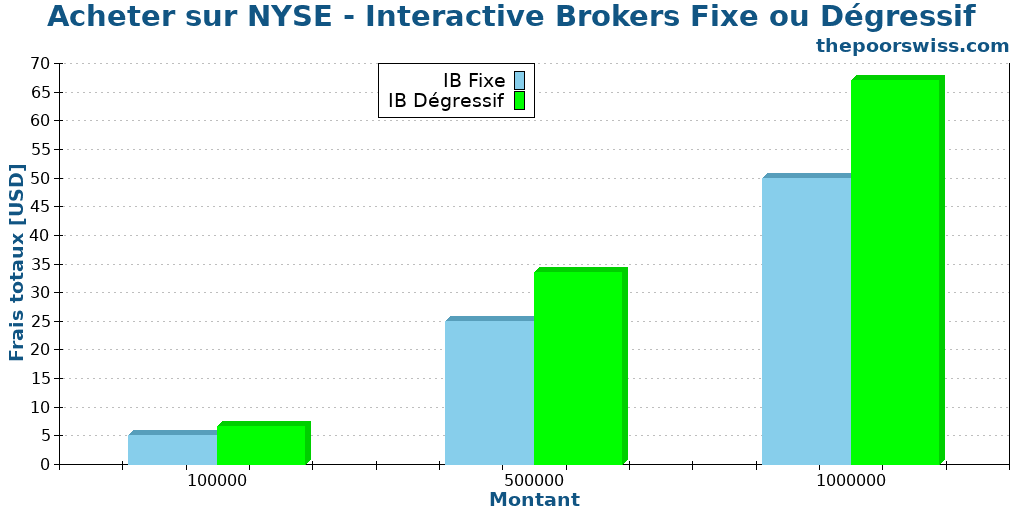
Il est intéressant de noter que la tarification dégressive d’Interactive Brokers est moins chère pour toutes les opérations inférieures à 50 000 USD, mais commence à être légèrement plus chère pour les opérations plus importantes. Pour les petites opérations, la tarification dégressive est presque trois fois moins chère. Cependant, il convient de mentionner que les deux modèles de tarification sont extrêmement bon marché pour les ETF américains.
Pour les opérations de vente, il existe deux frais réglementaires supplémentaires :
- Les frais réglementaires de la SEC de 0,0000229 par action
- Les frais réglementaires de la FINRA de 0,00013 par action, avec un maximum de 6,49 USD
Ces deux frais réglementaires s’appliquent à la fois à la tarification fixe et à la tarification dégressive. Cela ne changera donc pas le modèle le moins cher, mais il est toujours intéressant de connaître les prix.
Voici donc comment cela se traduit par la vente sur le NYSE :
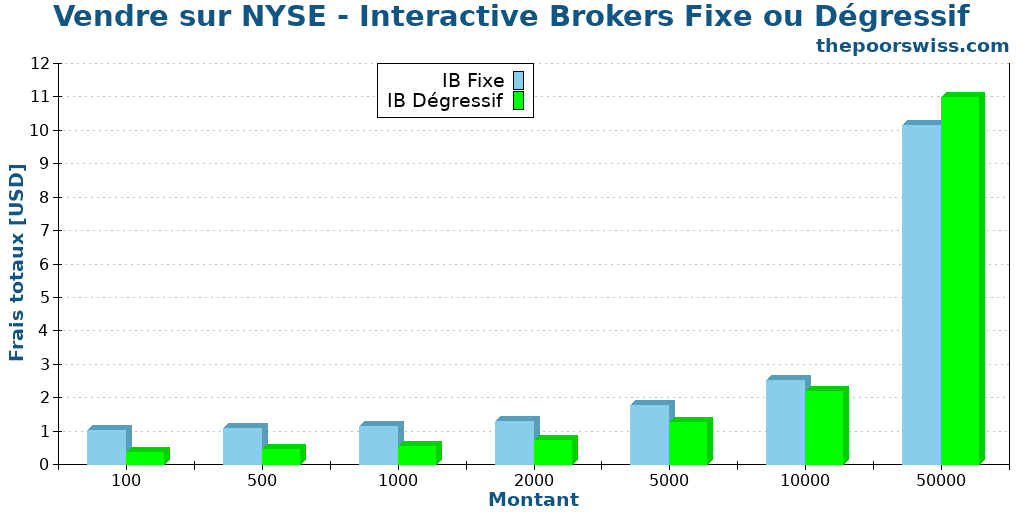
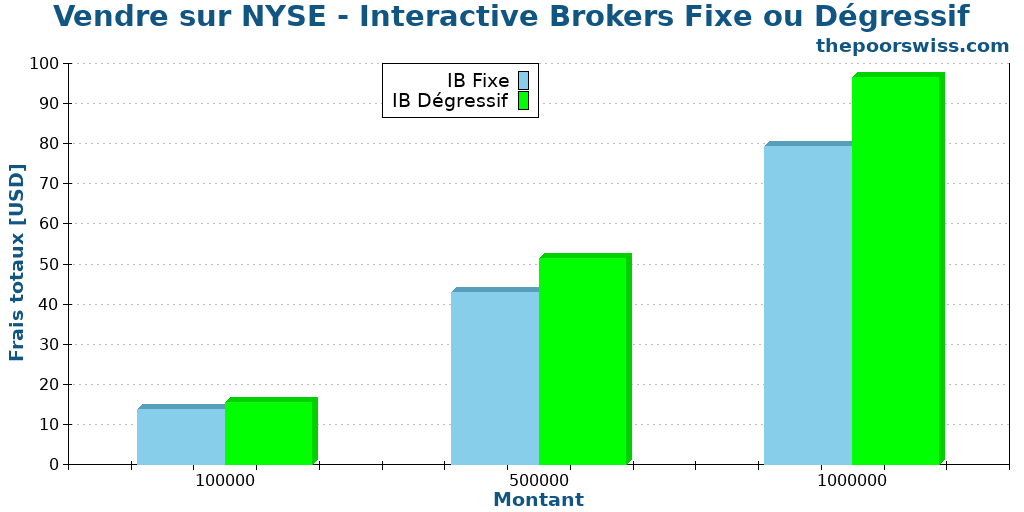
Le modèle de tarification dégressive est généralement le moins cher, jusqu’à de très grandes opérations. L’écart est légèrement plus petit que pour les opérations d’achat. Cependant, les frais de vente pèsent lourdement sur les opérations importantes qui sont maintenant plusieurs fois plus chères.
Pour la plupart des investisseurs passifs, le fait d’avoir des ventes plus chères ne devrait pas être un problème. En effet, nous devrions acheter plus souvent que nous ne vendons.
Pour une petite conclusion sur les bourses américaines : La tarification dégressive est moins chère que la tarification fixe pour acheter des ETF américains sur le NYSE.
Conclusion
Le courtier dont vous avez besoin pour acheter des actions et ETFs avec des frais incroyablement bas! Investissez dans des compagnies américaines dès 0.50 USD!
- Très bon marché
- Exécution sans faute
Nous pouvons constater que ni la tarification fixe ni la tarification dégressive ne sont toujours l’option la moins chère. Cela dépend de la bourse que vous utilisez et de la taille de vos transactions.
Si vous achetez principalement des ETF américains, vous devriez utiliser la tarification dégressive pour économiser de l’argent. Si vous effectuez de petites opérations, la tarification dégressive est également excellente. La tarification fixe est excellente pour les opérations moyennes à importantes sur les bourses suisses et européennes.
Nous devons mentionner une chose de plus : les modèles de tarification fixe et dégressive sont abordables. Interactive Brokers a une excellente tarification ! Compte tenu de ces résultats, je prévois de conserver la tarification dégressive, car j’utilise principalement des ETF américains.
Et toi ? Utilisez-vous la tarification fixe ou dégressive ?
Prochains articles
Évaluation de Saxo bank 2026 – le meilleur courtier suisse
Vous recherchez le meilleur courtier ? Découvrez les frais réduits, l’absence de frais de dépôt de 0 CHF et pourquoi le courtier Saxo Bank est désormais un choix de premier ordre pour les investisseurs.
Automatisez vos investissements avec Interactive Brokers en 2026
Mettez vos investissements sur pilote automatique avec Interactive Brokers, d'une manière très simple et accessible à tous ! Il est temps d'automatiser vos investissements !
Yuh Review 2026: Une application pour payer, épargner et investir
Postfinance et Swissquote ont lancé une nouvelle banque numérique : Yuh. Yuh combine banque, investissement et crypto-monnaies en un seul service !
Apprenez des moyens faciles d'optimiser vos finances et d'économiser des milliers de francs en Suisse avec notre e-book exclusif. Découvrez les services financiers les plus rentables adaptés aux résidents avisés et aux expatriés!
Obtenez votre guide suisse d'économies GRATUIT
Excellent article.
Un détail qui peut avoir un impact également :
En passant de Lite(par paliers) a Pro(Fixe), les intérêts sur le cash augmentent sensiblement. Exemple avec un NAV > 100k, et 20k de USD : 100chf d’intérêt en plus par an (408 au lieu de 308chf, selon le calculateur IBKR).
Note: les 4.08% sur cash en USD sont seulement sur les tranches au-dessus de 10k. (pour CHF c’est 0.359%). En general c’est « benchmark – 0.5% ».
(et oui, Il est souvent préférable d’avoir investi le cash en ETF, mais dans certains cas, pour ceux qui ont besoin d’une partie de leur fortune en liquidité, l’impact n’est pas anodin).
PS: Et si je me trompe, merci de me corriger !
Bonjour Pablo
Vous mélangez deux concepts distincts. Lite et Pro sont deux types de comptes. D’ailleurs, je ne crois pas qu’on puisse ouvrir un compte Lite en tant qu’investisseur Suisse.
Et effectivement, Pro et Lite ont des taux d’intérêt très différent.
Les tarifications elle-mêmes ne changent pas le taux d’intérêt. Mais il est aussi vrai que Lite ne permet pas de choisir la tarification, seulement Pro le permet.
Merci pour la precision! en effet ce sont 2 concepts distincts. (Il y a bien les 2 options « Fixed » or « Tiered » pour « IBKR pro ») Merci.
Bonjour Batiste,
Merci beaucoup pour cette analyse.
Étant donné que j’investis pour le moment des petites sommes, je vais changer en frais par paliers.
Est-ce que tu as aussi calculé la différence pour les actions américaines?
Bonjour Jacquier
Je doute de comprendre la question, car l’article mentionne explicitement la bourse de New York.
Bonjour Baptiste,
Je pense que la question de Jacquier concerne les coûts d’achat des ACTIONS américaines vs. ETF. Je suis aussi intéressé, car l’article se concentre sur les ETF.
Merci pour ce super boulot!
Oui, en effet!
Je parle surtout d’ETFs parce que c’est tout ce qu’utilise, mais les frais sont exactement les mêmes chez IB. Ce qui est important, c’est le marché utilisé, mais les frais sont toujours les mêmes sur la même bourse peu importe que ça soit un ETF ou une action.
Bonjour,
Merci pour cet article.
Je n’arrive pas à acheter des ETF sur IB.
J’ai le message suivant:
»Trading restreint
This product is currently unavailable to clients classified as retail clients. »
Savez-vous comment je peux faire pour avoir accès aux ETF ?
Merci beaucoup
Bonjour Denis,
Quel produit essayez-vous d’acheter?
Si c’est un ETF américain, est-ce que vous êtes résidents de l’UE? Dans ce cas, ils sont en effet à cause de régulation européennes.
Salut Batiste.
Merci braucoup pour ton article.
Ça fait 1 an que j’utilise IB. Je n’ai aucune idée si j’utilise par pilier ou fixe. Comment puis-je savoir et comment puis-je changer si nécessaire ?
Merci bcp
Bonjour Jo,
Bonne question :)
Il faut aller voir dans les préférences, il doit y avoir une option de tarification.
Hello Jo,
Sauf erreur le mode fixe est défini par défaut.
J’imagine qu’il suffit de changer l’option dans les Settings/paramètres (après avoir cliqué sur la silhouette en haut à droite de l’écran) – configuration du compte – plan tarifaire IBKR puis cliquer sur Poursuivre et cela fera le changement…
Salut Batiste et Pedro.
Merci de votre aide. J’i trouvé dans les paramètres. C’était en anglais mais j’ai réussi.
Je ferai des testés pour comprendre lequel est moins cher.
Merci encore pour votre aide