
La flexibilité peut-elle favoriser votre retraite anticipée ?
| Mis à jour: |
(Information: certains des liens ci-dessous peuvent être des liens d'affiliation)
Si vous planifiez votre retraite anticipée, il est fort probable que vous vous basiez sur la technique de l’étude Trinity. Avec cette stratégie, vous retirerez chaque année un pourcentage de votre portefeuille initial, ajusté uniquement en fonction de l’inflation.
Certaines personnes souhaitent utiliser un taux de retrait plus élevé et affirment que cela fonctionne car elles peuvent faire preuve de davantage de flexibilité. Est-ce véritablement le cas ? La flexibilité peut-elle favoriser votre retraite anticipée ? Nous répondrons à cette question en effectuant des simulations avec diverses stratégies de flexibilité.
Qu’est-ce que la flexibilité ?
Commençons par une brève définition de ce que l’on entend par flexibilité. Nous parlons ici de faire preuve de flexibilité en matière de dépenses. Si vous êtes en mesure de réduire vos dépenses de 10 %, cela représente un niveau appréciable de flexibilité.
L’idée de la flexibilité dans le cadre d’une retraite anticipée est que lorsque la situation est favorable, nous pouvons dépenser davantage. Et lorsque la situation est moins favorable, nous devons dépenser moins (exercer notre flexibilité). De cette manière, nous pouvons effectivement réduire nos retraits et augmenter nos chances de réussite.
Mais quand devons-nous faire preuve de flexibilité ? C’est là la question principale. Nous ne connaissons pas l’avenir. Nous devons donc nous appuyer sur des heuristiques. Et les heuristiques présentent deux problèmes :
- Les heuristiques de flexibilité peuvent ne pas nous rendre suffisamment flexibles.
- Les heuristiques de flexibilité peuvent nous amener à dépenser trop peu.
Et le problème est que si nous optimisons l’heuristique pour un cas, nous l’aggravons pour l’autre cas. Ainsi, disposer d’une bonne heuristique est très difficile. Nous explorerons deux heuristiques dans cet article, mais il en existe beaucoup d’autres.
Les simulations
Si vous n’êtes pas familier avec ma méthode de réalisation des simulations, je vous invite à consulter mes résultats actualisés de l’étude Trinity.
Dans cette simulation, je partirai des hypothèses suivantes :
- J’utiliserai les rendements des actions et obligations américaines
- J’utiliserai les données de 1871 à 2023
- J’utiliserai les rendements mensuels dans toutes mes simulations
- Chaque mois de départ sera utilisé comme une simulation
- Les retraits seront ajustés mensuellement en fonction de l’inflation
- Nous supposerons un TER de 0,1 % sur le portefeuille
- Le portefeuille sera rééquilibré annuellement
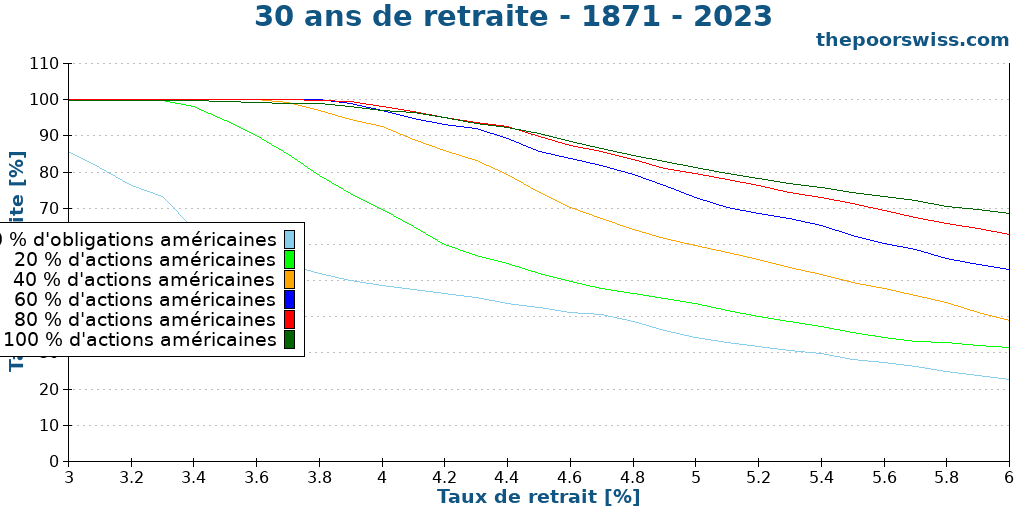
À titre de référence, voici les résultats standard pour plusieurs économies sur 30 ans de retraite :
Flexibilité basée sur le portefeuille initial
La première stratégie que nous pouvons examiner consiste à comparer la valeur actuelle du portefeuille à la valeur initiale du portefeuille et à utiliser cela comme seuil pour décider quand faire preuve de flexibilité. Pour cela, nous utiliserons deux seuils. À chacun de ces seuils, nous réduirons nos dépenses d’un pourcentage donné. Par exemple, une stratégie pourrait ressembler à ceci :
- Si le portefeuille chute en dessous de 90 % du portefeuille initial, nous réduisons nos dépenses de 10 %
- Si le portefeuille chute en dessous de 80 % du portefeuille initial, nous réduisons nos dépenses de 20 %
Avec cela, il y a quatre paramètres (les deux seuils et les deux changements de dépenses). Je ne peux pas tester toutes les combinaisons, nous essaierons donc quelques combinaisons et verrons ce que nous pouvons apprendre des résultats.
Voici donc les résultats pour 30 ans de retraite, avec diverses stratégies. Zéro est la référence sans flexibilité. Et les quatre chiffres des stratégies sont le premier seuil, le premier changement de dépenses, le deuxième seuil et le dernier changement de dépenses. Toutes les stratégies utilisent un portefeuille composé à 100 % d’actions.
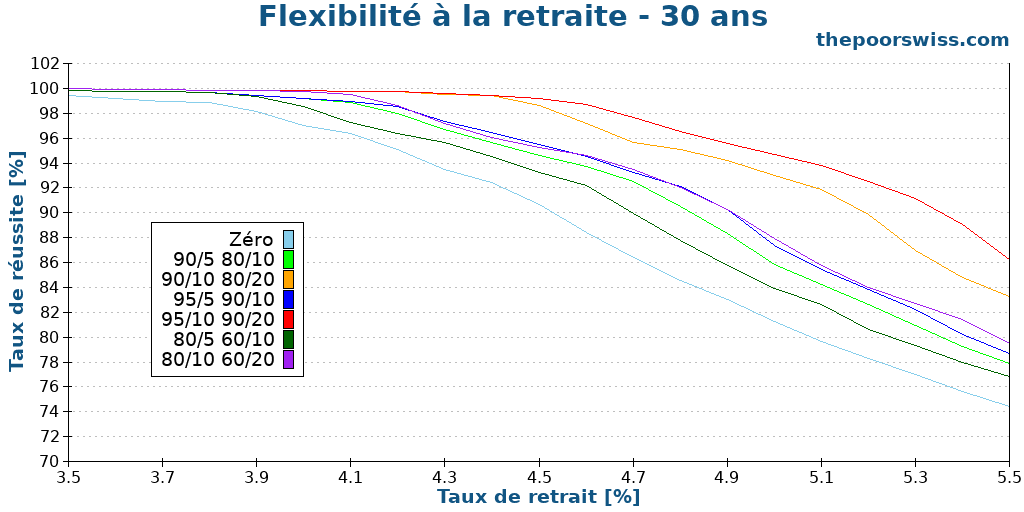
Nous pouvons observer plusieurs points intéressants à partir de cette première expérience. Premièrement, dans tous les cas, la flexibilité améliore notre taux de réussite. Cette constatation est logique puisque nous dépensons moins. Le deuxième point que nous pouvons observer est que les stratégies où nous réduisons nos dépenses de 10 % et 20 % sont plus efficaces que celles où nous les réduisons de 5 % et 10 %. Enfin, à réduction de flexibilité égale, réduire les dépenses plus tôt augmente davantage nos chances que d’attendre.
Comme 30 ans est une période relativement courte, nous pouvons l’étendre à 40 ans pour voir ce qui se passe.
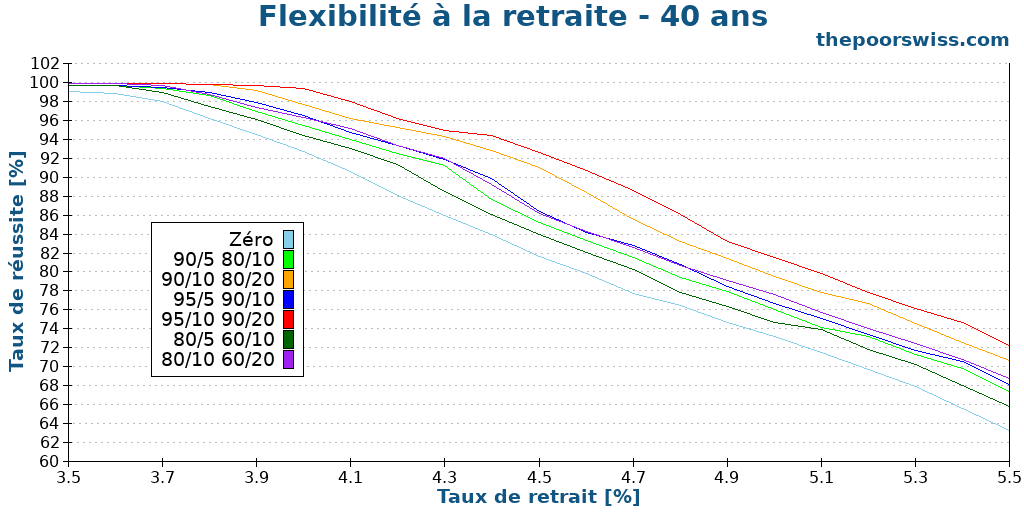
Nous pouvons tirer les mêmes conclusions de ce graphique. Néanmoins, les différentes stratégies de flexibilité ont désormais un impact moins prononcé qu’auparavant. En effet, l’écart entre l’absence de flexibilité et la meilleure flexibilité est moindre que précédemment.
Nous pouvons observer si le même phénomène se produit lorsque nous dépassons les 50 ans.
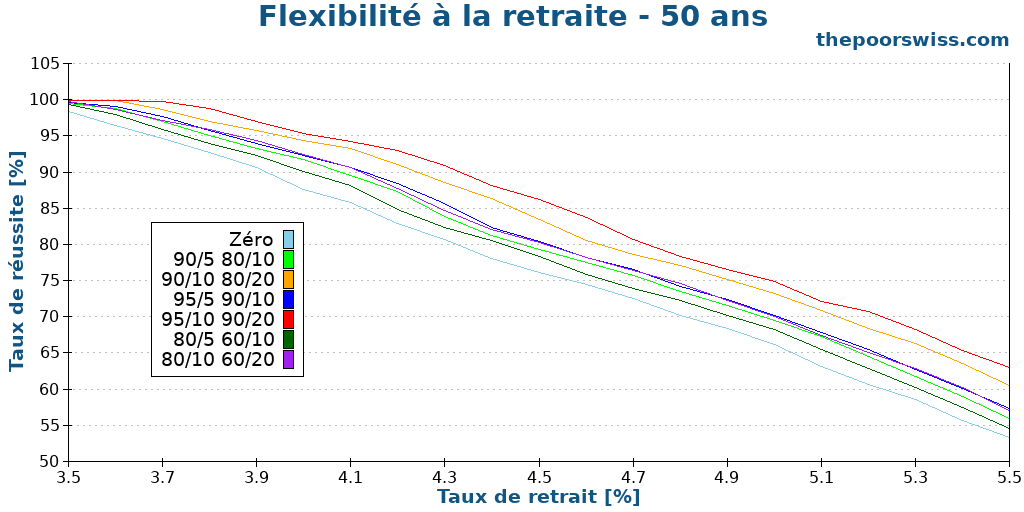
Il est intéressant de noter que la différence entre la meilleure stratégie et la stratégie sans flexibilité ne diminue plus. Ainsi, il subsiste toujours un effet significatif sur le taux de réussite. Bien entendu, une fois que nous dépassons certains taux de retrait élevés, les taux de réussite globaux sont de toute façon très faibles.
À présent, nous devons vérifier si la règle de flexibilité elle-même fonctionne efficacement. Être flexible est bénéfique lorsque cela s’avère nécessaire, mais ne l’est pas lorsque ce n’est pas le cas, car nous finissons simplement par dépenser moins sans raison valable. Par conséquent, nous devons examiner les erreurs de la règle. Par erreur, j’entends une simulation où nous avons opté pour la flexibilité, mais où la simulation aurait néanmoins réussi sans celle-ci.
Par conséquent, voici le taux d’erreur sur 40 ans.
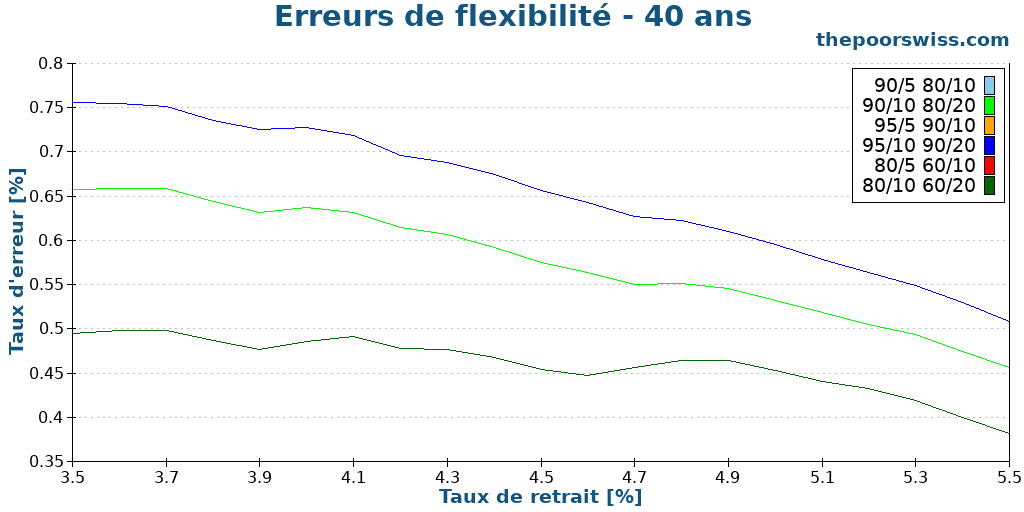
Et ici, nous pouvons observer les limites de cette heuristique flexible simple : cette stratégie est souvent erronée. Nous avons constaté que nous pouvons augmenter significativement notre taux de réussite. Cependant, nous pouvons constater que dans de nombreux cas, nous réduirions nos dépenses sans raison valable. Le taux d’erreur dépend des deux seuils. Plus les seuils sont agressifs (précoces), plus le taux d’erreur devient élevé. Il est également logique que le taux d’erreur diminue à mesure que le taux de retrait augmente, car le risque devient plus élevé. Mais même dans le meilleur des cas, nous parlons de taux d’erreur de 40%.
La bonne nouvelle est que l’autre type d’erreurs (ne pas être flexible lorsque nous aurions dû l’être) est très rare avec cette heuristique. Cela est logique puisque cette heuristique finit par être souvent flexible.
Ainsi, nous aurions besoin d’une heuristique bien meilleure si nous voulons être flexibles, ou être prêts à sous-dépenser considérablement.
Flexibilité basée sur l’état du marché
La seconde stratégie consiste à utiliser le marché lui-même pour déterminer si nous sommes en correction ou en marché baissier. Une correction survient lorsque nous sommes 10% en dessous du précédent sommet historique, et un marché baissier lorsque nous sommes 20% en dessous du précédent sommet. Sur la base de ce statut, nous appliquons la flexibilité à nos dépenses pour voir comment cela fonctionnerait. Pour être plus flexibles, nous appliquerons les mêmes seuils que dans le premier exemple.
Ainsi, pour commencer, voici les résultats pour 30 années de retraite, pour nos diverses stratégies. Les dénominations sont identiques à celles que nous avons utilisées pour la première stratégie.
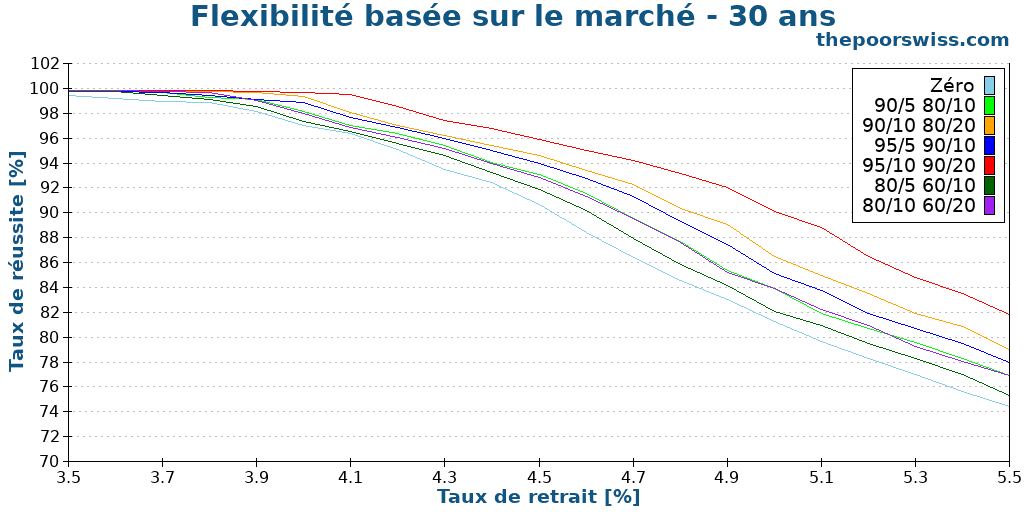
Une fois de plus, toutes nos stratégies surpassent la référence. Dans ce cas, l’impact de nos stratégies est moindre que pour la première stratégie. Néanmoins, nous pouvons encore constater une nette amélioration du taux de réussite, quelle que soit la stratégie. Comme précédemment, les stratégies qui appliquent la flexibilité plus tôt donnent de meilleurs résultats que celles qui attendent plus longtemps. Et comme auparavant, plus nous sommes disposés à réduire nos dépenses, plus nous augmentons nos chances de réussite.
Nous pouvons poursuivre en augmentant la période de retraite à 40 ans.
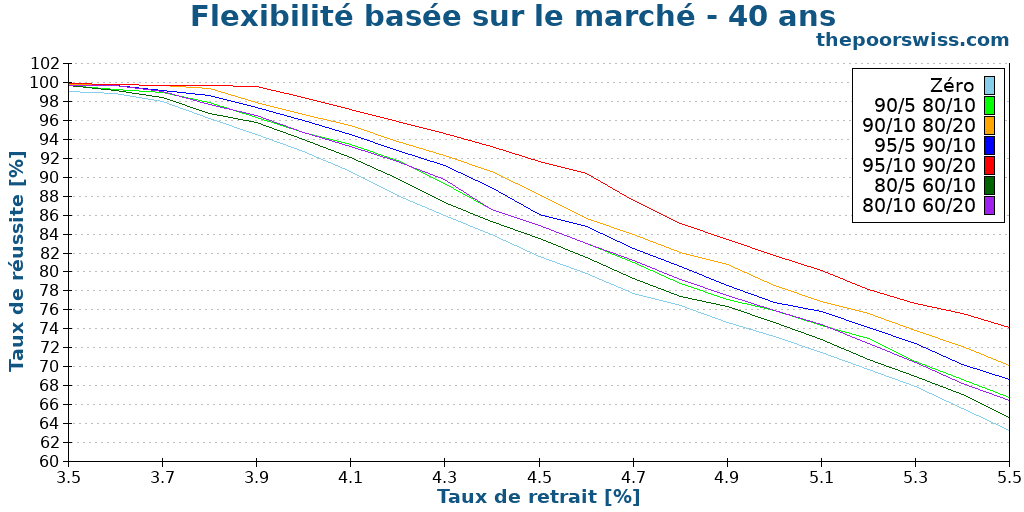
Il est intéressant de noter que lorsque nous dépassons les 40 ans, nous obtenons de meilleurs résultats que la première stratégie. Nous pourrions encore obtenir un taux de réussite de 90% avec un taux de retrait de 4,6% dans le meilleur des cas. La stratégie sans flexibilité ne nous permettrait d’atteindre qu’un taux de retrait de 4,1%.
Enfin, nous pouvons continuer à examiner les résultats pour 50 années de retraite.
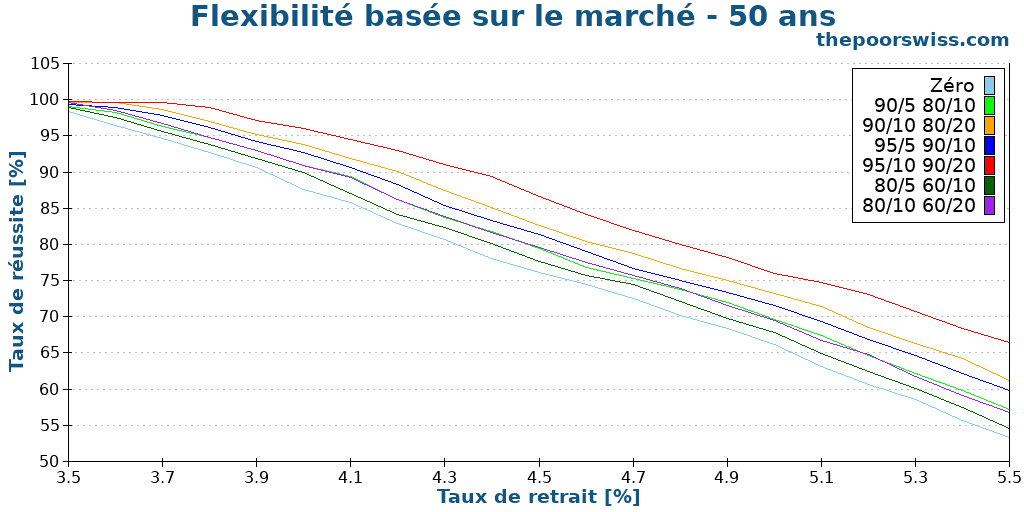
Une fois encore, les résultats sont meilleurs que lors de l’utilisation de la première stratégie. Avec un taux de retrait élevé, l’amélioration du taux de réussite est très importante. Nous pourrions utiliser un taux de retrait de 4,4% et obtenir encore plus de 90% de taux de réussite.
Jusqu’à présent, il semble que cette stratégie soit assez prometteuse. Ensuite, nous devrions examiner le taux d’erreur pour cette simulation.
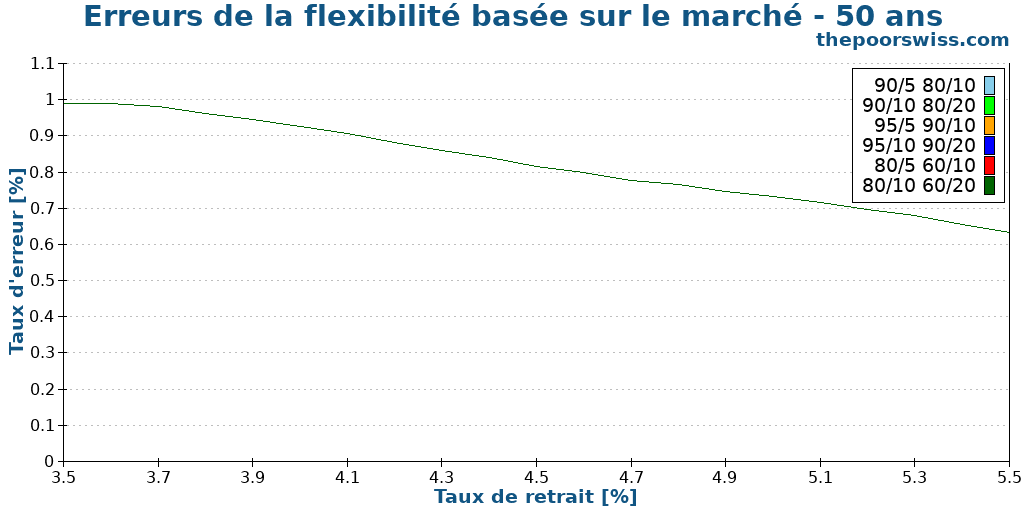
Le taux d’erreur pour toutes les configurations est identique, donc elles se chevauchent toutes.
Voici le secret de cette stratégie : elle commet beaucoup trop d’erreurs. Nous réduisons nos dépenses dans presque toutes les simulations. La raison est simple : les marchés connaîtront toujours des fluctuations significatives à la hausse et à la baisse sur une période de 40 ans. Ainsi, la probabilité de réduire les dépenses est incroyablement élevée. Par conséquent, cette stratégie s’apparente presque à une réduction systématique des dépenses. Il est logique qu’elle améliore le taux de réussite puisque nous réduirons effectivement les dépenses la plupart du temps. Mais cela signifie également que nous réduirons les dépenses lorsque cela n’est pas nécessaire.
Dans l’ensemble, c’est une stratégie convenable, mais elle est moins efficace que la précédente. Avec cette stratégie, nous serions contraints de réduire les dépenses dans un trop grand nombre de cas. Elle n’est pas suffisamment précise pour ne considérer que le marché boursier. Par exemple, une fois que nous sommes dans les 10 dernières années de la retraite, il est peu probable qu’un important déclin du marché boursier nous affecte, car nous avons probablement accumulé suffisamment au cours des décennies précédentes.
Par conséquent, j’estime que cette stratégie est inférieure à la première. La seule raison pour laquelle cette stratégie augmente davantage les taux de réussite est qu’elle s’active en permanence.
Conclusion
La flexibilité des dépenses peut-elle augmenter notre taux de réussite à la retraite ? Oui. Cependant, elle réduira également considérablement nos dépenses dans des cas où cela n’est pas nécessaire. En effet, il est très difficile de trouver une bonne heuristique pour décider quand réduire les dépenses. Et il est également très difficile de déterminer de combien nous devrions réduire les dépenses. Nous avons besoin d’une stratégie qui réduit les dépenses lorsque c’est nécessaire et d’un montant approprié, et qui ne les réduit pas lorsque ce n’est pas nécessaire.
L’autre problème est qu’une fois que nous nous appuyons sur la flexibilité, nous devons être capables de maintenir ce niveau de dépenses réduit pendant un certain temps. Il peut y avoir de longues périodes où nous dépensons significativement plus que ce qui était prévu. Et si nous ne pouvons pas maintenir ce niveau de dépenses réduit, nous nous retrouvons dans une situation où le taux de réussite sera encore pire que prévu.
Pour moi, le véritable problème réside dans la difficulté de trouver l’heuristique appropriée pour décider quand réduire les dépenses. Si nous pouvions trouver une excellente heuristique qui s’activerait au moment opportun, cela serait vraiment bénéfique. Dans de futurs articles, j’explorerai d’autres stratégies, et peut-être trouverons-nous quelque chose d’intéressant. D’après ce que nous avons constaté dans cet article, cette stratégie devrait être basée sur le ratio entre le portefeuille actuel et le portefeuille initial.
En attendant, je n’envisage pas d’introduire de telles stratégies dans mon plan de retraite.
Si vous êtes intéressé par ce type d’articles, vous pourriez vouloir en lire davantage sur les stratégies de taux de retrait variable, qui essaient également d’atteindre quelque chose de similaire.
Comme à l’accoutumée, si vous avez des suggestions pour de futurs articles concernant l’étude Trinity, je vous saurais gré de bien vouloir me les communiquer dans les commentaires ci-dessous.
Et vous ? Que pensez-vous de ces stratégies de flexibilité ?
Prochains articles

Faut-il utiliser un taux de retrait dynamique ?
Dépenses flexibles. Découvrez comment l’utilisation d’un taux de retrait dynamique (comme la méthode CAPE) peut augmenter votre taux de retrait sûr et réduire le risque d’échec.
Peut-on prendre sa retraite avec du liquide plutôt qu’avec des obligations ?
Liquide ou obligations ? Peut-on remplacer les obligations par du liquide dans son portefeuille de retraite ? Nous analysons l’impact sur la volatilité et les rendements à long terme.
6 clés pour éviter les pièges de l’indépendance financière
Le côté sombre du FIRE. Nous discutons des pièges potentiels de la quête de l’indépendance financière, de l’épuisement professionnel à l’isolement social, et de la manière de les éviter.
Apprenez des moyens faciles d'optimiser vos finances et d'économiser des milliers de francs en Suisse avec notre e-book exclusif. Découvrez les services financiers les plus rentables adaptés aux résidents avisés et aux expatriés!
Obtenez votre guide suisse d'économies GRATUIT