
Quand Mobility est-il moins cher que la possession d’une voiture ?
| Mis à jour: |
(Information: certains des liens ci-dessous peuvent être des liens d'affiliation)
I have talked about car costs a few times already on this blog. However, I have never written about Mobility.
Mobility is a Swiss car-sharing cooperative. Mobility has a large fleet of cars in Switzerland. Mobility users can then use these cars when needed and do not need to own a car.
Is Mobility cheaper than owning your car? We must find out!
Mobility carsharing
Mobility carsharing is a cooperative with more than 3000 cars in Switzerland. The principle is straightforward:
- you reserve a car
- you get a vehicle at one of their dedicated parking spots
- you drive wherever you want
- you fill the fuel tank (using the Mobility card)
- you deposit the vehicle in one of their dedicated parking spots (not necessarily the one you started from)
With that, you can almost always have a car available, but you do not need to own a car yourself. You do not need to pay for insurance, parking, or maintenance.
In most cases, you will drive the car back to where you started. So, you will pick up a car, drive it somewhere, park it while you do something, and then finally drive it back to the parking spot. In some places, there are options so that you can drive the car and then let the car in another place, but this is not common.
On the other hand, you have to reserve a car in advance, there may not be cars available, and you need to go to a parking spot with Mobility cars. The last disadvantage is that it is mainly reserved for the people living in cities.
Generally, it is known that Mobility is excellent for people that do not need a car all the time. So, if you use a vehicle occasionally, you may save money (and hassle) by using Mobility instead of owning your car.
But when is it exactly profitable?
Costs of Mobility
First, we need to check out the fees for Mobility.
There are two primary plans:
- Mobility EASY
- You do not pay any yearly fees
- You pay at least 3 CHF per hour
- You pay at least 0.65 CHF per kilometer
- You pay 2.50 CHF per trip
- Mobility PLUS
- You pay 129 CHF per year
- You pay at least 2 CHF per hour
- You pay at least 0.60 CHF per kilometer
If you use Mobility a lot, you should use the yearly plan. Otherwise, you should use the Click & Drive plan.
They also have different families of cars at Mobility. We will use the Budget and Eco options for our comparison. The Budget option costs 2 CHF per hour and 0.55 CHF per kilometer. And the Eco option costs 2.5 CHF per hour and 0.65 CHF per kilometer.
You do not have to pay for fuel with Mobility. Indeed, each car has a payment card for fuel. So, should you need fuel, you can use this card for free for the car’s fuel.
It is important to note that you have to pay for each hour you have the car, not only for the hours you drive. So, if you do a 10-minute drive to shop for 2 hours, you will pay for 2 hours and 20 minutes (two times 10 minutes) for the car.
They also have plans for students and student drivers (who learn to drive). And they have one plan where you can buy a share of Mobility and then not have to pay the yearly fees. However, we will not include these plans in our comparison to make it simpler and easier to compare annually.
I use 50 kilometers per hour average speed for all my tests for the number of hours driven. But I account for five times the duration. On average, people will not drive somewhere for one minute and then drive back. They are going somewhere to run an errand. And that errand takes time. Therefore, if you drive 20 minutes somewhere (round-trip), I will account for 100 minutes total duration of rent. Sometimes, it is much more, but sometimes less, depending on the trip. Five times is a good average for the simulation.
I also assume that each trip lasts 50 kilometers on average. So a 500km usage means ten trips. I use this information for the trip fee of the EASY plan.
Costs of owning a car
For my comparison, I will use the following parameters:
- Parking costs 100 CHF per month (in the city).
- Insurance costs 800 CHF per year for a cheap car and 1200 CHF per year for a medium.
- The cheap car does 5.5 liters per 100 kilometers, and the medium car does 6.5 liters.
- Maintenance will vary based on the kilometers, and the medium car is more expensive.
- A cheap car costs 15’000 CHF new and a medium car costs 25’000 CHF new
- We amortize both cars over ten years.
These numbers come from my (limited) experience with cars. I have had cars for more than ten years. I have always tried to limit my costs and never looked for powerful cars.
Of course, your mileage will vary. If you have an expensive garage, you will pay more maintenance costs. And depending on your canton, you may pay significantly more insurance.
But since this blog is for frugal people, I will also assume frugal ownership of a car.
Here, I am only considering buying a car in cash, but there are other ways to finance a car. And sometimes, buying a car in cash is not always the best solution.
Mobility vs owning a car
So, we will compare Mobility plans vs owning a car for different driving distances per year. I will display the yearly costs of each option.
First, we start with only 500 kilometers per year.
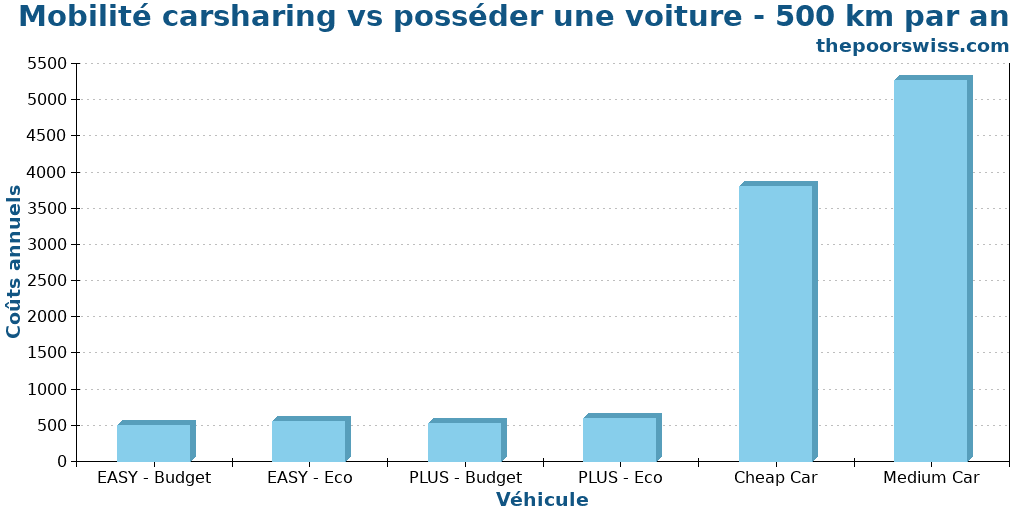
This graph shows that you should not own a car if you do not drive it! The base cost of a car is high even if you almost do not drive it. Parking, insurance, and amortization will be almost the same whether you drive it. In this case, using Mobility is much cheaper than owning your car.
We can also see that you can save a little money using the EASY option rather than the PLUS plan, but the difference is almost insignificant.
Then, we look at 1000 kilometers per year:
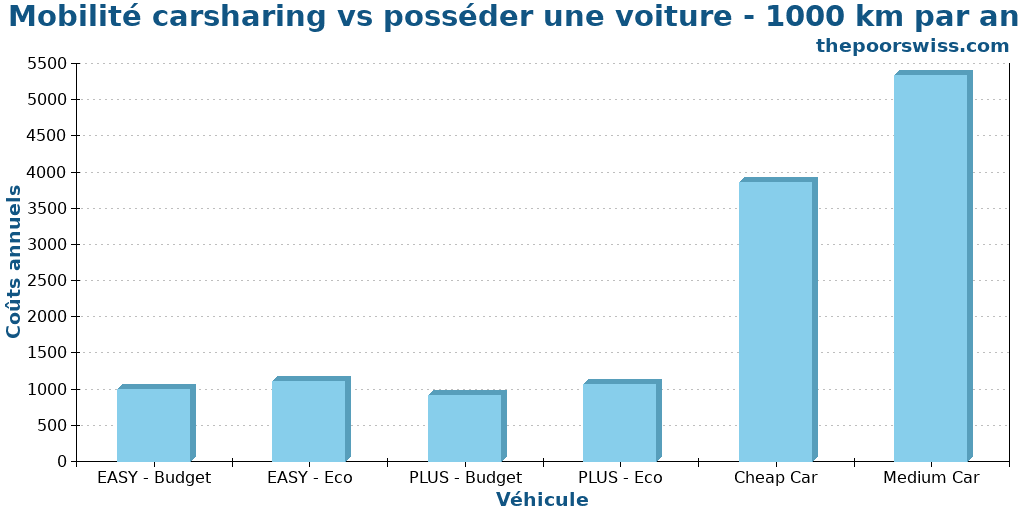
Once again, Mobility is much better, even though it has doubled in price. On the other hand, the PLUS plans have become more interesting than the EASY plan.
We then move directly to 2000 kilometers per year.
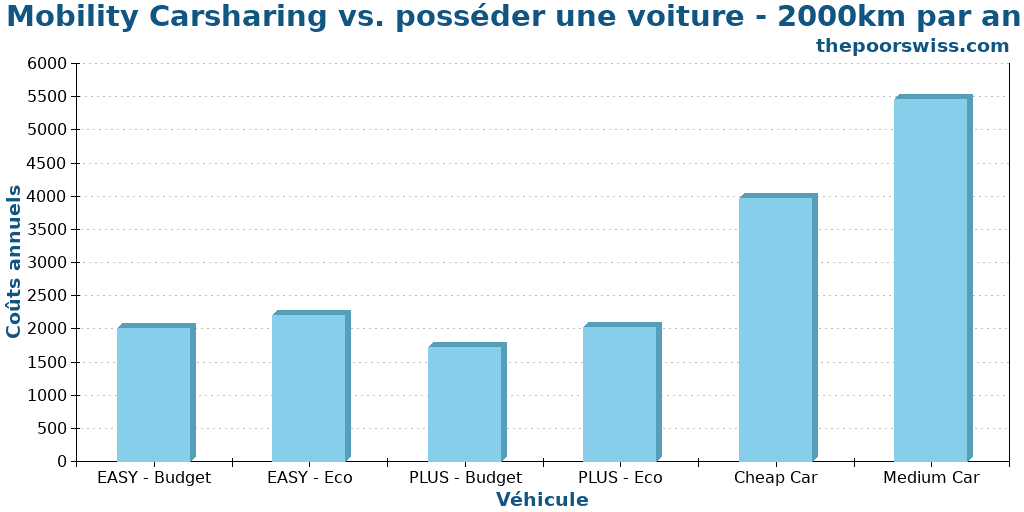
While Mobility is still significantly cheaper, we can see that the gaps have become smaller. But even at 2000 kilometers per year, Mobility is still very interesting!
We can jump to 5000 kilometers per year.
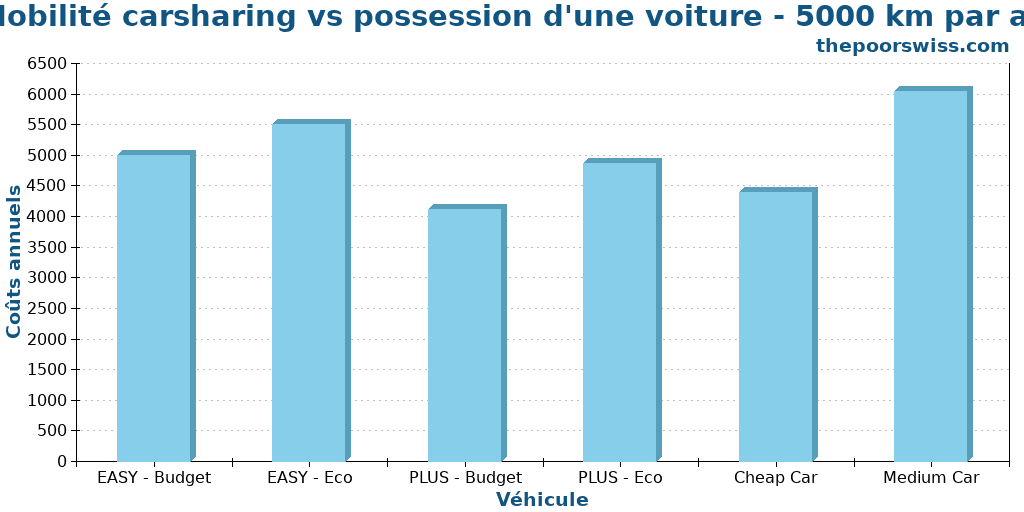
This time, the comparison becomes very interesting. At this point, the PLUS option of Mobility is only slightly cheaper than a cheap car, and the PLUS eco option is already more expensive.
It is also very interesting because this is where I am with my car these days. I could save very little money by switching to Mobility. I cannot even consider it because the next Mobility parking spot is 10 minutes away by car. But it is still interesting that with my driving needs, I should consider Mobility. I would think that the limit was lower.
On the other hand, I think that at 5000 kilometers per year, the convenience of having your own car outweighs the financial benefits of Mobility.
It is also interesting to note that the PLUS plan is significantly cheaper than EASY. Also, we can see more clearly the differences between the Budget and the Eco options.
Before we jumped to 10’000 kilometers, I checked where the threshold for Mobility was, and it was around 5450 kilometers per year for the parameters of our test. It means that below 5450 kilometers per year, Mobility (PLUS plan and budget car) is cheaper than owning a cheap car.
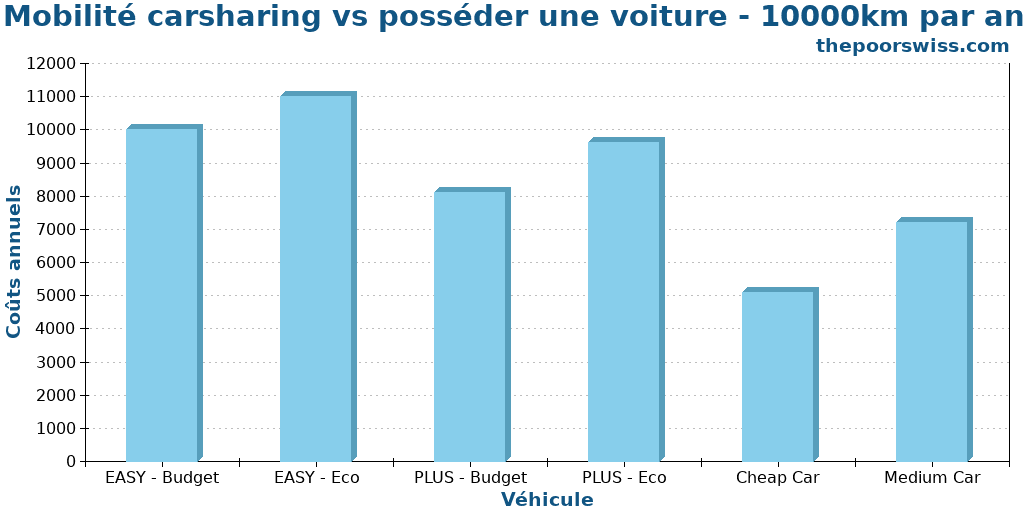
At 10’000 kilometers, owning a car becomes significantly cheaper than all the Mobility plans. Plus, at this number of kilometers, it is probably immensely more convenient. Since the average yearly mileage in Switzerland is about 13’500 kilometers, Mobility is not attractive for most people.
In that situation, even a medium car is cheaper than all the Mobility plans.
Here is what happens at 20’000 kilometers. For this example, I will assume amortization over only five years (100’000 kilometers).
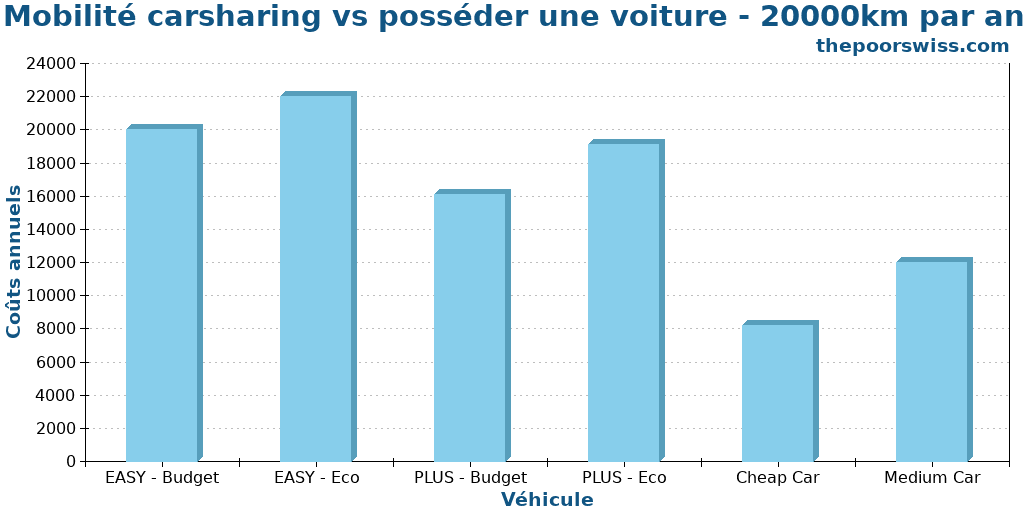
With this high driving number, the cheap car becomes significantly more affordable than Mobility. You could save 7000 CHF per year by owning your car.
Finally, here is what would happen with 50’000 kilometers (not sure anybody drives this much) with only two years of amortization.
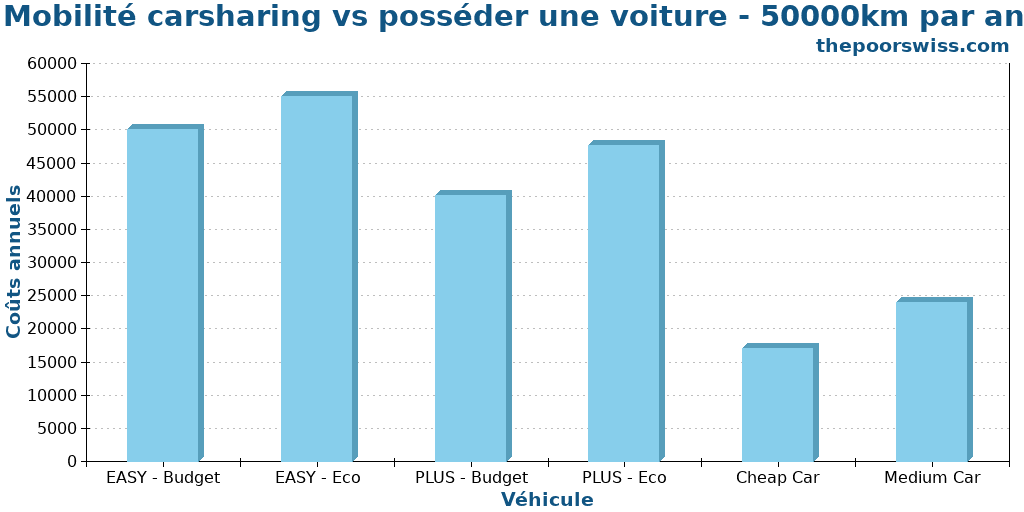
In this case, even a premium car would be cheaper than Mobility. But very few people (if any?) drive that much per year. At this point, owning a car is much cheaper than Mobility.
Conclusion
Overall, Mobility is an excellent alternative to owning your car if you do not drive too much. If you have access to a Mobility station and do not drive too much per year, you should consider it.
I was surprised by the results. With the amount of driving we do since I work from home, Mobility would become interesting. I was not expecting that.
I would still prefer the convenience of having my car since we use regularly for short drives. Nevertheless, it was an interesting result.
Indeed, there are advantages to owning your car if you need it in an emergency. But there are also advantages to Mobility, such as not having to deal with maintenance.
Talking about transportation, I have an article about how we get around in Switzerland. And if you are interested in cars, you should read my article about car insurance.
What about you? Have you ever tried Mobility?
Prochains articles

Comment élever un bébé de manière frugale en Suisse avec Mama Bear Finance
Avoir des enfants ne coûte pas forcément cher. Découvrez des conseils pratiques pour élever un bébé en Suisse de manière frugale, sans sacrifier la sécurité ni le bonheur.
5 principaux moyens d’établir un budget pour économiser davantage d’argent
Mieux gérer ton budget. Découvre les différentes façons de budgétiser, du budget base zéro à la règle 50/30/20, et trouve la méthode qui correspond à ta vie.
Comment économiser plus de 50 % sur un achat Amazon
Découvrez comment j'ai pu économiser 50 % sur l'un de mes achats sur Amazon en le commandant dans un autre pays !
Apprenez des moyens faciles d'optimiser vos finances et d'économiser des milliers de francs en Suisse avec notre e-book exclusif. Découvrez les services financiers les plus rentables adaptés aux résidents avisés et aux expatriés!
Obtenez votre guide suisse d'économies GRATUIT
j’ai été client régulier car je vivais en ville ; et j’en étais très satisfait malgré les contraintes. Preuve du succès de la formule, il m’arrivait souvent de ne pas avoir de voiture dispo dans mon quartier. Maintenant, je vis en campagne, c’est juste pas possible, il n’y a pas d’emplacement dans mon village. Aussi, tant que le carsharing n’est pas obligatoire ou favorisé, cela ne marche pas pour tout le monde.
Merci d’avoir partagé!
Effectivement, en campagne, c’est pas ça.
Du coup, c’est pas génial s’il n’y a pas assez de voitures (génial pour eux, mais pas les utilisateurs et sur le long-terme pour personne).
J’ai dû utiliser 3 fois mobiliy. Une fois il m’est arrivé d’avoir 5 minutes de retard pour revenir sur la place de parking. Déjà j’ai eu 50.- fr de pénalité de retard.
Mobility c’est terminé pour moi.
Wow, 50 CHF de pénalité pour 5 minutes, c’est effectivement violent :(
Restitution tardive du véhicule de la 6e à la 30e minute CHF 50, par demi-heure supplémentaire CHF 30
C’est une question de respect envers le conducteur suivant. C’est pourquoi Mobility conseille de compter large pour la réservation. Il est toujours possible de rendre la voiture avant la fin de la réservation (heures annulées facturées à moitié prix). En cas de retard, vous pouvez prolonger la réservation p. ex. d’une demi-heure si personne n’a réservé la voiture juste après vous.